

Season 4, Episode 14 (#116 overall)
Cayuga Production # 4867
Originally aired April 11, 1963
Fifty years ago tonight, The Twilight Zone brought forth yet another discontented man with a longing for the days of his youth. However, this isn't a Martin Sloan or a Booth Templeton, with whom we might identify or at least sympathize. This guy’s a rampaging asshole through and through.

“Of Late I Think of Cliffordville” introduces us to billionaire industrialist William J. Feathersmith, who is described by business associate Sebastian Deidrich as being “a predatory, grasping, conniving, acquisitive animal of a man, without heart, without conscience, without compassion, and without even a subtle hint of the common decencies.” This dialogue (yes, that’s dialogue, not narration) immediately tells us that Rod Serling wrote the script before we ever see the writing credit. As the series progressively winds down, Serling’s dialogue gets more bloated and unrealistic.

 Feathersmith and Deidrich both got their start in the titular town of Cliffordville, Indiana, in the 1910s. In the present, we witness Feathersmith essentially destroy Deidrich in a hostile takeover bid, after which he drunkenly laments his long, lost youth to Hecate, the building janitor who, coincidentally enough, is also from Cliffordville (wait, did I say coincidentally? I meant painfully implausibly). Feathersmith also finds time to cruelly insult Hecate, who has no choice but to lower his eyes and take it.
 On his way out for the night, Feathersmith's elevator inexplicably stops on the 13th floor, where he finds a new tenant. Feathersmith bursts in and demands to know how the place opened without his knowledge (this is, after all, his building). The occupant, the sparkling and charming Miss Devlin, eases him into a conversation about his dissatisfaction with his life now that he’s at the top and has nowhere else to go. He tells her of his younger days in Cliffordville, and his desire to go back and start over. Miss Devlin can help him with that because, as fate would have it, she’s the devil. She removes her hat to reveal two horns jutting out of her perfectly-coiffed hair (check out the similar horns rimming her hat; nice touch).
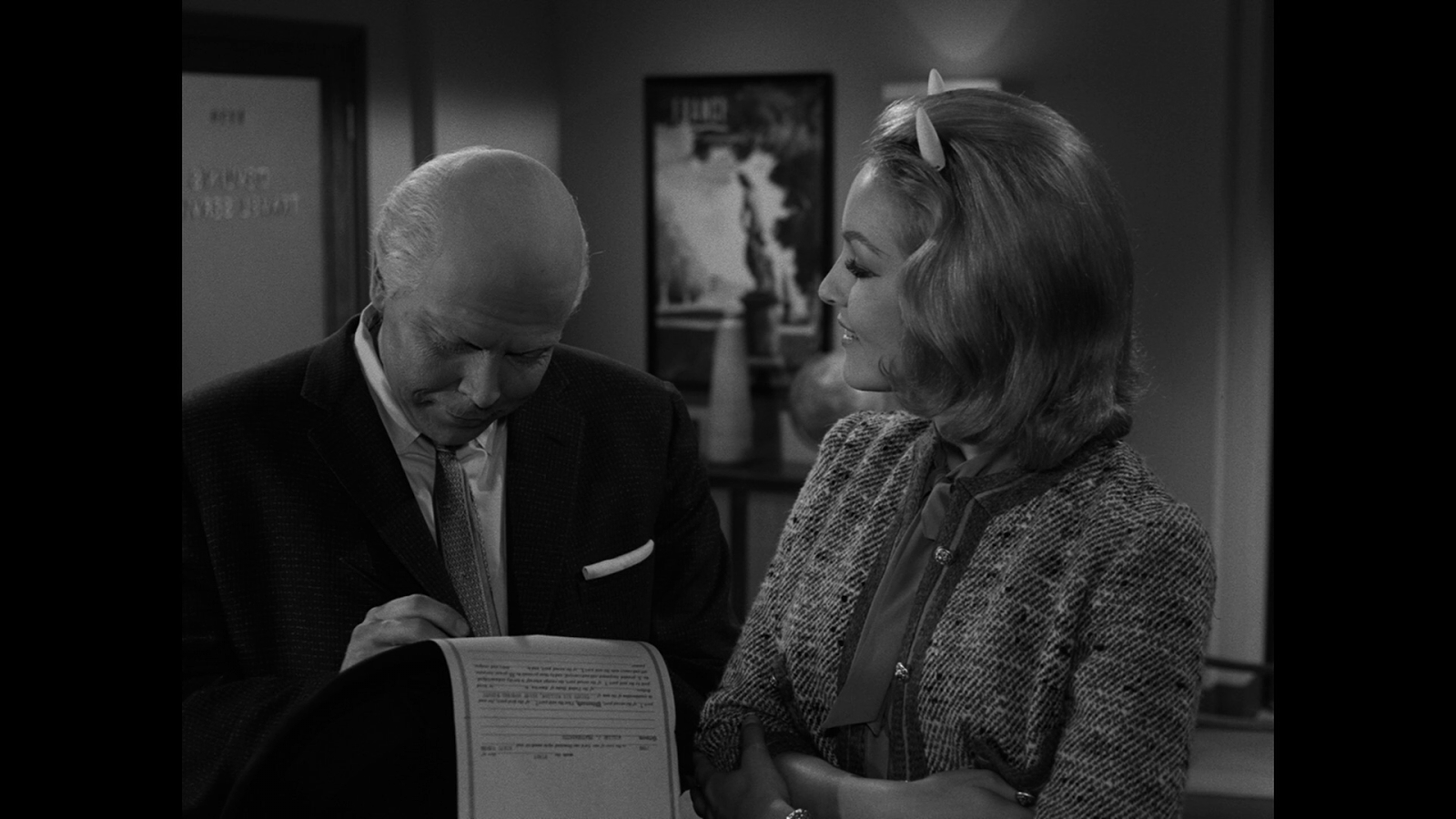 Miss Devlin offers to return him to 1910 Cliffordville as a young man while retaining his memory of the events of the fifty years hence. She doesn't ask for his soul, as he evidently relinquished it by default over his years of ruthless business dealings; instead, she demands his vast fortune (save for $1,400.00, which will be more than adequate seed money when he relives his climb to tycoondom. Feathersmith, practically drooling, hastily signs the contract (echoes of “Escape Clause” here or, more recently, “Printer’s Devil”). The dotted line, as they say, has been signed upon.
 There’s a nice bit when Feathersmith leaves Miss Devlin’s office. In one continuous shot, we see him walk away from the door (which is initially visible in the frame), take a few steps, then stop and turn back around. The travel agency is gone. I’m assuming this is another example of the rolling-wall approach used to great effect in season one’s “A World of Difference,” but I have no information confirming this. Unfortunately, this clever sequence is marred by a continuity error: after disappearing, Devlin’s Travel Agency is still listed on the floor directory!
Immediately after, Feathersmith steps into the elevator, vanishes, materializes on board an empty commercial jet in mid-flight, which then transforms around him into a train car. He looks at his watch, which has transformed into a vintage pocket watch, and we see that he is now a young man again. In a very Willoughby-esque moment, the train arrives in Cliffordville, much to Feathersmith’s delight.

"Of Late I Think of Cliffordville" is marred by inefficient pacing: Feathersmith doesn't reach Cliffordville until the 25:05 mark, which means the entire first half of the episode is spent on setting up the second (which seems more than a bit rushed by comparison). Further, the effectiveness of the first two acts are undercut by the terrible age makeup foisted upon Salmi (which is particularly painful to behold in high definition; check out that bald cap seam!), but it’s Salmi’s performance that ultimately dooms the proceedings, particularly in reference to his deliberate, obnoxious voice (maybe this was his intent to speak in an utterly repellent fashion so we would detest the character; however, it comes off amateurish and hammy, particularly his halting, braying laugh). Once Feathersmith is his new (old) younger self in Cliffordville, Salmi’s performance brightens up considerably. Oh sure, he’s still a rampaging asshole, but he becomes more human with each obstacle that the past (or Miss Devlin) throws in his path (look at his priceless expression when he first sets eyes on the homely and annoying Joanna Gibbons, whom he remembered as being beautiful and demure).

 William Feathersmith is essayed by TZ veteran Albert Salmi (he impressed us in season one’s “Execution” and season three’s “A Quality of Mercy”). As outlined above, it’s a problematic performance with some definite overacting, but I do suspect that this was intentional on his part. Salmi would meet up with Serling again a few years later, in the Night Gallery segment “The Waiting Room.” Salmi’s life ended tragically in 1990 when he murdered his wife and subsequently committed suicide.

John Anderson (Deidrich) makes his third of four Twilight Zone appearances (we previously saw him in season one’s “A Passage for Trumpet,” season two’s “The Odyssey of Flight 33,” and we’ll see him again in season five’s “The Old Man in the Cave”). Anderson also memorably portrayed the Ebonite Interrogator in the “Nightmare” episode of The Outer Limits. For me personally, I’ll always remember him as the lunatic General Stocker on TV’s The Greatest American Hero (“Operation: Spoilsport,” which is probably the single best episode of that series).


More TZ alumni on display here: Wright King (the janitor, Hecate) last visited us in season two’s “Shadow Play” as the troubled reporter Paul Carson, who tries desperately to convince the DA to pardon Dennis Weaver. Hugh Sanders (Cronk) stops by for his third TZ stint (we saw him previously in season one’s “Judgment Night” and season three’s “The Jungle”). John Harmon (Clark), meanwhile, popped up in season three’s “The Dummy.”


And, last but most certainly not least… TZ MEGA BABE ALERT! Feast your eyes on the stunningly gorgeous Julie Newmar, here salvaging this whole train wreck all by herself as the devilish Miss Devlin. Newmar is one of an elite subsection of TZ Babes, which also includes Suzanne Lloyd’s Maya the Cat Girl (“Perchance to Dream”) and Anne Francis (in two roles: Marsha the Mannequin in “The After Hours” and the title character in “Jess-Belle”). Good God, just look at her. *Sigh* Newmar is best remembered for her indelible interpretation of Catwoman on TV’s Batman (1966-1967).

 Sad to say, there’s nothing new or noteworthy here. We get echoes of “Walking Distance” and “The Trouble with Templeton,” set in the backyard of “A Stop at Willoughby” with a healthy dash of “Escape Clause” thrown in. However, despite the copious amounts of redundancy on display, the episode is elevated by Newmar’s delicious she-devil and, I must admit, watching Feathersmith getting his just desserts doled out to him in multiple stages is entertaining. We also get some great skewed camera angles to signify Feathersmith’s mental unraveling in act four, hearkening back to similar unraveling scenes in season one’s “Where Is Everybody?” and season three’s “The Dummy.” And the final scene positively drips with irony and cosmic justice, so things do end well…. but ultimately, the lopsided pacing really undermines the episode’s effectiveness. In the final analysis (well, mine anyway), “Of Late I Think of Cliffordville” only intermittently rises above mediocrity.
Next week: An overgrown man-child longs for the past. No, it’s not my life story.


