

Season 4, Episode 11
(#113 overall)
Cayuga Production #
4859
Originally aired
March 14, 1963
“Something happened. I know you’re not going to believe this. I’m not absolutely
certain that I believe it myself.
There’s another dimension. I don’t
know how it exists or where it exists, but there’s another world parallel to
ours. The same people, the same places,
most of the same chronology of events, except now and then there’s something a
little bit different…. I was there, General.
I was there for almost a week… looking at our counterparts, looking at
us. Us, as we exist in a parallel world,
one that exists alongside but which we can’t see, the world I stumbled into. I
don’t know how; some kind of space time continuum, some… warpage. There’s a doorway up there somewhere into
it. It exists. Every now and then I think it’s possible for
somebody to fall through it, and I did.”
That’s Major Robert Gaines,
relaying his fantastic experience during an apparent blackout during a space
flight. It sounds like something from
the mind of Jack Finney, whose short stories often featured time travel and
parallel realities (his “The Coin Collector” would've made a great TZ episode), but unfortunately Finney didn't write this… Rod Serling did. And
he kinda fucked it up.

Fifty years ago tonight, “The
Parallel” found Major Robert Gaines leaving the earth, blacking out, then
waking up in a military hospital with no memory of the rest of the mission,
including his return trip. After his
debriefing, he begins to notice subtle details in his world have changed: his
house now has a white picket fence that he doesn't remember being there, his
wife and daughter seem to think he’s “different somehow,” and oh! He’s magically been promoted to full
Colonel. We suspect that maybe he’s some
sort of brainwashed alien plant until it’s revealed that the man Gaines claims
to be President is someone his superiors have never heard of, some guy by the
name of John F. Kennedy.


Serling puts forth what could
have been an interesting mystery (a kind of companion piece to “And When the Sky Was Opened”), but “The Parallel” is hampered by both its overlong
length and several plotting problems that can’t be ignored. The bit at the end, in which it’s revealed
that Capcom established momentary telemetry with Gaines’ duplicate from Dupe
Earth, does seem to validate Gaines’ theory, so I guess he wasn’t just dreaming
during his six-hour blackout; however, it does nothing to assuage the lingering
questions. How exactly did he land his
capsule on Dupe Earth if the craft had no landing capabilities? Since he swaps places with his parallel self
while in space, we can reasonably assume that the fissure between the parallel
universes lies in earth’s orbit; how then does he manage to swap back without
going back up into space? Gaines spent
several days on Dupe Earth, yet was only out of radar contact for six hours,
which is impossible: for both earths to
exist side by side, wouldn't they move at the same rate of time?

The only solution which ties up
all the loose ends? After Gaines crossed
over to the Dupe Earth universe, God himself plucked the capsule out of the sky
and set it gently down on dry land (suggest
by Gaines’ initial explanation: “I blacked out, I simply blacked out. There was
some factor up there, something which I had no control over, something which
must have taken over for me.”). The Big
Guy subsequently snapped His almighty fingers to undo the whole thing, which explains
why Gaines snaps back into his own universe without even returning to space
first. This theory also serves to
obliterate most of the other plot holes, since the whole affair ultimately
never happened (except that Gaines remembers it, which is an odd choice; but
hey, He moves in mysterious ways). Serling
of course doesn't suggest this (admittedly bogus) possibility; he just slaps
together a half-assed denouement and moves on to his next script (gee, thanks
Rod). Interestingly, season one’s “And When the Sky Was Opened’ (also scripted by
Serling) provided even less insight into the astronauts’ inexplicable plight,
but somehow it worked there. Maybe
because the hour format intrinsically demands more explanation, I dunno.

One more irreconcilable
thing: after Gaines is back in his own
capsule in his own universe late in act four, the “wavy line” dissolve effect
is used to skip forward to his examination in the military hospital. Up to this
point, this transition signified the crossovers between the two earths. Are we to assume, then, that Gaines has
splashed down on a third earth? Of course not, it’s just an overused time
passage visual (usually framing a flashback)…. but it’s completely
inappropriate here.
 I usually love these kinds of
stories: parallel earths, alternate realities, evil twins, multiverse doppelgängers,
etc; “The Parallel,” however, has gotta be the single most boring exploration
of such concepts ever committed to film.
Any given episode of TV’s Sliders
beats this vanilla affair hands down (and that series had more than its share
of duds, despite a great concept).
I usually love these kinds of
stories: parallel earths, alternate realities, evil twins, multiverse doppelgängers,
etc; “The Parallel,” however, has gotta be the single most boring exploration
of such concepts ever committed to film.
Any given episode of TV’s Sliders
beats this vanilla affair hands down (and that series had more than its share
of duds, despite a great concept).
 At the very least, “The Parallel”
does offer some nice atmospheric visuals. When Gaines blacks out at the moment he crosses over into the Dupe Earth
universe, we fade in to a dark hospital room. A single light hangs over his unconscious body as we drunkenly pan in towards
him, conveying his disorientation as he wakes up. Later, the scenes with the capsule in the
hanger offer some excellent contrast between the inky blackness and the large
overhead lights (many of the shots are filmed low, looking up at the actors, adding
a nice paranoid tension; however, I’m not sure why the hell they keep the
hanger so goddamned dark). Oh, and
speaking of nice visuals….
At the very least, “The Parallel”
does offer some nice atmospheric visuals. When Gaines blacks out at the moment he crosses over into the Dupe Earth
universe, we fade in to a dark hospital room. A single light hangs over his unconscious body as we drunkenly pan in towards
him, conveying his disorientation as he wakes up. Later, the scenes with the capsule in the
hanger offer some excellent contrast between the inky blackness and the large
overhead lights (many of the shots are filmed low, looking up at the actors, adding
a nice paranoid tension; however, I’m not sure why the hell they keep the
hanger so goddamned dark). Oh, and
speaking of nice visuals….
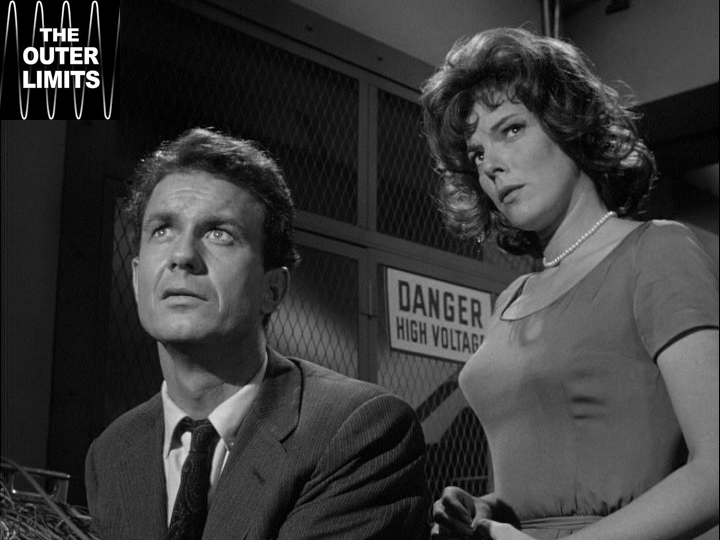

Another Outer Limits connection! The
skeptical General Eaton is played by Phillip Abbott, who stopped by in season two for "Long Distance Call." He also appeared in two TOL episodes (“The Borderland” and the
delightfully wacky “ZZZZZ”).

Speaking of The Outer Limits, its “Cold Hands, Warm Heart” is reminiscent of
“The Parallel” in the sense that we have an astronaut returning to earth who’s
just not quite himself. However, The Outer Limits wins for two reasons:
first, theirs has William Shatner; second, theirs features this hilarious
alien:

If you need another TOL connection, look no further than the
31:09 mark: Gaines is asked how he’s doing.
His reply: “Me? Well, that
depends. Depends on just what are the current standards for sanity, the
acceptable outer limits.”
 Colonel (er, Major) Robert Gaines
is played by Steve Forrest, who’s a bit stiff and bland, but I guess he gets
the job done (I can’t help but imagine what other TZ actors like Charles Aidman or Cliff Robertson might’ve done with
the role). This is Forrest’s only TZ appearance. I should mention that Forrest is Dana
Andrews’ younger brother (whom we enjoyed last week in “No Time Like the Past.”
Colonel (er, Major) Robert Gaines
is played by Steve Forrest, who’s a bit stiff and bland, but I guess he gets
the job done (I can’t help but imagine what other TZ actors like Charles Aidman or Cliff Robertson might’ve done with
the role). This is Forrest’s only TZ appearance. I should mention that Forrest is Dana
Andrews’ younger brother (whom we enjoyed last week in “No Time Like the Past.” Other familiar faces in “The
Parallel” include Paul Comi as the psychiatrist (previously seen in season
one’s “People Are Alike All Over” and season two’s “The Odyssey of Flight 33”) and William Sargent as The Project Manager (he’ll come
back for season five’s “Ninety Years Without Slumbering”). And OMG, there’s David Armstrong again (uncredited as usual), this time manning one of the tracking consoles at
Capcom. And he has a line (“We don’t
have contact here either. No contact at all!”)!
Other familiar faces in “The
Parallel” include Paul Comi as the psychiatrist (previously seen in season
one’s “People Are Alike All Over” and season two’s “The Odyssey of Flight 33”) and William Sargent as The Project Manager (he’ll come
back for season five’s “Ninety Years Without Slumbering”). And OMG, there’s David Armstrong again (uncredited as usual), this time manning one of the tracking consoles at
Capcom. And he has a line (“We don’t
have contact here either. No contact at all!”)!

Like many Twilight Zone episodes, “The Parallel” uses preexisting music from
the CBS Music Library in lieu of an original score. The serene pastoral music heard as Gaines
arrives at home back on Earth Prime (oops, spoiler!) is “Quiet Western Scene” by
Nathan Van Cleave. Here we only hear part of it (like we did in season three’s “The Changing of the Guard”); we’ll hear the whole lovely thing in “On Thursday We
Leave For Home” in May. I should also
mention that a single cue from Leonard Rosenman’s score from the aforementioned
“And When the Sky Was Opened” is used here. It’s title? “Missing Colonel,” of
all things!

1999’s The Astronaut’s Wife seems to have been inspired by “The Parallel,”
but there the astronaut (Johnny Depp) turns out to be an alien replacement
instead of a friendly duplicate from another earth. Jeez, if you’re gonna steal ideas from The Twilight Zone, there are so many
better episodes to crib from.
 One more thing that bugs me: Gaines’s capsule is called “Phoebus 10” on
Earth Prime, but on Dupe Earth it’s called “Astro 7.” Wouldn't you think that
this discrepancy would've come up during Gaines’ debriefing on Dupe Earth? Screw all the vague “something feels
different” shit; that right there is an immediate and obvious disparity between
the two earths. Sigh. File “The Parallel” under “D” for Dumb and hope next week’s episode is
better. Um, sorry to say… it’s kinda
not.
One more thing that bugs me: Gaines’s capsule is called “Phoebus 10” on
Earth Prime, but on Dupe Earth it’s called “Astro 7.” Wouldn't you think that
this discrepancy would've come up during Gaines’ debriefing on Dupe Earth? Screw all the vague “something feels
different” shit; that right there is an immediate and obvious disparity between
the two earths. Sigh. File “The Parallel” under “D” for Dumb and hope next week’s episode is
better. Um, sorry to say… it’s kinda
not.
Next week: It’s a
total fake-out. Barbara Eden is nowhere
to be found, dammit.


.png)


.png)


.jpg)


.png)

.png)
.png)
+2.png)


