Showing posts with label Buck Houghton. Show all posts

Thursday, January 3, 2013

TZ Promo: "In His Image" (1/03/1963)


Season 4, Episode 1 (#103 overall)
Cayuga Production # 4851
Originally aired January 3, 1963

The revamped Twilight Zone launched fifty years ago tonight with Charles Beaumont’s “In His Image.” There’s really no way I can discuss the episode without spoiling it, so… fuck it, I won’t even try.  In fact, I’ll get it over with by very quickly encapsulating the proceedings:

Guy murders a woman in a subway in what appears to be a brief psychotic episode. Guy picks up girlfriend and drives to his hometown.  Lots of details about the town don’t jibe with his memory, and he has a couple more violent episodes as he tries to figure out what the hell is happening.  He eventually tracks down a man who appears to be his identical twin, but is actually his maker.  It turns out our troubled hero is a robot, one with an unfixable flaw that causes him to periodically go crazy.  Creator and creation clash in an epic battle, from which only one of them will emerge.

See, I didn't spoil everything after all (I guess I could just mentioned that Beaumont’s teleplay was based on his own short story “The Man Who Made Himself,” which is a spoiler in itself).


George Grizzard shines as both Alan Talbot (the creation) and Walter Ryder, Jr. (the creator).  The two are completely different personalities (Alan is humored and gregarious, while Walter is bitter and withdrawn), and Grizzard expertly inhabits both.  Hands down, this is one of my favorite performances in the series' five-year run.  Season two’s “Nervous Man in a Four Dollar Room” featured a similar two-sides-of-the-same-coin performance by Joe Mantell, but his excellent work was hampered by less-than-optimal rear projection.  Here, things are technically perfect. If there are split-screen seams, I sure as hell can't see them (not even under Blu-ray’s high-resolution microscope).


Grizzard appeared in many television series throughout the fifties and sixties, and was an accomplished theater performer (he won a Tony in 1996 for his work in the revival of A Delicate Balance (shown at left).  Genre fans may have spotted him on Alfred Hitchcock Presents, on which he appeared three times. More recently, he had a recurring role on TV's Law and Order, and his last appearance on film was in Clint Eastwood's Flags of Our Fathers in 2006, shortly before he passed away in 2007).

Alan's girlfriend Jessica is played by the lovely Gail Kobe.  TZ babe alert!  *sigh*  We caught a brief glimpse of her in season one’s “A World of Difference,” and we’ll see her again in season five’s “The Self-Improvement of Salvadore Ross.”  She’s equally delicious in two of The Outer Limits’ sillier endeavors (“Specimen: Unknown” and “Keeper of the Purple Twilight;” the latter has to be seen to be believed). 
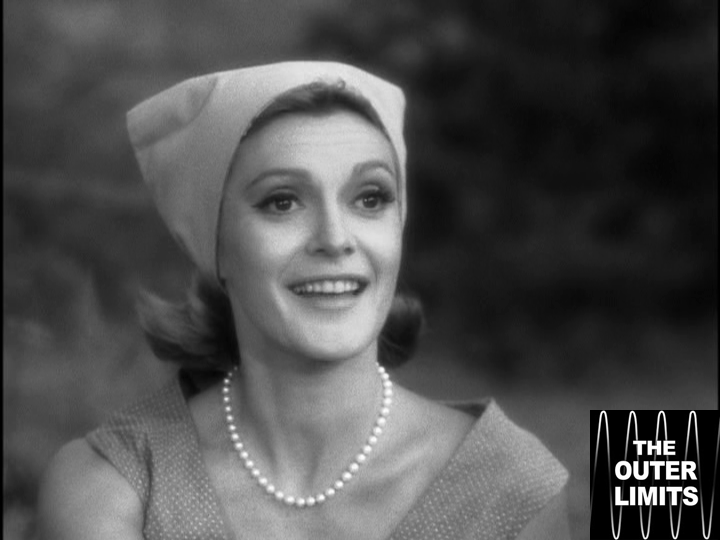

At least The Outer Limits was kind enough to get her all wet for us.


Katherine Squire, last seen in season three’s “One More Pallbearer,” appears for a brief but memorable role as the crazy Christian lady who badgers Alan in the subway, and good God is she repellent.  This is "witnessing" at its most coarse and obnoxious; thankfully, Alan dispatches her by tossing her in front of an oncoming train.  Sometimes murderous rages can be productive after all.


The onset of Alan’s violent fits are conveyed to us via a cacophony of blips, bloops and buzzes (standard sci-fi gizmos-gone-crazy sound effects; apparently inaudible to others), along with a bright light that comes over his face (apparently invisible to others; it’s reminiscent of the “death light” depicted in season one’s “The Purple Testament”).  It’s all effective enough but, frankly, Grizzard’s tortured reactions would have sufficed, and kept things a bit more subtle.


When Alan arrives at Walter's residence for what will become an epic showdown, we're treated to a nice atmospheric shot of Walter sneaking up behind him in the shadows.  If this shot looks vaguely familiar, it may be because we've already seen Grizzard perform a very similar arrival in season one's "The Chaser."


I'm sure this wasn't done intentionally, but it's a marvelous piece of visual continuity regardless (one that Arlen Schumer apparently missed in his amazing Visions from The Twilight Zone coffee table book, in which he draws several visual parallels between images from various episodes. By the way, every true TZ fan needs to own this book. It's about twenty years out of print, but can easily be tracked down on Amazon or eBay).


When viewed as a whole, The Twilight Zone is positively bristling with compelling and iconic images; here we get one of my personal favorites. Upon receiving a forearm injury right before the midway act break, Alan slowly peels the skin back to reveal the first concrete hint about the mystery of his identity.

  Boom!  You’re a robot, dude.


The idea of a simulacrum carrying on in ignorance of its own artifice was almost certainly a sci-fi clichĂ© by the time The Twilight Zone tackled it (in season one’s “The After-Hours” and season two’s “The Lateness of the Hour”), but in the capable hands of writer Charles Beaumont, the concept never feels unoriginal or stale (Beaumont also wrote another surprise-it’s-a-robot story called “Last Rites” in 1955, an equally fine yarn that would've made a great TZ episode).  Harlan Ellison would employ this device in his 1965 Outer Limits teleplay “Demon with a Glass Hand” (which happens to be my all-time favorite TOL episode; maybe I’m a much bigger fan of surprise-robot stories than I realized).


Walter Ryder Jr.’s basement lab is a pretty impressive set, complete with the usual wall-sized computer terminals and assorted gadgetry.  Particularly effective is what appears to be a brick-lined incinerator unit in the wall, but is more likely some sort of finishing/activation chamber for Ryder Jr.’s mechanical offspring (speaking of which, check out those failed proto-Alans lying dormant on a double-wide gurney).


And hey, Forbidden Planet alert!  The notorious bank of Pac-Man lights, originally a piece of equipment in that film’s C-57D Space Cruiser, makes yet another appearance on the series. This prop was used previously in “People Are Alike All Over,” “Elegy" and “Third From the Sun." I'm betting we'll see it again before the series ends...


As the first double-length TZ episode aired, “In His Image” never feels overlong or bloated (an attribute which next week’s episode will sadly not share).  It’s an absolute winner, one of my top 20 favorites of all time.


Next week:  There’s something scary inside that wrecked submarine, so whatever you do, don’t go down there!  No?  Okay, whatever you do, don’t go down there twice!  Still no?  Okay, can we at least agree that you won’t go down there a third time?  Oh come on, seriously??!


Wednesday, January 2, 2013

Introduction to Season 4


When The Twilight Zone wrapped up its third season in the spring of 1962, it found itself without a sponsor (maybe the existing sponsors weren't exactly thrilled with the show’s mediocre ratings and jumped ship); consequently, CBS didn't include the show in its fall 1962 schedule.  Things would eventually get resolved over the next several months, but the delay meant that the show wouldn't return to the air until mid-season,  allowing for only half the usual number of episodes.  But the reduced quantity was a minor concern when weighed against the massive changes wrought upon the show before its return. 

The most obvious difference, aside from the new opening title sequence (detailed yesterday, here), is the somewhat jarring switch to an hour-long format.  Serling had originally conceived The Twilight Zone as an hour show but bowed to CBS’s original wishes; this late change indicates that the network must have changed its mind (probably hoping a bigger show would equate to bigger ratings).  Another notable change is the loss of producer Buck Houghton, who had moved onto other pursuits during the show’s six-month limbo. Houghton’s initial replacement was Herbert Hirschman who, according to a 8/20/1962 letter to Serling, may have been responsible for changing the name of the series to, simply, Twilight Zone (minus the word The; thanks to Martin Grams’ exhaustively-researched The Twilight Zone: Opening the Door to a Television Classic for this interesting tidbit). The show would ultimately go through three different producers during its final two years on the air, a sure sign that the series was no longer the well-oiled machine it had been for its first three years.

Rod Serling was still around, but he was much less involved on the production end, as he had taken a teaching job at Antioch College when the show’s future had suddenly become clouded with uncertainty.  Serling retained his title as executive producer and continued hosting and narrating, but it’s worth noting that he only wrote seven of season four’s eighteen episodes (one of which was an adaptation of an existing short story by somebody else).  Since his writing had slipped so dramatically in terms of both quality and originality during season three, this was actually a blessing.  I hate saying that, but goddamn it, it’s true: Serling’s scripts were, for the most part, the weakest of the fourth season.  Meanwhile, Charles Beaumont and Richard Matheson really shined during season four, each contributing episodes that sit comfortably among my top 20 favorites.

There are a few cosmetic changes to note.  First and foremost, Serling’s on-camera appearances were no longer shot in tandem with each episode’s production (seasons two and three often found him on set, sharing the same scenery as the actors, sometimes in quite clever ways); rather, his season four narrations were shot in front of a plain gray background.  Further, his “next week” previews would now be augmented with episode clips.

For its first three seasons, each episode would begin with the opening title sequence, then pan down from a starry sky to the opening scene.  Now, the transition would be handled with a simple dissolve.  This extended to the end of the episode: instead of a return to the starry sky via an upward pan, a simple fade to black was employed. Finally, each episode’s end credits would no longer feature a unique still to distinguish it; rather, a simple starry sky was used behind the text.


Considering all the changes, season four ultimately feels like a different show.  However, I must note that, in my oh-so-humble opinion, season four is by and large decent.  There are a few mediocre entries, but nothing approaching past atrocities like “Mr. Bevis,” “Mr. Dingle, the Strong,” and “Four O’clock” (season five will have its share of horrific misfires too, but we’ll get to those in due time).  All told, season four is an odd experiment that didn't exactly succeed, but almost certainly didn't fail.


Tuesday, March 2, 2010

TZ Profile: Arlen Schumer (Part 1 of 2)


The subject of today’s spotlight needs no introduction, especially not to Twilight Zone fans operating at an obsessive fan level approximating mine. But since this blog is available to the entire world via this marvelous thing called the internet, I’ll pretend that those reading have never heard of the guy.

I first became aware of Arlen Schumer in 1991. Lisa, my first wife, who was well aware of my preoccupation with all things Twilight Zone (having purchased the first two Varese Sarabande soundtracks on cassette for me the previous Christmas), held up a book that she’d spotted as we browsed the shelves at Powell’s Books in downtown Portland.


I eagerly snatched it out of her hands and gazed lovingly at it. It wasn’t a work of fiction, like the Original Stories collection I’d purchased back in 1985. It wasn’t a work of nonfiction, like Zicree’s Twilight Zone Companion (which I’d beaten the hell out of since I’d first bought it in 1983). No, this was something else entirely. The title said it all: Visions from The Twilight Zone, by Arlen Schumer. And visions they were. We generally refer to this type of publication as a "coffee table" book. This was so much more. This was art. This was my favorite television series, in all its visual splendor, distilled and compressed into a 10" x 9" x .75" package. I had to have it, but at the time I was dead broke. Lisa, in her infinite generosity, bought it for me. No wonder I married her.


I took it home and devoured it with my eyes, my trembling fingers turning each page as I read the words aloud, snatches of dialogue married to stark, compelling images The words frequently didn’t match the specific episode shown, but the themes rhymed. This was poetry. No, it was something beyond poetry. There was something post-modern in Schumer’s approach, something akin to sampling, a practice that had only recently began to take over popular music, in which short musical riffs or drum loops were taken from one song and looped into another. The words and images from The Twilight Zone had been extracted, remixed, re-purposed, and presented as something wholly different, wholly original, yet still in keeping with the series’ recurring themes and ideas. This guy Schumer, whoever the hell he was, was an absolute genius.

...a sample page. Image from "Shadow Play" overlaid with text from "Escape Clause."

The images in the book stem from actual photographs of a black and white television screen, the resolution of which was a scant 250 scan lines. The result is a convincing approximation of what viewers of the show back in the early 60’s must have seen, and it adds to the visual mystique of the book immensely. All the text in the book is set in Bernard Modern, which just happens to be the very same font used in the series’ opening and closing credits. If that’s not attention to detail, I don’t know what is. The book also includes the classic episode “The Eye of the Beholder” in its entirety (in words and images), as well as insightful essays by J. Hoberman, Carol Serling (Rod's widow), and Schumer himself. Icing on the proverbial cake comes in the form of a piece culled from the private notes of series producer Buck Houghton, bestowed upon Schumer by Houghton himself.

…Our man Schumer, 20 years ago, rocking the bow tie.

The bio on Schumer in the book is pretty skimpy… graphic designer, graduated from the Rhode Island school of design, comic book artist, student of popular culture. The intervening 20 years have added some new credentials… but we’ll get to that, in Part 2.

The book, as books often do, went out of print several years ago. I remember spotting a hardcover copy at some point at a Barnes & Noble, clearance-priced at $5.00, and passing it up (d’oh!). If you don’t have this book, FIND IT. There are copies on eBay. There are second-hand copies on Amazon. Seek it out. Of all the Twilight Zone books in my collection, this is by far the most beautiful, the most exciting, the most moving. I had the rare joy of buying a copy for my friend Bill Huelbig, who resides on the other side of the country in New Jersey, this past Christmas. He’s just as big a Twilight Zone fan as I am, so I’m not sure how this particular work of art has eluded him all these years. I was happy to rectify the situation, and I’m prepared to do it again, should some other deserving TZ fan come forward, empty hands desperately outstretched. This book needs to be experienced. Hell, it needs to be BACK IN PRINT. Chronicle Books, are you listening? Do you even still exist?


Fast forward twenty years, give or take. Mr. Schumer presents The Twilight Zone Forever, a “multimedia visualecture” at The Times Center in New York City on 10/02/09, the show’s 50th anniversary. My aforementioned friend Bill buys a ticket and attends, much to his delight (and my internal dismay, since there’s no way in hell I can afford to make the trip). Bill reports back with a positive review (which will appear in Part 2 of this spotlight). A few weeks later, I take a chance and email Mr. Schumer, having only recently discovered his website, wondering if perhaps the presentation was videotaped. Turns out it was. And Mr. Schumer, out of an immeasurable kindness, sends me a DVD of the presentation. But we’ll get to that, in Part 2.

It doesn’t stop there. The magnanimous Mr. Schumer proceeds to send me an assortment of TZ-related gifts, one of which I’ll address right now, since it’s germane to the topic at hand.


Sight, Sound & Mind: A Montage of The Twilight Zone’s Words, Images & Music is a 12-minute DVD that mirrors Schumer’s Visions book, page by page (one dissolves into the next, with that 250-lines of resolution look gloriously intact), augmented by musical cues from various episodes, with all of the text read by the author himself. This alone makes the disc essential (honestly, can you imagine anybody but Anthony Bourdain reading Kitchen Confidential out loud? I like to think that if my novel Diminished Returns ever gets published, I’ll get to do the audio version). The Visions book is Schumer’s baby, and his voice brings it to vibrant, shimmering life.

I can’t stress enough what a treat this DVD is to behold. As I’ve already stated, the book needs to be back in print or, better yet, back in print with a copy of the DVD included. Until that happens, however, something of a guerrilla approach will be necessary for interested parties to attain the full experience. Get the book, then contact Mr. Schumer directly at arlen@arlenschumer.com to inquire about the DVD. Or inquire about the DVD first, then get the book. Either way, they’re two great tastes that taste great together.

My marriage to Lisa lasted nine years. The Twilight Zone, on the other hand, is forever. Arlen Schumer agrees, as you’ll see in Part 2 of our profile. Stay tuned, won’t you?