Showing posts with label Buzz Kulik. Show all posts

Wednesday, May 11, 2011

TZ Promo: “The Mind and the Matter” (5/12/1961)


“The Mind and the Matter” (5/12/1961)
Season Two, Episode 27 (63 overall)
Cayuga Production # 173-3659


Rod Serling will forever be remembered as a dramatist of distinction. His greatest works stand among the best that television has ever offered. The Velvet Alley. Patterns. Requiem for a Heavyweight. “Walking Distance.” “The Eye of the Beholder.” The list goes on. Upon cursory examination, his body of work is staggering in its radiant brilliance. However, the guy was human. He worked himself ragged which, coupled with his relentless chain smoking, killed him at the tender age of 50. He took on way too many commitments and, as a result, sometimes turned in work that was beneath him. When examining his body of work with a more critical eye, it’s impossible to deny that some of his stuff, for lack of a better work, stunk. 50 years ago tonight, one of his lesser literary children debuted.


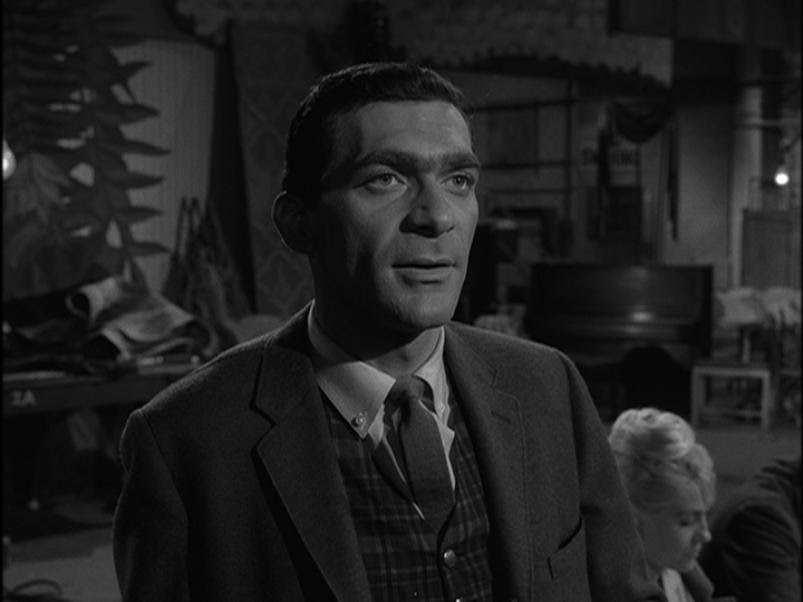
“The Mind and the Matter,” written by Serling and directed by Buzz Kulik, doesn’t quite descend to the depths of past stillbirths “Mr. Bevis” or “Mr. Dingle, the Strong,” but it’s still pretty bad. To sum up: guy hates people. Guy is given a New Age book on mind control, which actually works. Guy makes humanity disappear. Guy gets lonely and repopulates the earth with duplicates of himself. Guy realizes what an ass he really is. Guy puts everything right.


That’s it. Do we care? No. Are we glad when it’s over? Hell YES. Funnyman Shelley Berman tries to make it work, but Serling’s script is just limp. The only interesting sequence -- -when our dubious hero surrounds himself with copies of himself --- is ruined by bad makeup effects (probably the only failure in William Tuttle’s illustrious career… this guy created the makeup for The Time Machine’s Morlocks, fer chrissakes).


Jack Grinnage, playing the sap who spills coffee on our hero and gives him the mystical magical book as an apology of sorts, is shockingly annoying. According to imdb.com, Grinnage turned down a role in Forbidden Planet (thankfully!). It’s pretty thin, but I’m counting is as a Twilight Zone-Forbidden Planet connection.


Berman, meanwhile, has had quite a career as a comedian and actor. He’s still active today, probably most recognizably from his recurring role as Judge Sanders on the late Boston Legal, which starred… William Shatner. There’s your Shatner connection.

Shelley Berman today.

The Twilight Zone
does have its share of successfully comedies. Unfortunately, they’re usually written by people other than Serling. I wonder what George Clayton Johnson would’ve done with this story…? Serling will give us a much more interesting enchanted book --- Ye Book of Ye Black Art --- in a much funnier outing called “The Bard” near the end of season 4. We’ll get to that one in a couple of years.


Two weeks from tonight: Another Serling comedy. But wait! This one doesn’t suck. In fact, it’s quite good. Count your eyeballs and tune in.


Thursday, April 7, 2011

TZ Promo: “A Hundred Yards over the Rim” (4/07/1961)


“A Hundred Yards over the Rim” (4/07/1961)
Season Two, Episode 23 (59 overall)
Cayuga Production # 173-3654


His name is Christian Horn. He’s the leader of a ragged group of settlers on their way to a new life in the west. They’re out of water, Horn’s son rages with fever, and spirits are at an all-time low. Horn sets off on foot, rifle in hand, to explore what lies beyond a sand-covered hill nearby (“just over that rim there, about a hundred yards”). The year is 1847. When Horn comes down the other side, however, it’s 1961.


“A Hundred Yards over the Rim,” written by Rod Serling and directed by Buzz Kulik, first aired 50 years ago tonight. Generally regarded as one of the series’ finer offerings, it’s a simple story of a desperate man who, by processes unknown, finds himself in a future that makes almost no sense to him. The present-day folks he encounters are in a similar quandary: who is this guy, covered in sweat and dust and wearing a stovepipe hat in the desert? And why is his dental work so old fashioned….?


Cliff Robertson nails it as Christian Horn. He behaves and moves like a wounded animal, confused and utterly lost, an artifact displaced from everything he knows. He reminds us of Albert Salmi’s Joe Caswell from season one’s “Execution,” but with less menace. It’s a truly great performance, one of the best in the entire series.


The on-location shooting near Olancha, California (roughly 20 miles south of Lone Pine, where “King Nine will Not Return” was shot earlier this season) provides some absolutely breathtaking imagery. Check out the scene in which Horn encounters a highway, something completely alien to him. It’s just him and the road, and an endless desert all around. The sight of Horn, juxtaposed against modern pavement (Route 190, in this case), is one of the series’ indelible iconic images. And that scene in which a police cruiser chases Horn back up the rim (pictured right)? The wide open scenery just plain breathes. You really get an effective (and authentic) visual representation of those “wide open vistas” the old west promised newcomers. The production value achieved by the location shooting elevates an already-good episode to greatness.


The outskirts of Olancha are featured in a 2010 video montage showcasing various locations in and around Death Valley where select TZ episodes were filmed. Created by fellow fan (and fellow TZ music enthusiast) Paul Giammarco, Twilight Zone: Death Valley (linked above) is absolutely wonderful (and would’ve made a great bonus feature on the blu-ray). Incidentally, I scored (pun intended) copies of cue sheets for all 156 TZ episodes from Paul several years back. I thanked him then, and I’m thanking him again here.


A highlight of the episode is Fred Steiner’s exciting musical score. Employing a diverse collection of percussive instruments (including vibraphone, glockenspiel, tympani, and chimes) alongside piano and harp (and, fittingly, harmonica), the music propels the action and creates a tense, otherworldly mood. The harmonica keeps things genre-specific (this is, after all, essentially a western), but the rest of the diverse ensemble provides a nice off-kilter counterbalance.

Steiner in 2007.

Steiner’s first TZ score was “King Nine Will Not Return” earlier this season, and he’ll be back to score season three’s “The Passersby” (which, incidentally, is the best thing about that one; we’ll get to it in October). Steiner composed a total of 7 original scores for the series, but he isn’t typically mentioned alongside luminaries like Bernard Herrmann and Jerry Goldsmith when TZ music is discussed. It’s a shame.


Next week: Season one’s “The Mighty Casey” gets repeated. The week after, another great time travel episode --- also shot near Olancha --- premieres. This one’s about four criminals and a master plan to pull off the ultimate heist…. which goes terribly awry. It’s pure gold, baby.


Thursday, December 9, 2010

TZ Promo: "The Trouble with Templeton" (12/09/1960)


“The Trouble With Templeton”
Season Two, Episode 9 (#45 overall)
Cayuga Production # 173-3649


Tonight’s episode, first aired on this date exactly fifty years ago, features a man in a morose state of nostalgia who somehow finds himself transported to his coveted past. No, his name isn’t Martin Sloan.

“The Trouble with Templeton” is a competent production, but in all honesty, I’ve never felt particularly warm toward it. Perhaps my “meh” feeling stems from the fact that, on a thematic level, nothing happens here that we haven’t already seen in previous episodes, most notably season one’s “Walking Distance”… and on every level, this episode is inferior to that gentle masterpiece. Like I said, it’s competent enough on its own, but there’s really nothing transcendent going on here.

Oh, except for one thing. There’s a jaw-droppingly beautiful shot late in the episode: Templeton has sought out his dead wife in a speakeasy, where he hopes for a sweet reunion with his lost love. He’s met instead with a raucous barrage of loud Dixieland jazz and general obnoxious behavior. He objects, gets himself slapped across the face, and flees. The ghosts of his past abruptly drop their drunken merriment act as they watch him go. The music stops, everyone stands still, and the lights go down… except for a single spotlight, which the beautiful Pippa Scott steps into, an incalculable longing in her eyes.

I guess that’s an interesting point, one that perhaps elevates the episode a bit. Templeton aches for the dead past, but it appears that dead past aches even more for him. A sobering thought.


“The Trouble with Templeton” is written by E. Jack Neuman, so at least it’s not Serling pilfering himself this time around (he’ll do enough of that as the series progresses). Buzz Kulik directs. Brian Ahern and the aforementioned Pippa Scott star.

Interesting cast note: the snooty theater director is played by a young Sydney Pollack, who would go on to a rather impressive directing career (he won an Academy Award for 1982’s Out of Africa). Pollack continued to act periodically as well, turning in memorable performances in Tootsie (which he also directed) and Eyes Wide Shut, among many others. He passed away in 2008. Here, he’s an arrogant ass… which is exactly what he’s supposed to be.

I would be remiss if I failed to mention the lovely score by Jeff Alexander. It's comprised mostly of fairly generic Dixieland-style jazz, but sprinkled throughout are some very lovely cues. One in particular, "Cerebellum," will reappear in season four's "Death Ship" and season five's "Probe 7 - Over and Out." It's a beautiful little piece of music.


Next week: A band of thieves gets their grubby mitts on a camera that takes pictures of the future. Intriguing concept, right? Don't get your hopes up. Say cheese and tune in.