Showing posts with label TZ action figures. Show all posts

Thursday, May 29, 2014

Episode Spotlight: "The Fear" (5/29/1964)


Season 5, Episode 155
Originally aired 5/29/1964
Cayuga Production # 2633


On March 25, 1964, a sad bit of Twilight Zone history occurred when shooting wrapped on Cayuga’s final production. It was no secret at that point that the series had been cancelled (CBS had announced its fall schedule in January), so the crew certainly knew that their work in the fifth dimension was coming to an end. I’d like to believe that Rod Serling was there with them on the set to hear that final “Cut!” uttered, and that in that moment he felt a rush of pride for his contribution to the landscape of imaginative television. However, I think it’s far more likely that he was nowhere near that set, and that he was too worn out to give much of a damn. As fatigued as the series often felt as it wound down, Serling’s own fatigue was magnified several times over.

That final production, Serling’s “The Fear,” premiered on CBS a scant two months later, exactly fifty years ago tonight.


Charlotte Scott, a big city fashion editor who is on an extended sabbatical following a nervous breakdown, is staying in a luxurious cabin near an unspecified mountain village. State trooper Franklin visits her to follow up on a report of some strange lights in the sky in the area.


The two are beset by mysterious phenomena: bright lights appear and disappear outside the house, high branches in the surrounding trees are broken, and all communication with the outside world (his police radio and her telephone) is cut off.  His squad car rolls on its own (despite the emergency brake being engaged) and flips onto its side.


Soon after, Franklin discovers that his car has been flipped back over…. and a set of oversized fingerprints have been left on it. The next morning, the pair discovers an enormous footprint in a nearby clearing and, overcome with terror, Ms. Scott runs away screaming. She quickly comes face to face with the apparent source of the strange happenings: a gigantic humanoid creature whose entire head is a single eyeball.


Franklin fires several rounds into the creature, which promptly deflates. It’s a balloon! The pair then spies a small flying saucer nearby, inside which tiny aliens are reporting to their superiors that their plan to frighten the giant Earthlings has failed. The ship takes off with its proverbial tail between its legs.


“The Fear” is written by Rod Serling, his 92nd (!) and final contribution to the legendary series that he unleashed upon the world. I’d love to plumb the depths of his teleplay and analyze meanings both surface and hidden, but the sad fact is… well, there aren’t really any such depths or meanings to speak of. “The Fear” centers on a single theme, revealed right up front in the episode’s title: fear. The episode’s about being afraid in the face of the unknown… and that’s it. Serling tackled many sociopolitical themes and their impact on the human condition throughout the series, and the fact that his final Twilight Zone makes no meaningful comment on anything is more than a bit deflating (ha! See what I did there?) He misquotes FDR’s famous “the only thing we have to fear is fear itself” in his closing narration and, if that’s the point he’s trying to make, I would argue that it’s not appropriate to the story. I think it’s entirely appropriate to be afraid if there’s a giant alien coming after you, whether or not it turns out to be a hoax later.

In the director’s chair this week is Ted Post, who also helmed “Probe 7, Over and Out,” and “Mr. Garrity and the Graves” earlier this season and, way back in season one, “A World of Difference” (a favorite of mine). His work here is more or less workmanlike, but there are a few nice touches (Franklin’s flashlight-armed searches outside are effectively spooky, and hey, you’ve gotta love those huge fingerprints on his car!). I do have an issue with the enormous footprint our protagonists find, however: wouldn’t there be several of them? The fact that there seems to be only one should have been a tipoff that things might not be as they appear. And how the hell does Franklin’s car flip onto its side? Even if it struck something as it was rolling, it wasn’t moving any more than five miles per hour. Those enormous fingerprints don’t appear until after the car is returned to its upright position, so we can’t even blame the aliens for this one. And Franklin’s estimation that the giant is "500 feet high" turns out to be a hilarious miscalculation, as we see when our heroes come face to face with it.


As Franklin and Ms. Scott work through the mystery of the giant alien, the episode feels like a companion piece of sorts for “Stopover in a Quiet Town” (how awesome would it have been to end things with the giant alien girl looming over Franklin and Charlotte, the sky booming with her mischievous giggling? It wouldn’t have made much sense, but I think I would’ve preferred it to the actual denouement). I guess we could also draw parallels to season three’s “The Little People” and, for that matter, “The Invaders.”

When I reviewed "The Brain Center at Whipple's" two weeks ago, I lamented the fact that the appearance of Robby the Robot signaled the final Forbidden Planet connection we'd see in the series. I love being proven wrong when it comes to stuff like this: while the tiny aliens' flying saucer isn't our beloved United Planets C-57D Space Cruiser, the stock shot (from "Death Ship") of the ship beating a hasty retreat most certainly is. So there you go,kids: one more Forbidden Planet alert for the road. 

“There are more things in heaven and earth, Horatio, than are dreamt of in your philosophy,” says Franklin to Ms. Scott early in the episode. If this quote from Shakespeare’s Hamlet seems a bit familiar, it’s because Richard Matheson also used it in season one’s “The Last Flight.”

A couple of complaints: first, it seems contrary to Serling’s usual sympathetic humanist ethic to have Franklin start shooting at the giant alien without even attempting to communicate with it, particularly since the alien has never exhibited any overt intent to bring harm or destruction. Hey Rod, remember “The Gift”Second, “The Fear” is probably the single most over-the-top example of Serling’s notorious “purple prose” tendencies supplanting natural, realistic dialogue. Zicree says it best in his Twilight Zone Companion: “(M)uch of the dialogue sounds like two Rod Serlings talking to each other.”


When I reviewed the Outer Limits episode “The Borderland” back in December, I described Mark Richman’s performance as a “pretty impressive Rod Serling impression.” Here’s a short clip to illustrate:


Pretty uncanny, huh? Now, Richman doesn’t act (much) like Serling in “The Fear,” but he definitely resembles him.


Bif Bang Pow! named their action figure of the big guy Cyclops, which is probably an appropriate name for it (it certainly sounds more ominous than “Alien Balloon”). I don’t have it, so I can’t comment on its merits (I stopped collecting Bif Bang Pow!’s TZ stuff about a year or so ago, which I probably should’ve mentioned before now; long story short: too many quality control problems on their end, plus the majority of their offerings just don’t interest me; I’ll try to elaborate in a separate post soon).

.
THE MUSIC
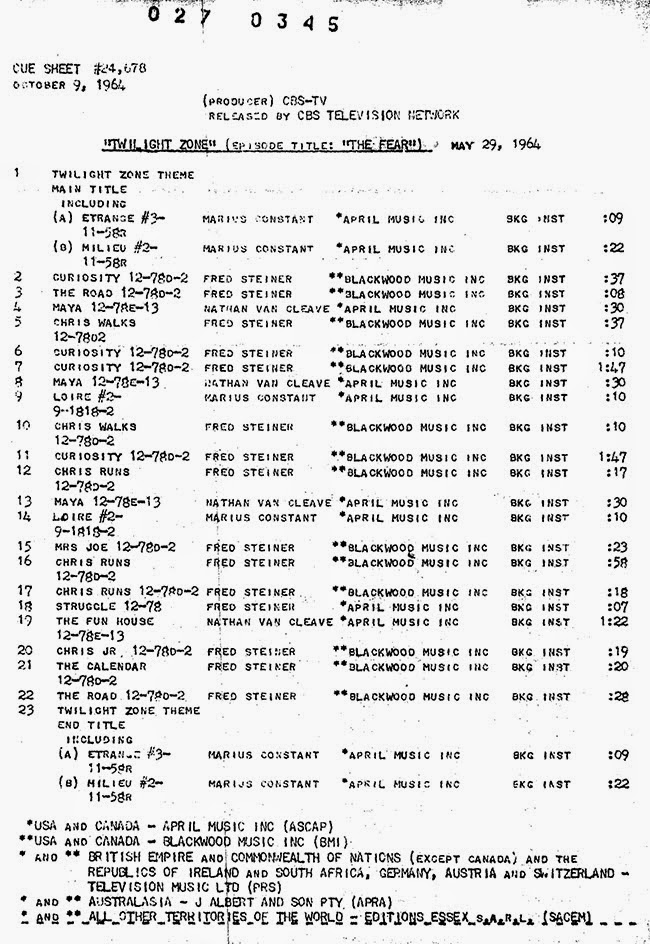

“The Fear” is stock-scored, meaning that the underscore is a patchwork of pre-existing recordings from the CBS Music Library, comprised mostly of Fred Steiner cues (from “King Nine Will Not Return” and “A Hundred Yards over the Rim,” both from season two). We also hear “Maya” and “The Fun House” from Nathan Van Cleave’s score for season one’s “Perchance to Dream.” Hearing music from the show’s earlier days this close to the end is a welcome touch indeed (though I doubt that was the intent), and I’m happy to report that the various cues mesh pretty well together, despite originating from three different scores. While “The Fear” doesn’t feature an isolated music track on the DVD and Blu-ray releases of the series, all three of those earlier scores have been released multiple times over the years, on both vinyl and CD, from both Varese Sarabande and Silva Screen Records. The Definitive DVD and Blu-ray releases of the first and second seasons also include isolated music tracks for all three episodes, so if one wanted to piece together a soundtrack for “The Fear,” the resources are easily obtained (except for that short little Marius Constant bit, dammit).


.
DRAMATIS PERSONAE

Trooper Robert Franklin is played by Mark Richman in his only Twilight Zone appearance. Richman has extensive genre experience, including roles on The Outer Limits (“The Borderland” and “The Probe”), Alfred Hitchcock Presents (“Man with a Problem” and “The Cure”), The Invaders (“The Leeches” and “Inquisition”), The Incredible Hulk (“Triangle) and, a bit more recently, Star Trek: The Next Generation (“The Neutral Zone”).

Richman with TZ alum Susan Oliver.

Charlotte Scott is played by the beautiful Hazel Court in her only Twilight Zone appearance. Genre fans can spot her in four episodes of Alfred Hitchcock Presents (“The Crocodile Case,” “The Avon Emeralds,” “Arthur,” and “The Pearl Necklace”) and one episode of Boris Karloff’s Thriller (“The Terror in Teakwood”). On the big screen, Court can be seen in 1957’s The Curse of Frankenstein from Hammer Films, not to mention a trio of Roger Corman adaptations of Edgar Allen Poe stories (1962’s The Premature Burial, 1963’s The Raven, and 1964’s The Masque of the Red Death). Did I mention that she’s beautiful? She’s definitely a TZ Babe, make no mistake. *Sigh*


The part of the giant Cyclops “alien” is played by a BIG GODDAMNED BALLOON which, to my knowledge, never worked in television again (though it would’ve been positively smashing in the Macy’s Thanksgiving Day Parade, right?).


“The Fear” was the final Twilight Zone episode to be filmed (“The Bewitchin’ Pool,” the final episode aired, was shot earlier but took longer to complete in post-production; more on this when we get to it), and it definitely feels like the show is running on fumes as it lurches toward the finish line. It’s not exactly terrible, but it’s nowhere near good: like the aliens’ giant balloon, it’s ultimately a bit flat.


Next:
There’s only one new episode left of the entire series… but you’re gonna have to wait
three weeks for it. Talk about cancelus interruptus….


Thursday, March 20, 2014

Episode Spotlight: "The Masks" (3/20/1964)


Season 5, Episode 25 (145 overall)
Originally aired 3/20/1964
Cayuga Production # 2601


Jason Foster’s doctor has informed him that he could shuffle off his mortal coil at any moment; that he truly is at death’s proverbial door. But he’s not quite ready to go yet: he has a final score to settle and, fifty years ago tonight, he did just that.

Mardi Gras festivities boom and swell outside as Foster’s daughter Emily and her husband Wilfred, along with their children Paula and Wilfred Jr., hover around the mansion like vultures as they impatiently wait for the old man to kick off and leave them his riches. Foster has every intention of doing just that; however, he has one small prerequisite: they must each wear masks to celebrate Fat Tuesday. Foster has commissioned a set of special masks, crafted by a local Cajun, which are said to "possess magical properties."


Wilfred (avarice), Emily (self-pity), Jason (death), Wilfred Jr. (cruelty) and Paula (vanity).
Each mask is a caricature depicting their deepest, darkest flaws: Wilfred is a money-hungry douchebag, Emily is a fragile crybaby, Paula is a vain and self-absorbed bitch, and Wilfred Jr. is a semi-retarded bully. Foster, meanwhile, will wear a skull mask, since he is very near death. The masks must be worn until midnight; if any of them remove their mask prior to then, they’ll automatically forfeit their inheritance. 

The hours drag by, and the four vultures grow increasingly uncomfortable in the masks. Foster gives them a final dressing down before he dies as midnight strikes. The newly-wealthy heirs remove their masks… and are horrified to discover that the exaggerated features of the masks have impressed themselves permanently onto their faces.

“The Masks” is one of Rod Serling’s better fifth season efforts. It’s a bit talky, but within tolerable limits (as opposed to, say, “The Long Morrow,” in which his trademarked “purple prose” runs rampant). It feels like a classic revenge tale straight out of E.C.’s Vault of Horror comic series (in fact, there are many TZ episodes that seem uncomfortably similar to tales first published in E.C.’s various horror and sci-fi comics; at some point I’ll be posting a special report on this topic, probably this summer), in which nasty people get a nasty, unexpected comeuppance.

We’re clearly supposed to side with Foster; however, I don’t think he’s any better than the family members whom he so clearly loathes. Listen to how he addresses them! He’s snide, condescending, vicious and downright cruel. He’s no hero, particularly since he opts to disfigure them rather than, say, leave his money to charity instead of rewarding their misbehavior(s) with his fortune. I’d say he’s the real villain here.


The New Orleans Mardi Gras setting is only briefly glimpsed in a couple of stock shots at the start of act two; I would've liked to have seen a bit more. And why not show us the Cajun who made the masks, maybe just a quick scene of him delivering the masks to the butler, before Foster’s exchange with his doctor in the prologue? I guess what I was looking for is a bit more voodoo, a bit more mystery, a more pronounced and ominous shadow hanging over the proceedings. 


The real star here, of course, is the quintet of masks that the cast wears throughout the episode’s second act, all designed by William Tuttle (who gave us many of the series' greatest makeup triumphs, including "Eye of the Beholder," "The After-Hours" and "Steel"). Unfortunately, the actual makeup jobs on the actors’ faces after their unmasking are disappointingly indistinct. Their distorted features aren’t exaggerated nearly enough; their new faces should be just as sharply detailed as the masks, not sixth-generation dupes of them.


In the director’s chair for “The Masks’ is film noir siren Ida Lupino, who starred in season one’s “The Sixteen-Millimeter Shrine.” Lupino also co-starred in 1951’s On Dangerous Ground, the cast of which also included Frank Ferguson (whom we saw two weeks ago in “Queen of the Nile”; incidentally, frequent TZ contributor Bernard Herrmann provided the score for that film). Her many directing credits include nine episodes of Boris Karloff’s Thriller, three episodes of The Fugitive, and two episodes of Alfred Hitchcock Presents


FANTASTIC PLASTIC


In 2010, the character of Jason Foster (wearing his skull mask) was immortalized in plastic by Bif Bang Pow! in their first wave of Twilight Zone action figures. It’s happily one of their better efforts (except for the lack of a wheelchair, which would’ve been awesome); my review can be found here. The line appears to have all but dried up; however, most of the figures can still be purchased at Entertainment Earth.

DRAMATIS PERSONAE

This week’s cast only features a couple of TZ veterans; however, they’re all connected by their work for Alfred Hitchcock.

According to the IMDB, Jason Foster is Robert Keith’s last credited role (apparently he took that death mask a little too seriously). It’s his only TZ appearance, but he worked for Hitch twice (“Ten O’clock Tiger” on Alfred Hitchcock Presents and “Final Escape” on The Alfred Hitchcock Hour). You may have also seen him on The Fugitive, playing Richard Kimble’s father in “Home Is the Hunted.”


We last saw Virginia Gregg (here playing Emily Harper) as Ossie Stone, mother of the tortured Jess-Belle, in the season four episode of the same name. She worked fairly extensively for Hitchcock, including four stints on Alfred Hitchcock Presents (“Don’t Come Back Alive,” “Santa Claus and the Tenth Avenue Kid,” “And So Died Riabouchinska,” and “Nightmare in 4-D”), three on The Alfred Hitchcock Hour (“A Home Away from Home,” “Thou Still Unravished Bride,” and “Consider Her ways”: that last one features an original musical score by the aforementioned Bernard Herrmann) and, perhaps most significantly, provided the voice of Norma Bates in his 1960 horror classic Psycho (also scored by Herrmann). Gregg reprised her voice role in that film’s second and third sequels.


The obnoxiously gregarious Wilfred Harper is played by Milton Selzer, who also played the head alien in season three’s “Hocus-Pocus and Frisby.” He briefly appeared in Hitch’s 1963 Marnie (also scored by Herrmann, incidentally).


Paula Harper is played by Brooke Hayward in her only TZ appearance; she also appeared in “The Cadaver” on The Alfred Hitchcock Hour, a series on which Willis Bouchey (here playing Foster’s doctor) appeared three times (“I Saw the Whole Thing,” “The Paragon,” and “One of the Family”).


“The Masks” is comprised of five unpleasant people hating on one another almost continuously for half an hour. It could’ve been fun, like Serling’s earlier “Uncle Simon,” but here all the meanness just isn’t enjoyable. It’s still a pretty well-crafted horror story, but ultimately its Tuttle’s masks that really save the day. Hey Bif Bang Pow!, if you're reading this, how about selling full-sized replicas of the masks? They'd make amazing Mardis Gras accessories... hell, they'd look stunning just hanging on a wall.


Next week:
It’s “Dust” all over again, but darker. Like, literally.


Friday, November 1, 2013

Episode Spotlight: "Living Doll" (11/01/1963)


Season 5, Episode 6 (126 overall)
Originally aired 11/01/2013
Cayuga Production # 2621


Fifty years ago tonight, a mean ol’ sumbitch matched wits with a doll… and lost miserably. Jeez, wotta wuss.


Erich Streator is your average everyday wicked stepfather. Overbearing and cruel, he makes life miserable for his wife Annabelle and stepdaughter Christie on a daily basis. When Annabelle buys Christie a new Talky Tina doll, Erich is clearly perturbed because, well, nobody in his house should ever enjoy anything. Kinda reminds me of my stepdad when I was a kid.


Hi Daddy! Meet your adorable new nemesis!

“My name is Talky Tina, and I love you very much,” coos Tina whenever her string is pulled. But whenever she’s alone with Erich, she says other, more interesting phrases: they start with “I don’t think I like you” and quickly escalate to “I’m going to kill you.” The aforementioned battle of wits escalates from there and, to borrow a catchphrase from Highlander: there can be only one.


ZICREE RAPED MY CHILDHOOD!


I was pretty new to the series when I first read Marc Scott Zicree’s The Twilight Zone Companion in 1982, and there were many episodes that I hadn't seen yet, one of which was “Living Doll.” Zicree’s comments on the episodes are as follows:

“Erich Streator is trying desperately not to alienate his wife and her young daughter. When the child brings home a doll that makes clear its murderous intentions --- but only when it's alone with him --- Erich is in one hell of a bind. If he tries to tell his wife of it, he sounds like a lunatic, and if he tries to protect himself by attempting (unsuccessfully) to destroy the doll, his actions seem those of a twisted mind striking out resentfully to hurt a helpless little girl. Poor Erich; it is clear early on that he hasn't much of a chance against this ruthless doll.” 

Whatchoo talkin' 'bout, Zicree?

This was all I knew about “Living Doll” until I finally saw it a few years later. I was expecting to see a basically decent guy get decimated unfairly by an evil doll; imagine my surprise to discover that said “decent guy” was actually the villain of the piece! Did Zicree even watch the episode before writing about it? He couldn't have possibly sympathized with Erich Streator AT ALL if he had; however, the excessive praise he heaps on it would seem to imply that not only had he seen it, but had deemed it absolute top tier Zone: “Masterfully written and superbly directed, acted, photographed and scored, it is an episode that can stand with the best of any season.”  It was at this point, at the tender of age of 13, that I had the sobering realization that Zicree was perhaps not the be-all-end-all Twilight Zone expert that I’d assumed he was. I mean, he’d written a goddamned book about it; how the hell could he have been so incredibly wrong?

I think, in describing this dark event in my TZ-formative years, I've figured out why I’m so hostile toward Zicree. Serling was my new idol (after outgrowing such childhood heroes as Spiderman and Luke Skywalker), but he died before I ever heard his name, so Zicree, having chronicled Serling’s wonderful TV series, was the closest I could get to him. And the son of a bitch let me down by being so blatantly wrong about something so obvious. Erich Streator was a bad guy; he deserved what he got. This was the cosmic justice that lay at the very heart of The Twilight Zone, which even I understood at that early age. If Zicree didn't understand that, then who was he to write the book in the first place?

Ahem. I think I might just have exorcised a serious demon here. Maybe now I can move on with my life. Maybe I can even forgive Mr. Zicree his egregious trespasses against my inner child. Maybe.

Okay, therapy session over. Let’s move on.


“Living Doll” has a great concept (which is unfortunately pretty clichĂ©d nowadays; I’m looking at you, Child’s Play franchise) which, coupled with Telly Savalas’s fantastic bad-guy-you-love-to-hate performance, makes for a highly entertaining half-hour (except for the last thirty seconds; see below). Unfortunately, it’s pretty flat on a visual level, the exception being when the action moves to Erich’s garage, where he attempts to dispose of Tina in a number of ways (she’s definitely more menacing in semi-darkness). Still, these scenes offer nothing on the level of, say, season three’s “The Dummy” (which features a menacing ventriloquist’s dummy framed by complex camera work with marvelous lighting).  And the final shot of the episode, in which slow-motion is abruptly employed for no apparent reason, does nothing to advance the mood (and was likely done to stretch out the ending to accommodate Serling’s closing narration, which suggests poor planning during filming).  

In fact, the ending is disappointing in general, since having Tina murder Erich is the easiest possible conclusion. Why not have Erich scared straight, so to speak, and forced to treat his family better under Tina’s ongoing supervision? Further, why the hell does Tina threaten Annabelle (Christie’s one and only champion) after Erich is dispatched? Up until this point, the episode was operating under the cosmic justice approach (discussed in detail last week) but, in the final moment, gears are abruptly switched over to something more akin to chaos theory. It seems Tina is just an all-around evil doll (yawn) instead of a protective shield for a mistreated child (infinitely more satisfying) after all.

One minor bid of weirdness. Annabelle says to Erich that “I know you got more than you bargained for when you married me; two for the price of one, wasn’t it?” Um… surely he was aware that she had a kid, right…? If he wasn’t, then I’m almost willing to cut him some slack for being such an asshole. On that note, surely she was aware that he was a profoundly mean bastard, so why the hell did she marry him in the first place? 


Jerry Sohl and Charles Beaumont

“Living Doll” is the first of three episodes credited to writer Charles Beaumont this season. Unfortunately, he didn't actually write any of them, as by this time his health was rapidly deteriorating (he passed away in 1967). In this particular case, Beaumont mapped out the plot with Jerry Sohl, who ghostwrote the script.


THE MUSIC


“Living Doll” features another great score from Bernard Herrmann. As a fan(atic) of his work, I find it fascinating to compare his Twilight Zone work with the film scores he composed around the same time (for example, his score for 1959’s Journey to the Center of the Earth shares similar instrumentation with TZ’s “The Lonely” from that same year). His sole film score in 1963 was Jason and the Argonauts which, now that I think about it, doesn’t really sound like “Living Doll” at all.  Here, Herrmann employs a very small ensemble (two harps, celesta and bass clarinet) to create moody, suspenseful cues that perfectly underline the escalating psychological warfare between Erich and Talky Tina. The original Herrmann recordings have never been properly released; however, they can be obtained via the isolated music tracks present on both the DVD and blu-ray sets of season five (from Image Entertainment).  


Additionally, Joel McNeely recorded all seven of Herrmann’s Twilight Zone scores in 1999 for a 2-CD set released by Varese Sarabande Records (which was the only game in town for 4/7ths of Herrmann’s TZ output before Image came along). I do have some issues with some of McNeely’s interpretations (some cues are too fast while others are too slow; further, much of “Where Is Everybody?” just sounds off to my ears); however, his take on “Living Doll” is quite good (though it’s no match for the original recording).


FAMILIAR FACES


Telly Savalas, who has a long history of imposing and often malevolent characters on his resume, is perfect as Erich Streator.  This is his only TZ appearance, but he does have another connection to the series: he appeared in 1962’s Cape Fear, which was scored by Bernard Herrmann (and co-starred TZ vets Martin Balsam, Edward Platt and Paul Comi). Savalas also played super villain Ernst Stavro Blofeld in 1969’s On Her Majesty’s Secret Service, one of my favorite James Bond films.


Mary La Roche (Annabelle Streator) previously entered The Twilight Zone as Mary, Gregory West’s mistress, in season one’s “A World of His Own.” Here she plays an unhappy wife, so I guess she got to play both sides of the extramarital fence (though I guess Erich isn't depicted as an adulterer; but honestly, would we be surprised?).


Tracy Stratford is convincingly sad and under-loved as Christie (she was also Tina in season three’s “Little Girl Lost,” which was also scored by Bernard Herrmann. Wait, so first she played Tina, then she had a doll named Tina… is it possible that Talky Tina came from the fourth dimension?). Additionally, Stratford provided the voice of Lucy Van Pelt in the 1960s Charlie Brown TV specials. So when Annabelle tells Erich to see a psychiatrist, I wonder if she meant….

Good grief! Uh, I mean... who loves ya, baby???

And hey, Telly Savalas and Charlie Brown are both bald. Coincidence?  I dunno… maybe Charles Schulz was a Twilight Zone fan…?


June Foray, probably the hardest working voice actor in Hollywood, provides the unforgettable voice of Talky Tina. She’ll also do some (slightly controversial) dubbing later this season in “The Bewitchin’ Pool,” but she has another less-obvious TZ connection as well.  80’s kids like me will have no trouble remembering the 1985 film Weird Science, but do you remember the TV spin-off, which lasted five seasons (1994-1998) on the USA Network? In the episode “Sci-Fi Zoned,” the main characters are trapped inside black and white episodes of their favorite TV show (a thinly-veiled TZ knockoff called The Sci-Fi Zone), one of which involves a murderous doll named “Talking Tammy,” who is voiced by…. yup, you guessed it, June Foray (she also voices a sentient candy bar named “Baby Ruth” in the same episode).


An iconic episode like this is almost guaranteed to spawn a parody somewhere along the line. Like “Nightmare at 20,000 Feet” a few weeks back, “Living Doll” got the Simpsons treatment in 1992’s “Treehouse of Horror III,” in which a Krusty the Klown doll menaces Homer Simpson (“Clown without Pity”). Also of interest to genre fans is the framing device employed in this episode, which is patterned after TV’s Alfred Hitchcock Presents and features the rotund Homer standing in for Hitch.

Good morn--- D'oh!


Bif Bang Pow! has immortalized Talky Tina in every conceivable form (a talking bobblehead, action figure, and a fully-functioning life-sized replica). The bobblehead seems to be sold out but, as of this writing, the action figure and life-size replica are still available through Entertainment Earth (but, as with any collectible, they won’t be around forever). I can’t comment on the life-sized replica since I don't own it (c'mon, how could I possibly justify buying a fucking doll? For over a hundred bucks, no less!), but I've reviewed the other two (see here and here).


Questionable ending aside, “Living Doll” is great fun and a definite highlight of The Twilight Zone’s fifth and final season. Other than the misfire “A Kind of a Stopwatch” two weeks ago, season five’s offerings have ranged from good to excellent… unfortunately, the quality is about to start dipping in a big way.  Stay tuned, but temper your expectations from here on out.


Next week: Hoo boy. Where’s Charles Bronson and Elizabeth Montgomery when you need ‘em?