

Season 4, Episode 18 (#120 overall)
Cayuga Production # 4852
Originally aired May 23, 1963
50 years ago tonight, an ex-streetcar conductor-turned-struggling television writer found a supernatural route to instant success, with the help of history’s greatest playwright.

“The Bard,” the eighteenth and final episode of The Twilight Zone’s abbreviated fourth season, finds Julius Moomer badgering his agent, Mr. Hugo, into giving him a crack at a pilot for a series about black magic. Does he know anything about black magic? Of course not, but he’ll happily research it. Hugo, clearly exasperated with Moomer’s aggressive begging, relents.

Our first indicator that supernatural forces are at work comes when Moomer visits a book shop in search of material for said research. An ancient tome (cleverly titled Ye Book of Ye Black Arte) flies from a shelf, apparently of its own volition, and lands at his feet. Spooked, the clerk lets him have the book gratis and hustles him on his way. Moomer’s subsequent attempts at conjuring (what exactly he’s trying to conjure isn't clear) appear unsuccessful at first, but his misfortunes reverse when he inadvertently summons….
 …yup, it’s William Shakespeare himself. He doesn't seem terribly nonplussed to have inexplicably materialized in the twentieth century; in fact, he rather congenially agrees to ghostwrite Moomer’s pilot assignment. The Tragic Cycle results, Moomer gains instant acclaim from the Television City bigwigs, Shakespeare objects to the sponsor-demanded changes to his work and, as the saying goes, hilarity ensues.
 “The Bard” is surprisingly successful for a Serling-penned comedy (like earlier entries “Will the Real Martian Please Stand Up?” and “The Night of the Meek”; his other attempts are dreadfully unfunny and, in the cases of “Mr. Bevis” and “Mr. Dingle, the Strong,” actually rage-inducing). Since most of the characters here are larger-than-life, Serling’s inflated and unrealistic dialogue isn't as glaringly inappropriate (an exception is Cora, a meddlesome kid in Moomer’s building who suspects he’s up to no good):
Caption: Seriously, what 12 year-old talks like this?
 Much of the success of “The Bard” stems from Serling’s inside perspective on the inanities associated with television production. Shakespeare’s bristling against network interference, for example, comes straight out of Serling’s own well-documented experience with censorship of his pre-TZ work.If you haven’t seen it, there’s a remarkable Mike Wallace interview with Serling in which this very topic is discussed in detail.
 There’s also a marvelous in-joke in the episode’s prologue: among Moomer’s many failed TV series ideas is one in which he proposes to turn The Millionaire into The Multi-Millionaire and expanding it to fill an hour time slot. Serling is clearly jabbing CBS for its questionable decision to do that very thing to The Twilight Zone (his point must have hit home, seeing as how the very next episode aired --- the season five opener “In Praise of Pip” --- found the show returned to its original half-hour format).
Jack Weston is perfectly cast as the talentless but endlessly determined Julius Moomer. We last saw Weston murder poor Pete Van Horn in season one’s “The Monsters Are Due on Maple Street.”

 The great John Williams (no, not the film composer) shines as the beleaguered William Shakespeare. Williams was a frequent face on TV’s Alfred Hitchcock Presents; he also appeared in Hitch’s Dial M for Murder and To Catch a Thief. His last role was Sire Montrose on the “War of the Gods” episode of TV’s Battlestar Galactica in 1979.
 The estimable John McGiver appears as Mr. Shannon, the soup magnet whose company is sponsoring The Tragic Cycle, and we’ll see him again in season five’s “Sounds and Silences.” McGiver is excellent as liberal Senator Thomas Jordan in one of my favorite films, 1962’s The Manchurian Candidate, in which he famously takes a fatal bullet through a carton of milk.
 A young Burt Reynolds offers his services as Rocky Rhodes, the actor cast in The Tragic Cycle’s lead. Rhodes is an obvious lampoon of the method actors of the day, but Reynolds goes the extra mile and infuses him with a certain, shall we say, dullness of mind that is truly hilarious to behold. Reynolds went on to a storied career in film, and was apparently quite a sex symbol in the 70’s, as evidenced by his appearance in Cosmopolitan Magazine in 1972.
 Effective March 23, 2015, Blogger will disallow all sexually explicit or graphic nude images. Therefore, ol' Burt's nether region must be concealed. Sorry, guys 'n dolls.
I hadn't seen “The Bard” in probably 20 years or so before scanning the episode for screen captures recently. Reynolds’ performance brought to mind Matt Leblanc’s dimwitted but lovable Joey Tribbiani from TV’s Friends. I dunno, maybe it’s just me (betcha never thought you’d see a Friends reference here, did you?).
 Fred Steiner was commissioned to create original music for “The Bard,” his seventh and final contribution to The Twilight Zone’s musical landscape. His score is comprised solely of brief, comical cues (appropriate, since there’s really no drama to be found here) and, while it all works fine within the context of the episode, I’m sure they could’ve pulled similar cues from the CBS Music Library (for free!) and used Steiner’s considerable talents elsewhere (stock scores were used in a number of season four episodes which certainly deserved original music, like “In His Image,” “Death Ship” and “Printer’s Devil”). Steiner also contributed the score for “I Dream of Genie” earlier this season, which was equally pointless… man, what a waste. For Rod’s sake, this is the guy who gave us “The Passersby” in season three, which stands one of the all-time great TZ scores! Anyway, if you care, Steiner’s underscore for “The Bard” is isolated on both DVD releases (volume 42 and the season 4 Definitive Edition set) and the more recent season 4 blu-ray release, so you know where to go if you want funny music to accompany those cat videos you’re about to upload to YouTube.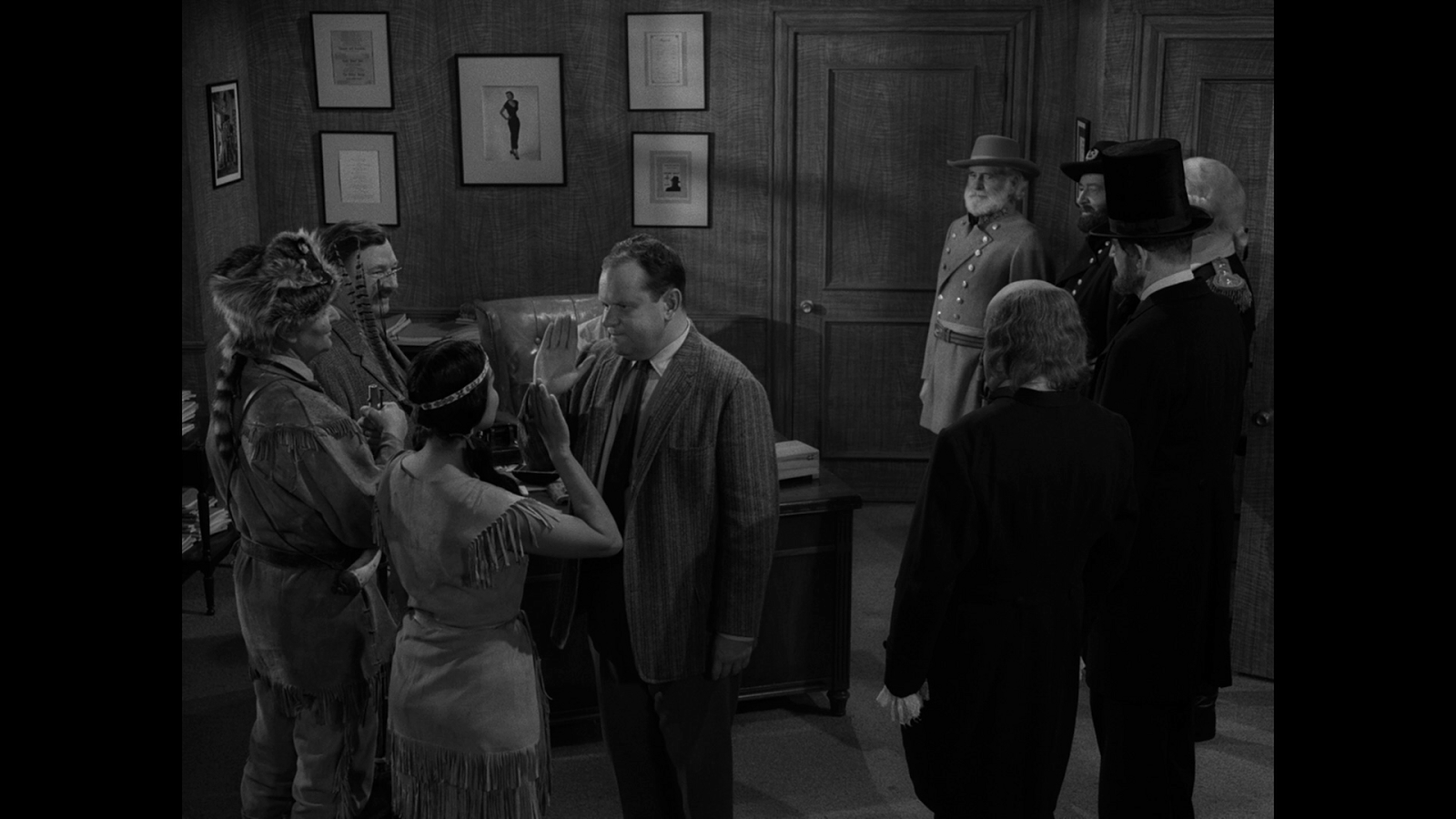
“The Bard” is a nice hearty chuckle to close out the series’ abbreviated fourth season. The Twilight Zone would return for its final season in September 1963, which means we’ll be back in September of this year to celebrate each episode’s 50th anniversary. I imagine it’ll be pretty quiet ‘round here between now and then... Have a great summer!


+1.jpg)
.png)
.jpg)

.jpg)
.png)


.png)


.png)


.jpg)


.png)

.png)
.png)
+2.png)


