Showing posts with label Forbidden Planet. Show all posts

Sunday, April 19, 2020

4x04 "Quantum Gleep"


Howdy pardners! This week we saddle up and transcend the shackles of time to corral the classic Twilight Zone episodes “Execution” and “BackThere.” Along the way host Craig does his usual drooling over Forbidden Planet props and related gadget porn, and somehow The Smiths make an unlikely appearance. Giddyup!

Mohawk Midgetape 300 gadget porn:


“Oscillate Wildly” performed by The Smiths (“How Soon Is Now?” single B-side, copyright 1985 by Rough Trade Records)

“The Good, the Bad, and the Ugly (Il Buono, Il Butto, Il Cattivo)” composed and conducted by Ennio Morricone (from The Good, the Bad and the Ugly Original Motion Picture Soundtrack, copyright 1966 by Capitol Records)

The Twilight Zone is a trademark of CBS, Inc.

Between Light and Shadow: A Twilight Zone Podcast is a nonprofit podcast. Music clips and dialogue excerpts used herein are the property of their respective copyright owners; we claim no ownership of these materials. Their use is strictly for illustrative purposes and should be considered Fair Use as stated in the Copyright Act of 1976, 17 U.S.C. section 107.

Sunday, March 1, 2020

4x01 "Cupid Is as Cupid Does"


We’re back! Love is in the air as Craig gazes seductively into the eyes of the first two Twilight Zone episodes he ever saw (“The Chaser” and “Jess-Belle”). Along the way he completely undermines his own efforts to be more “woke” when it comes to lusting after the opposite sex… just in time for Valentine’s Day (which was two weeks ago, so our perfect record of always being late remains intact). It’s a heady brew of Paley Center complaints, surprising Psycho tangents, and more cast connections than you can shake a silver hairpin at. Draw a warm bath, light some candles, and crack open the Courvoisier. Ooh la la!


Rondo Hatton Classic Horror Awards ballot: https://rondoaward.com/rondoaward.com/blog/?p=890


“I’m in the Mood for Love” performed by the Jackie Gleason & His Orchestra (from the album Music for Lovers Only, copyright 1953 by Capitol Records)


“Love Potion No. 9” performed by The Clovers (copyright 1959 by Capitol Records)


“Every Breath You Take” performed by The Police (from the album Synchronicity, copyright 1983 by A&M Records)


“The Ballad of Jess-Belle (single edit)” performed by Terrea Lea (copyright 1963 by CBS Music)


“I Wonder as I Wander” performed by Terrea Lea (from the album Folk Songs and Ballads, copyright 1958 by HiFi Records)


“The Ocelot” composed and conducted by Joseph Mullendore (from the album Honey West: Original Music from the Soundtrack, copyright 1965 by ABC Records)


“Love Potion No. 9 (instrumental)” performed by Enoch Light and The Light Brigade (from the album Discotheque Vol. 2, copyright 1965 by Command Records)


The Twilight Zone is a trademark of CBS, Inc.

Between Light and Shadow: A Twilight Zone Podcast is a nonprofit podcast. Music clips and dialogue excerpts used herein are the property of their respective copyright owners; we claim no ownership of these materials. Their use is strictly for illustrative purposes and should be considered Fair Use as stated in the Copyright Act of 1976, 17 U.S.C. section 107.

Thursday, May 29, 2014

Episode Spotlight: "The Fear" (5/29/1964)


Season 5, Episode 155
Originally aired 5/29/1964
Cayuga Production # 2633


On March 25, 1964, a sad bit of Twilight Zone history occurred when shooting wrapped on Cayuga’s final production. It was no secret at that point that the series had been cancelled (CBS had announced its fall schedule in January), so the crew certainly knew that their work in the fifth dimension was coming to an end. I’d like to believe that Rod Serling was there with them on the set to hear that final “Cut!” uttered, and that in that moment he felt a rush of pride for his contribution to the landscape of imaginative television. However, I think it’s far more likely that he was nowhere near that set, and that he was too worn out to give much of a damn. As fatigued as the series often felt as it wound down, Serling’s own fatigue was magnified several times over.

That final production, Serling’s “The Fear,” premiered on CBS a scant two months later, exactly fifty years ago tonight.


Charlotte Scott, a big city fashion editor who is on an extended sabbatical following a nervous breakdown, is staying in a luxurious cabin near an unspecified mountain village. State trooper Franklin visits her to follow up on a report of some strange lights in the sky in the area.


The two are beset by mysterious phenomena: bright lights appear and disappear outside the house, high branches in the surrounding trees are broken, and all communication with the outside world (his police radio and her telephone) is cut off.  His squad car rolls on its own (despite the emergency brake being engaged) and flips onto its side.


Soon after, Franklin discovers that his car has been flipped back over…. and a set of oversized fingerprints have been left on it. The next morning, the pair discovers an enormous footprint in a nearby clearing and, overcome with terror, Ms. Scott runs away screaming. She quickly comes face to face with the apparent source of the strange happenings: a gigantic humanoid creature whose entire head is a single eyeball.


Franklin fires several rounds into the creature, which promptly deflates. It’s a balloon! The pair then spies a small flying saucer nearby, inside which tiny aliens are reporting to their superiors that their plan to frighten the giant Earthlings has failed. The ship takes off with its proverbial tail between its legs.


“The Fear” is written by Rod Serling, his 92nd (!) and final contribution to the legendary series that he unleashed upon the world. I’d love to plumb the depths of his teleplay and analyze meanings both surface and hidden, but the sad fact is… well, there aren’t really any such depths or meanings to speak of. “The Fear” centers on a single theme, revealed right up front in the episode’s title: fear. The episode’s about being afraid in the face of the unknown… and that’s it. Serling tackled many sociopolitical themes and their impact on the human condition throughout the series, and the fact that his final Twilight Zone makes no meaningful comment on anything is more than a bit deflating (ha! See what I did there?) He misquotes FDR’s famous “the only thing we have to fear is fear itself” in his closing narration and, if that’s the point he’s trying to make, I would argue that it’s not appropriate to the story. I think it’s entirely appropriate to be afraid if there’s a giant alien coming after you, whether or not it turns out to be a hoax later.

In the director’s chair this week is Ted Post, who also helmed “Probe 7, Over and Out,” and “Mr. Garrity and the Graves” earlier this season and, way back in season one, “A World of Difference” (a favorite of mine). His work here is more or less workmanlike, but there are a few nice touches (Franklin’s flashlight-armed searches outside are effectively spooky, and hey, you’ve gotta love those huge fingerprints on his car!). I do have an issue with the enormous footprint our protagonists find, however: wouldn’t there be several of them? The fact that there seems to be only one should have been a tipoff that things might not be as they appear. And how the hell does Franklin’s car flip onto its side? Even if it struck something as it was rolling, it wasn’t moving any more than five miles per hour. Those enormous fingerprints don’t appear until after the car is returned to its upright position, so we can’t even blame the aliens for this one. And Franklin’s estimation that the giant is "500 feet high" turns out to be a hilarious miscalculation, as we see when our heroes come face to face with it.


As Franklin and Ms. Scott work through the mystery of the giant alien, the episode feels like a companion piece of sorts for “Stopover in a Quiet Town” (how awesome would it have been to end things with the giant alien girl looming over Franklin and Charlotte, the sky booming with her mischievous giggling? It wouldn’t have made much sense, but I think I would’ve preferred it to the actual denouement). I guess we could also draw parallels to season three’s “The Little People” and, for that matter, “The Invaders.”

When I reviewed "The Brain Center at Whipple's" two weeks ago, I lamented the fact that the appearance of Robby the Robot signaled the final Forbidden Planet connection we'd see in the series. I love being proven wrong when it comes to stuff like this: while the tiny aliens' flying saucer isn't our beloved United Planets C-57D Space Cruiser, the stock shot (from "Death Ship") of the ship beating a hasty retreat most certainly is. So there you go,kids: one more Forbidden Planet alert for the road. 

“There are more things in heaven and earth, Horatio, than are dreamt of in your philosophy,” says Franklin to Ms. Scott early in the episode. If this quote from Shakespeare’s Hamlet seems a bit familiar, it’s because Richard Matheson also used it in season one’s “The Last Flight.”

A couple of complaints: first, it seems contrary to Serling’s usual sympathetic humanist ethic to have Franklin start shooting at the giant alien without even attempting to communicate with it, particularly since the alien has never exhibited any overt intent to bring harm or destruction. Hey Rod, remember “The Gift”? Second, “The Fear” is probably the single most over-the-top example of Serling’s notorious “purple prose” tendencies supplanting natural, realistic dialogue. Zicree says it best in his Twilight Zone Companion: “(M)uch of the dialogue sounds like two Rod Serlings talking to each other.”


When I reviewed the Outer Limits episode “The Borderland” back in December, I described Mark Richman’s performance as a “pretty impressive Rod Serling impression.” Here’s a short clip to illustrate:


Pretty uncanny, huh? Now, Richman doesn’t act (much) like Serling in “The Fear,” but he definitely resembles him.


Bif Bang Pow! named their action figure of the big guy Cyclops, which is probably an appropriate name for it (it certainly sounds more ominous than “Alien Balloon”). I don’t have it, so I can’t comment on its merits (I stopped collecting Bif Bang Pow!’s TZ stuff about a year or so ago, which I probably should’ve mentioned before now; long story short: too many quality control problems on their end, plus the majority of their offerings just don’t interest me; I’ll try to elaborate in a separate post soon).

.
THE MUSIC


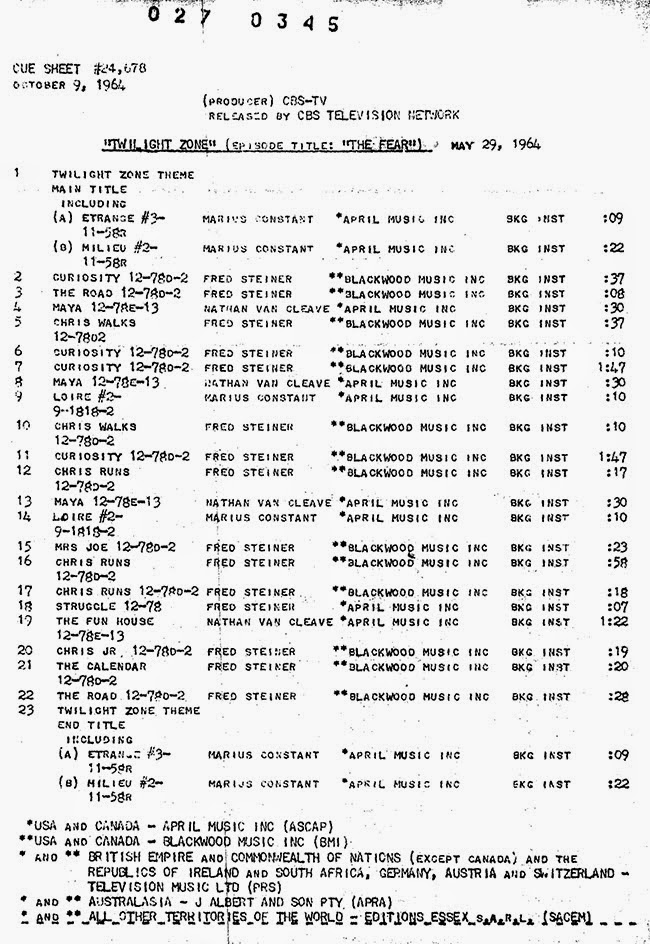
“The Fear” is stock-scored, meaning that the underscore is a patchwork of pre-existing recordings from the CBS Music Library, comprised mostly of Fred Steiner cues (from “King Nine Will Not Return” and “A Hundred Yards over the Rim,” both from season two). We also hear “Maya” and “The Fun House” from Nathan Van Cleave’s score for season one’s “Perchance to Dream.” Hearing music from the show’s earlier days this close to the end is a welcome touch indeed (though I doubt that was the intent), and I’m happy to report that the various cues mesh pretty well together, despite originating from three different scores. While “The Fear” doesn’t feature an isolated music track on the DVD and Blu-ray releases of the series, all three of those earlier scores have been released multiple times over the years, on both vinyl and CD, from both Varese Sarabande and Silva Screen Records. The Definitive DVD and Blu-ray releases of the first and second seasons also include isolated music tracks for all three episodes, so if one wanted to piece together a soundtrack for “The Fear,” the resources are easily obtained (except for that short little Marius Constant bit, dammit).


.
DRAMATIS PERSONAE

Trooper Robert Franklin is played by Mark Richman in his only Twilight Zone appearance. Richman has extensive genre experience, including roles on The Outer Limits (“The Borderland” and “The Probe”), Alfred Hitchcock Presents (“Man with a Problem” and “The Cure”), The Invaders (“The Leeches” and “Inquisition”), The Incredible Hulk (“Triangle) and, a bit more recently, Star Trek: The Next Generation (“The Neutral Zone”).

Richman with TZ alum Susan Oliver.

Charlotte Scott is played by the beautiful Hazel Court in her only Twilight Zone appearance. Genre fans can spot her in four episodes of Alfred Hitchcock Presents (“The Crocodile Case,” “The Avon Emeralds,” “Arthur,” and “The Pearl Necklace”) and one episode of Boris Karloff’s Thriller (“The Terror in Teakwood”). On the big screen, Court can be seen in 1957’s The Curse of Frankenstein from Hammer Films, not to mention a trio of Roger Corman adaptations of Edgar Allen Poe stories (1962’s The Premature Burial, 1963’s The Raven, and 1964’s The Masque of the Red Death). Did I mention that she’s beautiful? She’s definitely a TZ Babe, make no mistake. *Sigh*


The part of the giant Cyclops “alien” is played by a BIG GODDAMNED BALLOON which, to my knowledge, never worked in television again (though it would’ve been positively smashing in the Macy’s Thanksgiving Day Parade, right?).


“The Fear” was the final Twilight Zone episode to be filmed (“The Bewitchin’ Pool,” the final episode aired, was shot earlier but took longer to complete in post-production; more on this when we get to it), and it definitely feels like the show is running on fumes as it lurches toward the finish line. It’s not exactly terrible, but it’s nowhere near good: like the aliens’ giant balloon, it’s ultimately a bit flat.


Next:
There’s only one new episode left of the entire series… but you’re gonna have to wait
three weeks for it. Talk about cancelus interruptus….


Thursday, May 15, 2014

Episode Spotlight: "The Brain Center at Whipple's" (5/15/1964)


Season 5, Episode 33 (153 overall)
Originally aired 5/15/1964
Cayuga Production # 2632


Wallace V. Whipple is gleefully automating his factory, boosting profits but forcing scores of loyal employees into unemployment. Chief engineer Hanley is righteously horrified, but it ends up being plant manager Dickerson who steps up and takes action: he gets himself plastered late one night and attacks one of the computer banks in the soulless factory. Whipple grabs the night watchman’s pistol and puts a nonfatal bullet into him to protect his investment.


Hanley is let go shortly thereafter, followed by a programmer who complains that the factory is too quiet. Alone, Whipple goes stir crazy in short order and, when one of the machines malfunctions, he loses his cool altogether.


Whipple finds Hanley in a nearby tavern some weeks later, and informs him that he too has been phased out… and replaced by a machine. He laments about man’s obsolescence in the face of technology, finally experiencing first hand the misery that his greed has created. We close on Whipple’s replacement, a rather familiar automaton…


Rod Serling’s “The Brain Center at Whipple’s” (which turns fifty years old tonight) reaches for meaning in its exploration of man’s dependence on --- and possible subjugation by --- the machines he builds for his own convenience. It’s certainly a potent concept, one we’ve seen pop up multiple times this season, but here Serling renders it all but mute beneath the overblown, at times near-histrionic, speechifying the characters engage in. After a while it’s all just noise. We want to sympathize with Joe Six-pack (er, Dickerson), but by the time he’s done with his drunken rant, I kinda wanted to shoot him too. Hanley comes out the hero of the piece, but he doesn’t actually do anything but occupy the moral heart of the piece; nothing he says makes a damn bit of difference.  The worst offender is Dickerson, whose drunken rampage is made all the creepier by the fact that he stares directly into the camera for a really long time.


The direction by Richard Donner is serviceable, actually decent in spots (I do enjoy the montages, but I guess that’s more editing than direction). And it’s a pretty small detail, but I love the fact that the neon Whipple sign is visible through the window of the nearby bar (this may be more set-decoration than direction). And Hanley’s surprise slapping of Whipple is quite convincingly staged (there; that’s gotta be thanks to Donner, unless there was a stunt coordinator on the set). Donner will be back next week for “Come Wander with Me,” which is much more stylish.

The final scene in Whipple’s office, in which things have clearly began to unravel, contains what I can only assume is an intentional sight gag. The walls are covered with hand-written equations and formulas; presumably Whipple has been feverishly trying to figure out even more ways to maximize efficiency around the plant. Given the episode’s obvious cautionary-tale angle, we’re seeing the literal “handwriting on the wall.” But y'now... if I zoom in on the picture, the writing looks more like scratches. So hell, what do I know?


If the super computers around Whipple’s plant look familiar, it’s because we’ve seen variations on them twice this season (“The Old Man in the Cave” and, more recently, “From Agnes – With Love”). They have less personality here, which I suppose is appropriate (Agnes, by contrast, was positively alive); I suppose they’ll be more interesting to look at when they eventually attain sentience, maybe after Whipple’s factory is taken over by Cyberdyne Systems.

.
THE MUSIC


“The Brain Center at Whipple’s” is stock-scored almost exclusively with cues by Marius Constant, who of course is responsible for the famous Twilight Zone theme used for four of the show’s five seasons. The cue titles (“F Story,” “A Story,” “D Story,” etc.) suggest that they all come from the same work, but I couldn’t tell you what it is. I’m guessing it was composed specifically for the CBS Music Library to be used for a variety of purposes (remember, Constant’s TZ theme is actually two pieces of stock music spliced together). I should also note that Constant composed two original scores for the 2003 UPN Twilight Zone series (for the episodes “Burned” and “Rewind”); I must admit this is a cool historical note, even though I pretty much despise the UPN series.

.
DRAMATIS PERSONAE

Richard Deacon stars as Wallace V. Whipple in his only TZ appearance; he’d cross paths with Rod Serling again in 1973 on Serling’s Night Gallery (“How to Cure the Common Vampire”). Genre fans may also recall his role as Dr. Bassett in 1955’s Invasion of the Body Snatchers (which starred TZ alum Kevin McCarthy); eagle-eyed viewers might also have glimpsed him in This Island Earth that same year (he had an uncredited bit part as a pilot). Most TV viewers probably remember Deacon best as Mel Cooley on The Dick Van Dyke Show (1961-66).


Mr. Hanley is played by Paul Newlan in his only TZ appearance. Newlan has a secondary Rod Serling connection: he appeared in 1956’s The Rack, the big-screen adaptation of Serling’s 1955 teleplay for The United States Steel Hour, in which he shared the screen with several future TZ alums, including Anne Francis, Lee Marvin, and Cloris Leachman. Newland doesn’t have much else in the way of genre credits, but he did appear on Boris Karloff’s Thriller an impressive four times (“The Big Blackout,” “The Cheaters,” “The Grim Reaper,” and “The Remarkable Mrs. Hawk”).


That drunken lout Dickerson is played by Ted de Corsia, who played Marty Sall way back in season one’s “The Sixteen-Millimeter Shrine.” De Corsia also did two tours on The Outer Limits (“It Crawled Out of the Woodwork” and the two-part “The Inheritors”). His other genre appearances include The Alfred Hitchcock Hour (“The Magic Shop”) and the aforementioned Thriller (“The Fingers of Fear”).


Robby the Robot (Dion Hansen) makes his second TZ appearance (he had a much more prominent role in “Uncle Simon” earlier this season) and, in doing so, gives us one more Forbidden Planet alert! before the series ends in a few short weeks. Bittersweet? Definitely.

Robby with TZ alum Earl Holliman.


In perusing the cast list for this episode, I was momentarily excited to see that the part of “Night Watchman” was played by none other than suave 70’s game show host Bert Convy… until I read it again. It’s Burt Conroy, playing the night watchman at Whipple’s factory. I’m not gonna lie… I’m a bit disappointed.


L.A. artist (and super nice guy) Woody Welch has shared several TZ sketches and paintings via his Facebook page in recent months, including a great sketch of Mr. Whipple himself, Richard Deacon. Woody has an uncanny knack for capturing facial likenesses, and this is no exception. Oh, and here’s a Welchified Robby the Robot too!


.

“The Brain Center at Whipple’s” is generally maligned by reviewers, but I don’t dislike it. Its main fault is the usual over-written Serling dialogue which, despite its inflated nature, still manages to crackle here and there. The performances are fine, it looks nice… and hell, we get another Robby the Robot cameo. I just can’t hate it.

Couldn’t happen, you say? Look at that smartphone or tablet in your hand, and reflect on much you rely on it. Maybe it’s not banks of computers or bulky robots that have subjected us, but we’re very clearly ruled by the technology we’ve created.


Next week:
A conniving rockabilly singer runs afoul of some scary mountain folk. Probably not a comedy.