Showing posts with label TZ Opening Sequence. Show all posts

Tuesday, September 24, 2013

Season 5 Opening Sequence


In a break with tradition, a new opening sequence was not created for The Twilight Zone’s fifth season (perhaps because the season four opening sequence had only been used for eighteen episodes, and they wanted to get their money’s worth). The existing opening was retained for the entirety of season five, which meant that it was attached to a total of 54 episodes, the most of any of the five opening sequences created for the series (season one had two, remember). Go here for the breakdown of the season four (and five) opening.


Left to right: season 1, season 1a, season 2, season 3, seasons 4-5.


Where season five differs is on the opposite end of the reel:  the end credits.


Gone is the starry black background; rather, an episode-specific still shot is used (as was the case for the first three seasons). An odious form of advertising appears this season: actual products (a tube of Crest toothpaste, a pack of Pall Malls, etc) are shown during the end credits of most episodes. These episodes find the end titles, normally centered on the screen, off-centered to create a dead area to accommodate the product on display.


Smoke up, Sulu.


In the case of "Spur of the Moment," a Red Cross ad is actually spliced directly into the end credits:


On the sonic end of things, Bernard Herrmann’s re-orchestration of Marius Constant’s TZ theme (from season three, detailed here) returns in shortened form, minus the ubiquitous “doo-doo-doo-doo” riff (it's "Milieu 2" on its own, without its usual partner-in-crime "Etrange #3"):


This version graces the end credits of 9 season five episodes:

In Praise of Pip
Steel
Nightmare at 20,000 Feet
The Last Night of a Jockey
The Old Man in the Cave
Uncle Simon
The 7th Is Made Up of Phantoms
Night Call
The Masks

As for the other 27 episodes, 26 of them feature a shorter version of the standard Constant theme which, despite being shorter overall, features a longer-than-normal chunk of "Etrange #3 (the aforementioned "do-do-do-do" riff). And finally, "Spur of the Moment" uses an even longer version of the standard Constant theme (to accommodate the Red Ad cross, shown above).

Got all that? Okay, bring on season five!


Tuesday, January 1, 2013

Season 4 Opening Sequence (1963)


A new season of The Twilight Zone usually means, among other things, a new opening sequence.  It was decided to contextualize the elements in Rod Serling's revised opening narration with actual objects (in order: door, window, eyeball, Einstein's Theory of Relativity, mannequin, clock).  The whole thing would crescendo with the appearance of the series name, which had inexplicably become, simply, Twilight Zone (dropping the word The).  Compared with the relative austerity of season 3's singular, spinning spiral, the new opening is positively bursting with diverse imagery.

This new opening sequence ran roughly five seconds longer than those of seasons two and three, so the existing theme music (Two library cues by Marius Constant, "Etrange No. 3" and "Milieu No. 1," spliced together) was now too short.  The existing end theme ("Etrange No. 3" and "Milieu No. 2" spliced together) was re-edited to create the new opening theme; unfortunately, the result lacks the frenetic urgency of its predecessor.

Let's break it down, shall we?


You unlock this door with the key of imagination. 


Beyond it is another dimension.


A dimension of sound.


A dimension of sight.


A dimension of mind.


You've moving through a land of both shadow and substance...


...of things and ideas.


You've just crossed over into...


...The Twilight Zone.


(dissolve to opening scene)


Here it is in full motion:


This opening sequence would carry forward into season 5, making it the most used --- and probably most recognizable --- of them all.  It's my least favorite, truth be told... probably because I've seen it so many times.

The new opening sequence is only one of several major changes --- cosmetic and otherwise --- that season 4 will bring.  Stay tuned.


Tuesday, March 13, 2012

Season 3 Theme Music Revision (1962)


Those who lamented (or continue to lament, to this day) the switch from Bernard Herrmann’s moody theme music to the frenetic, bouncy (and, admittedly, much more famous) offering by Marius Constant starting with The Twilight Zone’s second season should get a kick out of this.

When Herrmann was called in to score season three’s “Little Girl Lost" (which we'll be spotlighting on Friday), he went the extra mile and re-recorded the Constant theme (both opening and closing pieces) with decidedly different instrumentation; hell, “decidedly different” is putting it mildly. Check it out:


Pretty wacky, eh? Brittle, electronic... it almost sounds like an Esquivel recording. I like to think that this was Herrmann’s way of thumbing his nose at Constant for supplanting him as the show’s theme music provider (Herrmann was certainly known for not always playing nice). Cayuga apparently liked his rendition enough to switch over to it for most of the remaining season three episodes.

Herrmann's take on Constant's end title music, meanwhile, survived for a mere five weeks before Constant's recording was reinstated. Here it is:


Interestingly, a number of season five episodes contain a variation on Herrmann's version of the Constant end title theme, but it sounds like different recording. I have no idea where it came from... but hey, we'll deal with it when we get to season five (Autumn 2013!).


Tuesday, December 6, 2011

Spotlight: Icons of The Twilight Zone bobblehead (Bif Bang Pow!)


Bif Bang Pow! continues its wonderful line of Twilight Zone bobbleheads with something completely unexpected. I mean, they thought WAY outside of the box on this one. This may be the first bobblehead in history, TZ or otherwise, that's neither a character or a vehicle. It's not an alien, or a robot, or a spaceship, or a Dharma Initiative polar bear, or a TIE Fighter, or Charlie Sheen, or even Jesus. Nope, it's....


...well, what is it, exactly? For guidance, we'll look to the piece's name: Icons of The Twilight Zone: Five Unforgettable Symbols Synonymous with The Twilight Zone.


It's a monolith of sorts, incorporating iconic images from the various opening sequences used throughout the series' five-year run. The central 2-dimensional image is the door from seasons 4-5 ("You unlock this door with the key of imagination..."), surrounded by a starfield. From there, five distinct objects float out in front, three of which bobble on springs.

Clockwise, from... well, the clock:

Bobbling Clock (from seasons 4-5)

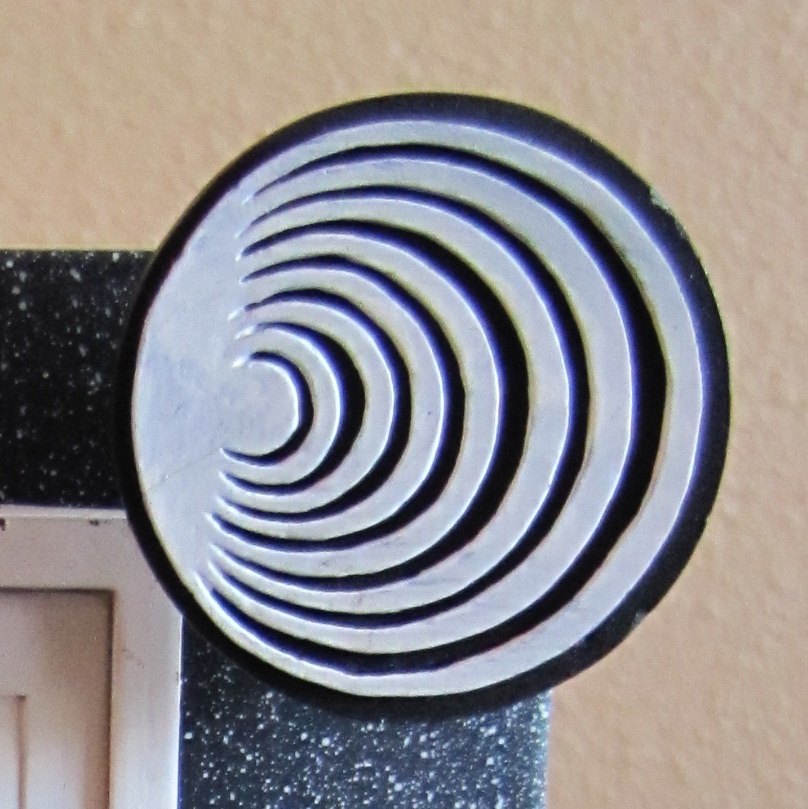
Bobbling Spiral (from season 3)


Eyeball (from seasons 4-5)


Bobbling Einstein's Theory of Relativity (from seasons 4-5)


Flying saucer (from several episodes;
most prominently season 3's "To Serve Man")


The eyeball and flying saucer do not bobble; rather, they are held in place by thin dowels, and can be turned to any angle you choose.


The Twilight Zone logo is attractively sculpted on the back of the piece. In fact, the backside looks nice enough to display on its own. Now there's a reason to get two!

Help! I've fallen and I can't get up!

This piece weighs 15.5 ounces; however, it seems all the weight lies at the front, which makes it extremely prone to falling forward. I'd suggest slipping something thin under the front edge to balance it out. I'm planning to stick a few rubber self-adhesive bumper feet under mine:


Balance issue aside, this is a frankly gorgeous piece. A Comic-Con exclusive, this particular item is ALREADY sold out over at Entertainment Earth. You can probably find one elsewhere (eBay, etc), but if you're at all inclined to track one down, I'd jump on it sooner rather than later. In fact, I need to find myself a backup... just in case.

Dali print not included.


Wednesday, September 14, 2011

Season 3 Opening Sequence (1961-1962)


The third season of The Twilight Zone premiered on September 15, 1961, and with it came a brand new opening title sequence. The theme music by Marius Constant remained the same (until late into the season, when a decidedly different rendition would appear... but we'll get there in time), and Rod Serling's opening narration was only minimally revised. Season three's opening sequence, designed by Pacific Title (thanks to fellow fan --- and fellow Portland native --- Joel Henderson for this tidbit of info), is the simplest of the entire series. It's literally one single object --- a spinning top of sorts ---spinning away from camera, off into space. And yet, in its simplicity, it manages to evoke a surreal, almost trancelike vibe.

The spinning spiral, by the way, was not new to The Twilight Zone. We saw it way back in season one's "Perchance to Dream," framed by a dreamlike fog. Coincidence? Perhaps.


Okay, let's break it down. Cue the music.

You're traveling through another dimension...

A dimension not only of sight and sound...

...but of mind.

A journey into a wondrous land whose boundaries are that of imagination.

Your next stop---

The Twilight Zone!


Here it is in full-motion glory, down-rezzed into a fuzzy mess by Blogger...


That distinctive spiral appears on the covers both the DVD and blu-ray editions of season three from Image Entertainment.


Thursday, April 28, 2011

TZ Promo: "The Silence" (4/28/1961)


“The Silence” (4/28/1961)
Season Two, Episode 25 (61 overall)
Cayuga Production # 173-3658


Fifty years ago tonight, a most unusual challenge was thrown down… with devastating results for both men involved.

“The Silence,” written by Rod Serling and directed by Boris Sagal, concerns a rather simple (albeit highly unusual) wager that boils down to the following: if you shut up for a year, you’ll get half a million dollars.


Archie Taylor, an esteemed member of an exclusive gentleman's club (which looks a lot like the one Russell Johnson belonged to in “Back There”), is fed up with fellow member Jamie Tennyson’s constant yammering. Yammering doesn’t quite cover it. As we see in the episode’s prologue, Tennyson is an obnoxious bore of the worst kind. Worse, he has nothing of substance to say. Sound like anybody you know? (A pin drops somewhere nearby, while crickets chirp softly in the distance)


Tennyson is in financial straits, so he accepts Taylor’s wager. To keep Tennyson honest, Taylor has a glass enclosure built in the club’s basement, which will serve as Tennyson’s living quarters during his year of silence. And so we go from there.


It’s a pretty riveting story; however, it’s pretty atypical for The Twilight Zone. There’s no fantasy or science fiction element here and, while the ending is a bit horrific (no, I won’t reveal it), it’s completely within the realm of possibility. In short, this stuff could really happen. As such, “The Silence” feels more grounded than most episodes (the same can also be said of season three’s “The Shelter” and season five’s “The Jeopardy Room”). Perhaps this is why Marius Constant’s “Mileu #2” is played during the episode (in addition to its usual appearance during the closing credits)… you know, to remind people that they’re watching The Twilight Zone and not Alfred Hitchcock Presents (this was only done one other time in the entire series, in “A Thing About Machines”).


As Tennyson’s year of quiet isolation drags on, we are treated to the old cinema trick of showing timekeeping objects to indicate the passage of time (this approach was brilliantly parodied in the 1982 film Top Secret!, in which pages fly violently from a calendar, the result of a gust of wind coming in through an open window and not time rushing forward). The device is unfortunately overused here. We see ticking clocks. We see a calendar. We also see the names of months superimposed over the action (sheesh, hit us over the head, why don’tcha?). I should also note that the “honeycomb fog” effect used in the opening title sequences from the first two seasons is incorporated into these time-passing bits. Why? I dunno, maybe to remind us (again) which show we’re watching.


Franchot Tone is fine as Taylor, whom we initially sympathize with… but grow to hate as the story progresses and his capacity for cruelty unfolds. Liam Sullivan is appropriately repellant as Tennyson (he looks a bit like Cary Grant in a few shots; it’s probably the ascot). Jonathan Harris (Dr. Smith from TV’s Lost in Space) makes his second TZ appearance as Tennyson’s lawyer and advisor, serving as the story’s de facto conscience.


All in all, “The Silence” is a worthwhile episode (it’s not in my Top 40, but it’s still quite good). And, like every other episode (except for the videotaped six), it looks absolutely stunning in high definition. If you haven’t started upgrading your collection to blu-ray, you’re really missing out (and no, I don’t work for Image Entertainment). The screen captures I use for this blog are pulled from the earlier Definitive Edition DVDs. I do have a blu-ray drive in my laptop, but so far I haven’t figured out how to do screen captures with it. Hopefully by the time season three starts up in September, I’ll be wowing you weekly with true high-def images.


Next week: “You’re bound to think it’s a dream; if not, you think it’s a nightmare.” One of my Top 10 favorite episodes of all time celebrates the big 5-0. Not to be missed.


Wednesday, September 29, 2010

Season 2 Opening Sequence (1960-1961)


After an incredible first season, a few changes were made for The Twilight Zone's second round, most notably the music. Season 1 utilized two distinct versions of Bernard Herrmann's ominous theme but, starting with Season 2 (and continuing throughout the remainder of the series), Herrmann's theme was jettisoned for something altogether different...

Two unrelated pieces of library music ("Etrange No. 3" and "Milieu No. 1") by French avant-garde composer Marius Constant were spliced together to create one of the most recognizable TV themes in history. On 9/30/1960, American audiences heard this new theme for the first time, and it went on to personify the series every bit as much as Rod Serling's unmistakable clenched-teeth narrative voice. Every one of us, at some point in our lives, has undoubtedly hummed, whistled, or otherwise mouthed that classic melody ("Doo doo doo doo, doo doo doo doo") when faced with a bizarre or uncomfortable situation. You know, those Twilight Zone moments. As much as I love the work of Bernard Herrmann, I can't deny the power of Constant's theme. It's effect is immediate. You know what you're in for as soon as you hear it.

Along with new theme music came new visuals. The season 2 intro is actually a melding of season 1's openings, smashed together and compressed for time. The wispy, honeycomb-like tendrils of fog that opened the standard season 1 opening are here, as is the black-line horizon with the setting sun from the alternate season 1 opening. In fact, these two elements are pretty much all we see, except for the new way the Twilight Zone logo appears at the climax: it springs up out of nowhere, as if on an invisible hinge, and flies straight toward us, smashing to bits at the last possible second, as if we've driven right through it. The Twilight Zone title logo, incidentally, is identical to the one used in the standard season 1 opening (with regards to the font; it's also the same version of the TZ logo I use in the interchangeable photo collages featured at the top of this blog). The final three seasons will use different title logos, but we'll get to those in time.

Compared to the elaborate visuals of the standard season 1 intro, the new opening is pretty basic. But is it effective? Absolutely. It's snappier, propulsive, and it gets us to the story faster.

Here's the breakdown:

You're traveling through another dimension...

...a dimension not only of sight and sound...

...but of mind.

A journey into a wondrous land of imagination...

Next stop ---

--- The Twilight Zone!


(pan down to opening scene)


Here it is in full-motion glory, sadly down-rezzed by Blogger...


Season 2 also brought a MAJOR visual change that would last throughout the remainder of the series. We'll discuss that in tomorrow's entry, as we spotlight the season 2 premiere, "King Nine Will Not Return," on the 50th anniversary of its first broadcast. I'll give you a hint: It involves the relative visibility of a certain creator/executive producer/narrator....