Showing posts with label Martin Grams. Show all posts

Thursday, January 31, 2013

TZ Promo: "Mute" (1/31/1963)


Season 4, Episode 5 (#107 overall)
Cayuga Production # 4858
Originally aired January 31, 1963

Before we start, notice anything strange about that title card?  That lettering is positively GIGANTIC.  Okay, the title is a measly four letters long, but other short-titled episodes didn't get an oversized card (“Dust” and “Two,” for example). Oddly enough, the title is regular-sized in the end credits.  After the missing quotation marks two weeks ago (“Valley of the Shadow”) and now this, I’m starting to think Pacific Title had a gremlin on staff, tampering with their output.


Richard Matheson’s “Mute” opens on a clandestine meeting in which several couples enter into a secret pact to raise their children in silence, to (hopefully) promote telepathy.  It’s not disclosed if this consortium has already achieved some success in this rather peculiar endeavor, or if they’re flying completely blind.  It’s so crazy, it might just work.


And work it does.  Fast forward ten years to a house fire in the quaint little town of German Corners, PA.  A young girl, Ilse Nielsen, is found outside the house, safe and sound, while her parents are charred to a crisp inside.  Volunteer fireman-slash-town sheriff Harry Wheeler brings the girl home temporarily until her disposition is decided.  Ilse doesn't speak to anyone, but she can hear them plainly enough, and through a series of telepathic flashes, we see that this kid is the real deal.  Cora, Ilse’s new foster mother, dotes on her to the point of hysterical obsession (we discover that the Wheelers’ only child drowned, so I guess we can cut her a bit of a break… just a bit now); meanwhile, her new schoolteacher, Miss Frank, apparently wants to eat her for lunch, piece by quivering piece.


What we have here is your basic fish-out-of-water story.  Will Ilse retain her unique individuality, or will she go native and start talking like the other chimps in town?  My God, the suspense is unbearable! Okay, I’m being a bit flippant here, but there actually is a fair amount of tension throughout. We immediately identify with Ilse (especially compared with the rest of the characters), so naturally we want and hope for the best for her… but what exactly is best for her?  That’s the question at the heart of this story, and unfortunately Matheson gets it completely and utterly wrong.


 Extra crispy.


The episode succeeds best in those moments in which we’re offered glimpses inside Ilse’s thoughts (she’s able to  highjack someone else’s eyes to witness the discovery of her parents’ charred corpses, for example). The shrill echo effect used to represent how Ilse hears spoken voices is effective (if it’s harsh on our ears, imagine her discomfort!).   


Ilse is well-played by Ann Jillian, acting mostly with her eyes. Jillian, who would grow up to be a staggeringly beautiful woman, is probably best known for playing herself in The Ann Jillian Story, a 1988 TV movie chronicling her battle with breast cancer (for which she won a Golden Globe and an Emmy nomination).  Is it creepy to consider her a TZ babe?  Probably, since for our purposes she’s a kid.  Dammit.


Frank Overton plays Harry Wheeler with what appears to be an all-consuming resentment for everything and everyone.  We last saw Overton in season one’s “Walking Distance,” in which he wasn't nearly as cranky.


The highly annoying and frequently-hysterical Cora Wheeler is played by Barbara Baxley.  She’ll return to The Twilight Zone 23 years later in “Profile in Silver” (incidentally one of my favorites of the revived series).  Don’t worry; she’s not nearly as gratingly manic there.  Maybe she’s mellowed with age…?


Twilight Zone veteran Oscar Beregi (“The Rip Van Winkle Caper,” “Deaths-Head Revisited”) essays the Karl Werner role competently enough, but it’s the least interesting of his three TZ roles.  Blame Matheson’s script, which doesn't give an actor of his magnitude nearly enough to do.


Irene Dailey is quite effective as Miss Frank, the teacher-from-hell who misdiagnoses Ilse’s unique condition and relentlessly badgers her to speak.  Dailey is best remembered for her work on TV’s Another World (which I've never seen, so I can’t comment on her work there.  Days of Our Lives, on the other hand, well… that’s another story).


The fire at the Nielsen residence is well-staged (that’s a real fire, folks), which adds some nice production value.  However, some unintentional comedy arises from Percy Helton’s cameo as a firefighter on the scene.  Helton is impossible to miss in anything he ever did, given his comically raspy voice (imagine a slightly-less obnoxious Andy Devine).  We’ll see (and hear) him again in season five’s “Mr. Garrity and the Graves.”


If the sight of Ilse fleeing the house and out into traffic seems painfully familiar, it’s because we just saw the exact same scene played out a mere seven episodes ago, in season three’s “I Sing the Body Electric.” Both were shot on the same city park/town square set (MGM Lot 2; thanks again, Martin Grams!), and both use almost-identical shots:


I've been talking about the series’ visual identity a lot lately, examining the recurrence of specific imagery across multiple unrelated episodes, but I think this crosses the line a bit (a lot, actually).


“Mute” is the first episode of the fourth season to feature an original music score.  Fred Steiner (who will contribute a full two-thirds of the original scores in this abbreviated season) delivers a compelling work heavy on the strings (particularly the viola) with the occasional harp flourish thrown in for good measure.  The cue used at the start of the prologue (a zither piece that sounds like a reject from Anton Karas’ score for The Third Man) isn't by Steiner, though: it’s an uncredited library composition called "Peasant Waltz" (see cute sheet above). Steiner scored a total of seven Twilight Zone episodes (including season three’s "The Passersby," which is easily one of my top 5 favorite TZ scores), matching the output of Bernard Herrmann and Jerry Goldsmith, but he’s probably best remembered as the composer of the themes for both Perry Mason and The Rocky and Bullwinkle Show.


“Mute” is ultimately hard to watch because so many of the characters are just plain unpleasant. Sheriff Wheeler is gruff to the point of cruelty, his wife Cora is a trembling basket case set to erupt at the drop of a hat, and Miss Frank, Ilse’s school teacher, is an unabashed sadist.  Ilse’s struggles are primarily due not to the loss of her parents, but to the emotional and psychological chaos inflicted upon her by these three individuals, chaos that will undoubtedly continue after the end credits roll.  The script implies that Ilse’s unconventional upbringing is a form of abuse, and that her new life in German Corners represents her salvation, but Matheson completely wrecks it by making her saviors so toxic. If Ilse’s new parents were Jonathan and Martha Kent, I might feel differently… but they aren't, and I don’t.


The climactic moment when Ilse finally capitulates and speaks is effective enough from a dramatic standpoint, but impossible to accept as a triumph.  We could argue the questionable merits of the consortium’s antisocial (and anti-verbal) methods, but at the end of the day, they've figured out how to cultivate and promote telepathy, and the profound implications therein demand further research and development.  By leaving Ilse in German Corners, the Werners both squash her budding talent and abandon her in an emotionally hostile environment.  So yeah, even the well-meaning Werners, who came to America to save Ilse, end up screwing the poor kid over like everybody else.  The girl can’t win.


I would've liked to see Ilse’s telepathy explored more; and perhaps expanded to include telekinesis.  I’d love to see her wreak some good old fashioned havoc on German Corners (maybe toss that bitch Miss Frank out a window or something).  At the very least, maybe a quick end scene suggesting that Ilse will continue developing her talents on her own, in secret…. yeah, that might've made quite a difference.  As it is, “Mute” ends with Ilse smiling contentedly, which is supposed to signify a happy ending… but it’s anything but that.  Despite the window dressing, we've just watched a goddamned tragedy unfold before our eyes.


Next week:  Matheson redeems himself with season four’s finest episode.  Three guys in a flying saucer land on a remote planet and face the darkest horror imaginable.  Not to be missed.


Thursday, January 10, 2013

TZ Promo: "The Thirty-Fathom Grave" (1/10/1963)


Season 4, Episode 2 (#104 overall)
Cayuga Production # 4857
Originally aired January 10, 1963


Yawn.

After last week’s engaging “In His Image,” The Twilight Zone brings us what might have been an intriguing ghost story, but instead emerged as a maritime exercise in seafaring tedium.


“The Thirty-Fathom Grave” concerns a naval destroyer whose sonar picks up a clanging sound thirty fathoms below.  It turns out there’s an American submarine down there, half buried in the sand.  A couple of dives later, it’s determined that the sub is one torpedoed by the Japanese during WWII.  Coincidentally (or not), a crew member on the destroyer was also the sole surviving crew member on that ill-fated sub, and that incessant clanging is driving him six kinds of crazy.


This could’ve been a nice little paranormal excursion of the nautical variety, like season one’s “Judgment Night,” but it’s severely overlong at the show’s new hour length.  It…. just…. drags.  By the time we get to the denouement, when the source of the mysterious undersea clanging is revealed, it’s not enough to justify the hour we've just spent waiting for it.  The episode does achieve quite a bit of production value by shooting on an actual US destroyer, not to mention the impressive miniature work employed for the exterior submarine scenes (the close-ups were shot in an actual underwater tank; equally impressive).  And the core story is actually a pretty good ghost tale, but Serling’s supersized script kills it before it ever gets out of the dock.  As presented, “The Thirty-Fathom Grave” is dead in the water. 


A-ha! In his wonderfully detailed The Twilight Zone: Opening the Door to a Television Classic, author Martin Grams reveals that Serling originally wrote “The Thirty-Fathom Grave” as a half-hour script, then expanded it to suit the show’s new format.  Well shit, this could’ve been a pretty great episode after all.  Kinda makes me want to create a “lost” 25-minute version.  I do have the necessary software at my disposal.  I’m just sayin’.


Happily, the cast is pretty decent.  Character actor Simon Oakland, last seen in season two’s “The Rip Van Winkle Caper,” is his usual gruff-but-compassionate self as Captain Beecham.  He’s probably best remembered as Captain Schrank in 1961’s West Side Story, not to mention 1960’s Psycho.  In fact, it was his role in Psycho that subsequently led to his appearance as the Empyrian, a birdlike alien, on The Outer Limits’ “Second Chance” four years later. Oakland was also a regular on TV’s Kolchak: The Night Stalker, and he died after a long battle with cancer in 1983.


...and speaking of The Outer Limits, diver McClure is played by John Considine, who played the stoic Bertram Cabot from “The Man Who Was Never Born,” one of that series’ finest offerings).


Crewman Bell, the ship’s resident guilt-ridden basket case, is effectively and twitchily played by Mike Kellin, another character actor who appeared in countless TV series throughout the fifties, sixties and seventies.  Coincidentally, Kellin was a real-life Lieutenant Commander in the US Navy during WWII (typecasting, perhaps?).  Like Oakland, he died of cancer in 1983.


We also see Bill Bixby in a minor role as the Officer of the Day.  For me, Bixby will always be Dr. David Banner, the beleaguered Jekyll to Lou Ferrigno’s Hyde on TV’s The Incredible Hulk.  I was a huge fan of the Marvel comic series, and became a devoted fan of the show when it premiered in 1977.  Bixby also starred in the earlier TV series The Courtship of Eddie’s Father and My Favorite Martian.  Bixby sadly died after a long battle with cancer in 1993.


Noticing a trend here?  Is there some kind of curse associated with this episode?  Was everybody exposed to something on that destroyer? On a serious note, it’s sobering to realize just how many Twilight Zone actors and crew members are now gone.  I guess it’s to be expected, since the series is over 50 years old now, but… damn.


“The Thirty-Fathom Grave” is by no means a terrible episode.  It looks great and it’s well acted, but ultimately it can’t overcome the ponderous script and bloated length.  File it under W for “waterlogged” and set sail, Cap’n.


Next week:  A machine that creates a ham sandwich out of thin air?  I’m so there.


*There’s a reason I keep pointing out Outer Limits connections.  ‘Nuff said for now.


Thursday, January 3, 2013

TZ Promo: "In His Image" (1/03/1963)


Season 4, Episode 1 (#103 overall)
Cayuga Production # 4851
Originally aired January 3, 1963

The revamped Twilight Zone launched fifty years ago tonight with Charles Beaumont’s “In His Image.” There’s really no way I can discuss the episode without spoiling it, so… fuck it, I won’t even try.  In fact, I’ll get it over with by very quickly encapsulating the proceedings:

Guy murders a woman in a subway in what appears to be a brief psychotic episode. Guy picks up girlfriend and drives to his hometown.  Lots of details about the town don’t jibe with his memory, and he has a couple more violent episodes as he tries to figure out what the hell is happening.  He eventually tracks down a man who appears to be his identical twin, but is actually his maker.  It turns out our troubled hero is a robot, one with an unfixable flaw that causes him to periodically go crazy.  Creator and creation clash in an epic battle, from which only one of them will emerge.

See, I didn't spoil everything after all (I guess I could just mentioned that Beaumont’s teleplay was based on his own short story “The Man Who Made Himself,” which is a spoiler in itself).


George Grizzard shines as both Alan Talbot (the creation) and Walter Ryder, Jr. (the creator).  The two are completely different personalities (Alan is humored and gregarious, while Walter is bitter and withdrawn), and Grizzard expertly inhabits both.  Hands down, this is one of my favorite performances in the series' five-year run.  Season two’s “Nervous Man in a Four Dollar Room” featured a similar two-sides-of-the-same-coin performance by Joe Mantell, but his excellent work was hampered by less-than-optimal rear projection.  Here, things are technically perfect. If there are split-screen seams, I sure as hell can't see them (not even under Blu-ray’s high-resolution microscope).


Grizzard appeared in many television series throughout the fifties and sixties, and was an accomplished theater performer (he won a Tony in 1996 for his work in the revival of A Delicate Balance (shown at left).  Genre fans may have spotted him on Alfred Hitchcock Presents, on which he appeared three times. More recently, he had a recurring role on TV's Law and Order, and his last appearance on film was in Clint Eastwood's Flags of Our Fathers in 2006, shortly before he passed away in 2007).

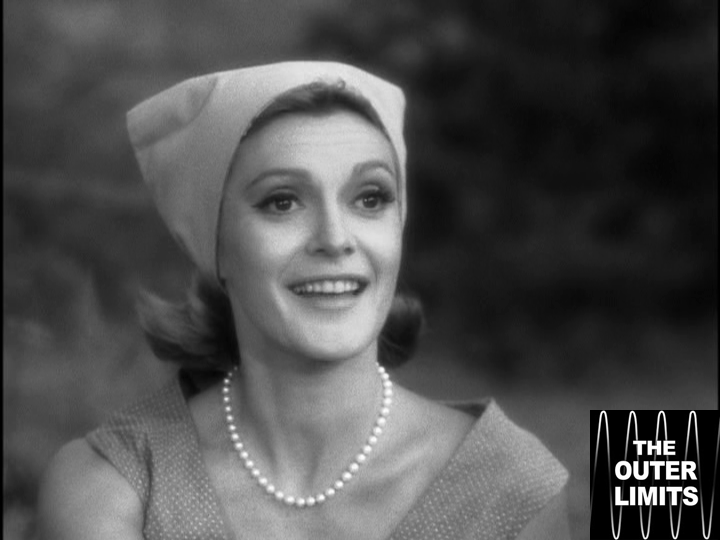
Alan's girlfriend Jessica is played by the lovely Gail Kobe.  TZ babe alert!  *sigh*  We caught a brief glimpse of her in season one’s “A World of Difference,” and we’ll see her again in season five’s “The Self-Improvement of Salvadore Ross.”  She’s equally delicious in two of The Outer Limits’ sillier endeavors (“Specimen: Unknown” and “Keeper of the Purple Twilight;” the latter has to be seen to be believed). 


At least The Outer Limits was kind enough to get her all wet for us.


Katherine Squire, last seen in season three’s “One More Pallbearer,” appears for a brief but memorable role as the crazy Christian lady who badgers Alan in the subway, and good God is she repellent.  This is "witnessing" at its most coarse and obnoxious; thankfully, Alan dispatches her by tossing her in front of an oncoming train.  Sometimes murderous rages can be productive after all.


The onset of Alan’s violent fits are conveyed to us via a cacophony of blips, bloops and buzzes (standard sci-fi gizmos-gone-crazy sound effects; apparently inaudible to others), along with a bright light that comes over his face (apparently invisible to others; it’s reminiscent of the “death light” depicted in season one’s “The Purple Testament”).  It’s all effective enough but, frankly, Grizzard’s tortured reactions would have sufficed, and kept things a bit more subtle.


When Alan arrives at Walter's residence for what will become an epic showdown, we're treated to a nice atmospheric shot of Walter sneaking up behind him in the shadows.  If this shot looks vaguely familiar, it may be because we've already seen Grizzard perform a very similar arrival in season one's "The Chaser."


I'm sure this wasn't done intentionally, but it's a marvelous piece of visual continuity regardless (one that Arlen Schumer apparently missed in his amazing Visions from The Twilight Zone coffee table book, in which he draws several visual parallels between images from various episodes. By the way, every true TZ fan needs to own this book. It's about twenty years out of print, but can easily be tracked down on Amazon or eBay).


When viewed as a whole, The Twilight Zone is positively bristling with compelling and iconic images; here we get one of my personal favorites. Upon receiving a forearm injury right before the midway act break, Alan slowly peels the skin back to reveal the first concrete hint about the mystery of his identity.

  Boom!  You’re a robot, dude.


The idea of a simulacrum carrying on in ignorance of its own artifice was almost certainly a sci-fi clichĂ© by the time The Twilight Zone tackled it (in season one’s “The After-Hours” and season two’s “The Lateness of the Hour”), but in the capable hands of writer Charles Beaumont, the concept never feels unoriginal or stale (Beaumont also wrote another surprise-it’s-a-robot story called “Last Rites” in 1955, an equally fine yarn that would've made a great TZ episode).  Harlan Ellison would employ this device in his 1965 Outer Limits teleplay “Demon with a Glass Hand” (which happens to be my all-time favorite TOL episode; maybe I’m a much bigger fan of surprise-robot stories than I realized).


Walter Ryder Jr.’s basement lab is a pretty impressive set, complete with the usual wall-sized computer terminals and assorted gadgetry.  Particularly effective is what appears to be a brick-lined incinerator unit in the wall, but is more likely some sort of finishing/activation chamber for Ryder Jr.’s mechanical offspring (speaking of which, check out those failed proto-Alans lying dormant on a double-wide gurney).


And hey, Forbidden Planet alert!  The notorious bank of Pac-Man lights, originally a piece of equipment in that film’s C-57D Space Cruiser, makes yet another appearance on the series. This prop was used previously in “People Are Alike All Over,” “Elegy" and “Third From the Sun." I'm betting we'll see it again before the series ends...


As the first double-length TZ episode aired, “In His Image” never feels overlong or bloated (an attribute which next week’s episode will sadly not share).  It’s an absolute winner, one of my top 20 favorites of all time.


Next week:  There’s something scary inside that wrecked submarine, so whatever you do, don’t go down there!  No?  Okay, whatever you do, don’t go down there twice!  Still no?  Okay, can we at least agree that you won’t go down there a third time?  Oh come on, seriously??!