Showing posts with label Jack Smight. Show all posts

Thursday, February 10, 2011

TZ Promo: “Twenty Two” (2/10/1961)


“Twenty Two”
Season Two, Episode 17 (#53 overall)
Cayuga Production # 173-3664


A Twilight Zone episode is usually easy to spot, even if you miss the opening titles. Richard Matheson said it best: “The ideal Twilight Zone started with a really smashing idea that hit you right in the first few seconds, then you played that out, and you had a little flip at the end; that was the structure.” * 50 years ago tonight, an episode premiered which followed this deceptively simple blueprint, but didn’t feel like a Twilight Zone at all.

“Twenty Two” (sans hyphen), written by Rod Serling and directed by Jack Smight, feels like CBS ran an episode of ABC’s One Step Beyond in some bizarre programming glitch. All the hallmarks are there: spooky music, premonitions of disaster (which of course come true), and a hook that isn’t so much supernatural as psycho-spiritual. Having said that, I don’t dislike the episode at all. It’s creepy, damn it. Who hasn’t had a nightmare in which they were invited to their own demise?


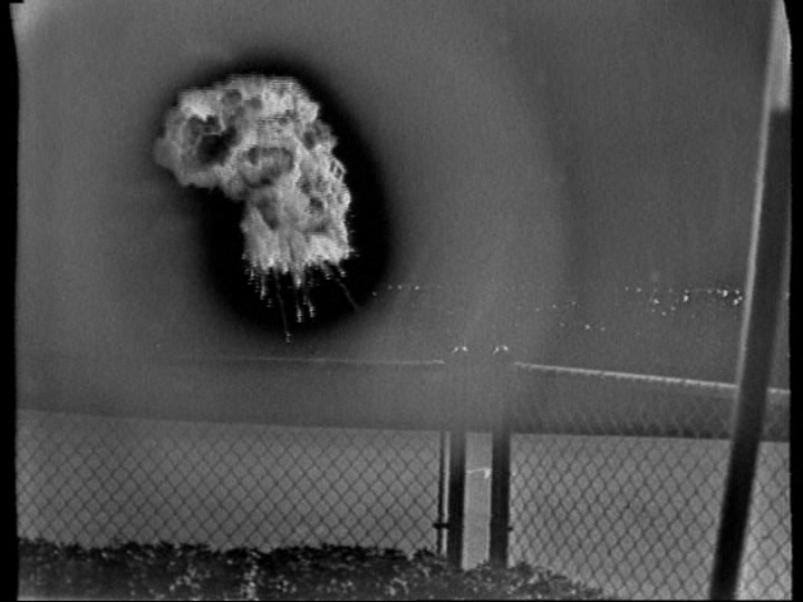
“Twenty Two” is one of six season two episodes that were videotaped instead of filmed, and the different (that’s being charitable) look contributes to the non-TZ vibe. It somehow works here, though…. The faux morgue set is impressive on video, but on film it might’ve looked fake. The same can be said of the exploding airplane in the finale.


This week’s damsel-in-psychological-distress is played by Barbara Nichols, who certainly has the, um, assets to play “the best little stripper-dancer that ever came down the pike” (as her agent describes her). In addition to screaming like a banshee and knocking over glasses of water on The Twilight Zone, she also appeared in 1957’s Sweet Smell of Success, a Burt Lancaster-Tony Curtis film noir that just came out on blu-ray from the Criterion Collection. No, I didn’t get paid for that plug (but I’d be happy to accept a free copy, if Criterion feels like sending me one!).


Forbidden Planet alert! Okay, this one is a bit of a stretch. The creepy doctor is played by Jonathan Harris, who we all know from TV’s Lost In Space!, the cast of which included the B-9 Robot, which was designed by Robert Kinoshita, who also designed Robby the Robot (the two 'bots certainly look related). Call it Two Degrees of Forbidden Planet.

Harris with Robby the Robot's cousin, the B-9. Oh, and there's Billy Mumy (a three-episode TZ veteran)!

The “spooky music” referenced above is made up predominantly of reused cues from Van Cleave’s “Elegy” score from season one. It works better here.

Room for one more, honey!

The freaky nurse is played by Arlene Martel (aka Arlene Sax), who is probably best known for her role as T’Pring, Spock's arranged wife-in-waiting, in Star Trek’s “Amok Time.” I know her best from my other favorite TV series of all time, The Outer Limits, where she played opposite Robert Culp in the wonderful “Demon with a Glass Hand." And speaking of The Outer Limits… well, stay tuned.


Two weeks from tonight: The Twilight Zone joins the mile-high club, in a manner of speaking. You won’t see any gremlins on the wing, but you might just see a brontosaurus if you get a window seat. Check in early.


* Matheson quote shamelessly cribbed from Marc Scott Zicree's The Twilight Zone Companion.


Thursday, December 23, 2010

TZ Promo: "The Night of the Meek" (12/23/1960)


"The Night of the Meek"
Season Two, Episode 11 (#47 overall)
Cayuga Production # 173-3663


The second of season two's six videotaped offerings, "The Night of the Meek" manages to transcend its humble production limitations and offer something truly remarkable. It's transcendent, period. I watch it every year around the holidays, where it stands proudly alongside such venerable classics as It's a Wonderful Life, White Christmas, and Miracle on 34th Street. Tonight, this delightful episode turns 50.


There is literally nothing wrong with this episode, which is a bit of a surprise, given that it's a light comedy by Serling (Serling and comedy mix about as well as oil and water). Art Carney is utterly charming, swimming in pathos but eager to please, as Henry Corwin, a drunken bum who, once a year, works as a department store Santa Claus (how he survives the rest of the year is a mystery).


John Fiedler is equally impressive as the prickish department store manager who berates him, fires him, then sics the cops on him. We dislike him, but we never really hate him. C'mon, it's Christmas. We don't hate anyone this time of year. By the end of the episode, we'll actually kinda like him.


1994's The Santa Clause stole its basic premise from this episode, which is my way of telling you how this episode turns out without actually telling you. 2003's Bad Santa, meanwhile, stole the idea of a drunk who works as a department store Santa. However, Henry Corwin is nothing like the slimy criminal that Billy Bob Thornton portrayed. He's a decent guy, terminally sad, usually drunk. He reminds us of Jack Klugman's Joey Crown, from season one's "A Passage for Trumpet."


In a strange way, the blurry videotape look actually works in the episode's favor. There's an immediacy to it, like live TV, and a spontaneous vibe that adds to the magic. The impressive set, which looks about the size of a full city block, is perpetually blanketed in falling snow.


And there are reindeer! REAL LIVE reindeer!


Our friends at Bif Bang Pow! have a Henry Corwin/Santa Claus action figure in the works (a prototype was shown at Comic Con in July; he's in the background above), but we likely won't see it till late 2011.... just in time for the holidays, I imagine.


Next week: Repeat city, folks. Season One's "A Stop at Willoughby" gets its second showing. In two weeks: We're back to film again (man, season two's like a yo-yo!), where we find a young man on the eve of his execution. If you're still glowing with holiday cheer by then, this should take care of that.


Thursday, December 2, 2010

TZ Promo: "The Lateness of the Hour" (12/02/1960)


“The Lateness of the Hour”
Season Two, Episode 8 (#44 overall)
Cayuga Production # 173-3652


50 years ago tonight, something quite bizarre happened on The Twilight Zone, and it had nothing to do with the story being presented. The picture looked… well, different somehow. Perhaps viewers didn’t notice, given the low quality of TVs back then, but the filmed program they’d been enjoying every week for a year-and-a-half was suddenly not film at all.


Videotape. Oh god, the dreaded videotape. Six episodes were shot on video during season 2 as a cost-cutting measure. Videotape was a primitive format in 1960; it certainly wasn’t the high definition format of choice that it’s evolved into over the past 50 years. Back then, it looked terrible. It’s like watching the show through a fishbowl smeared with Vaseline. Thankfully, the cost-cutting wasn’t that consequential, so they stopped after six and returned to film. The experiment, unfortunately, yielded six episodes that are permanently and irrevocably inferior to their 35mm siblings; happily, though, most of them are actually fairly decent (and watchable) episodes despite their visual failings. One of them, however, is just plain awful… but we’ll get to that one next month. Another of them, meanwhile, is an absolute treasure that transcends its technical limitations… we’ll be checking it out in three weeks, just in time for Christmas (that’s a hint, folks).


The first of the six to be broadcast, “The Lateness of the Hour,” stars the lovely Inger Stevens (last seen in “The Hitch-hiker”) as Jana, the terminally unhappy daughter of Dr. Loren (John Hoyt), who has staffed their mansion with robot servants and apparently keeps her confined to the house at all times. Jana hates the robots, and demands that her father get rid of them. More unhappiness ensues.


Written by Rod Serling and directed by Jack Smight (who directed three of the six videotaped episodes, plus season 1's "The Lonely"), “The Lateness of the Hour” is infused with a palpable sense of claustrophobia, due in part to Jana’s confinement to the house, and also due to the limitations of shooting on video. The entire episode takes place in two rooms (and a staircase). Since this particular story is light on action and heavy on dialogue (it could easily translate to a stage play), not much is ultimately lost by shooting it on video.


Next week: Speaking of stage plays, we’ll spend some time with one Mr. Booth Templeton, a renowned thespian who yearns to escape to his younger days. Like Martin Sloan before him, he’ll get his chance… but with a catch.


Friday, November 13, 2009

TZ Promo: "The Lonely" (11/13/1959)

“The Lonely” was the first Twilight Zone episode in the series’ regular production cycle (after the pilot “Where is Everybody?” was produced and successfully sold). However, as we discussed last week, episodes were almost never aired in the order they were shot. So while “The Lonely” was the second episode to be born, so to speak, it wasn’t presented until the 7th week into the show’s first season, on 11/13/59 (50 years ago today).


The episode was the first of several to be filmed in Death Valley. Here, the location is convincing as an asteroid far out in space, on which convicted murderer James Corey (well played by Jack Warden) is living out his life sentence. It’s a miserable, lonely existence, only periodically brightened by visits from a supply ship from earth. Allenby, the ship’s captain, believes Corey was wrongfully convicted, and sympathizes with his loneliness. He brings Corey a gift that just might end his loneliness forever. It’s a gift that could only come from… well, you know where.

The show also features the inimitable Ted Knight in a minor role as Allenby’s subordinate Adams, who is every bit as cocky and smart-assed as Ted Baxter, the role that would later make him famous on The Mary Tyler Moore Show.

Written by Rod Serling and directed by Jack Smight, “The Lonely” features a moody and alien score by Bernard Herrmann, composed especially for this episode. In fact, Herrmann even composed a variation on the show’s theme music using the same instrumentation as the score, which was used in the episode’s original airing… and subsequently changed to the standard opening theme for syndication. The version included on the Definitive Edition DVD restores this original variant theme which, for TZ music nuts like me, is cause for celebration.