Showing posts with label Richard Matheson. Show all posts

Saturday, June 27, 2020

4x07 "Bolie à Deux"


This week Craig referees an epic bout between the classic Twilight Zone episodes “The Big Tall Wish” and “Steel.” One of ‘em will take home the championship belt, and the other will limp home with dashed hopes and shattered dreams. In between rounds, fan-favorite Dr. Reba Wissner pops in to give us the lowdown on the musical underscore. You can’t get this on Pay-Per-View, folks.


A goldmine of fake product labels: http://www.theearlhayspress.com/index.html

Get Dr. Reba Wissner’s essential A Dimension of Sound: Music in The Twilight Zone here:

While you’re at it, snag Ron Rodman’s Tuning In: American Narrative Television Music:


“Metal Health” performed by Quiet Riot (from the album Metal Health, copyright 1983 by Pasha Records).

 “This Is a Brawl” composed and conducted by Danny Elfman (from the album Real Steel: Original Motion Picture Score, copyright 2011 by Varèse Sarabande Records).

“Love theme from Chinatown (End Title)” composed and conducted by Jerry Goldsmith (from the album Chinatown: The Original Motion Picture Soundtrack, copyright 1974 by ABC Records)

The Twilight Zone is a trademark of CBS, Inc.


Between Light and Shadow: A Twilight Zone Podcast is a nonprofit podcast. Music clips and dialogue excerpts used herein are the property of their respective copyright owners; we claim no ownership of these materials. Their use is strictly for illustrative purposes and should be considered Fair Use as stated in the Copyright Act of 1976, 17 U.S.C. section 107. 

Sunday, October 6, 2019

3x11 "We All Scream for Jet Stream"


Check your bags and try to avoid a TSA cavity search as you board tonight’s double-feature flight into the unknown. Craig takes the yoke and performs aerial maneuvers over, under and through the classic Twilight Zone episodes “The Last Flight” and “The Odyssey of Flight 33.” In the final analysis, only one will emerge unscathed. Along the way Craig struggles with French pronunciations, extols the glory of stop-motion dinosaurs and powers through some kind of sinus malfunction. Mon dieu!


Theme: “Neither Here Nor There (9/22/2019 Revision)” by Twin Loops

“Sunny” performed by Dave Pike (from the album Jazz for the Jet Set, copyright 1966 by WEA International)

“Interlude” performed by Thievery Corporation (from the album The Richest Man in Babylon, copyright 2002 by Eighteenth Street/ESL Music)

“On Danse a la Villette” and “La Vraie Valse Musette” performed by Basil Bunelik (solo accordian)

“Royal Air Force March Past” performed by the Central Band of the Royal Air Force (from the album On Tour: Central Band of the Royal Air Force, copyright 1995 by Cala Records)

“Serenata” performed by The Jonah Jones Quartet (from the album Great Instrumental Hits, copyright 1961 by Capitol Records)

"The Return of the Red Baron" performed by The Royal Guardsmen (from the album Snoopy and His Friends, copyright 1967 by Laurie Records)

The Twilight Zone is a trademark of CBS, Inc.

Between Light and Shadow: A Twilight Zone Podcast is a nonprofit podcast. Music clips and dialogue excerpts used herein are the property of their respective copyright owners; we claim no ownership of these materials. Their use is strictly for illustrative purposes and should be considered Fair Use as stated in the Copyright Act of 1976, 17 U.S.C. section 107.

Sunday, November 5, 2017

2x13 Special Report: Richard Matheson's 'Prey'


This time around we deviate (almost) completely from The Twilight Zone to examine Richard Matheson’s short story “Prey,” which MAY have been inspired by Matheson’s earlier “The Invaders.” Voice actor Karen Cenon lends us her talents for a dramatic reading of Matheson’s story, after which Craig faces yet another series of lashings for errors committed in past episodes.

Check out Karen Cenon as E.R.I.S. in The Haven Chronicles:


Opening music: “Neither Here nor There (Zuni variant)” by Twin Loops

“Moo-Wy-Yeh,” “Hee-le-lee Song,” “Ha-Ha-Wu Dance,” “Rain Dance Song” and “Harvest Dance Song” by Leo Quetawki (from the album Zuni: Traditional Songs from the Zuni Pueblo, copyright 2004 by Canyon Records)

“Fast Comanche Dance” by Leslie Shebala (from the album Zuni: Traditional Songs from the Zuni Pueblo, copyright 2004 by Canyon Records)

“Herbal” by Simon Boswell (from the Hardware Limited Edition soundtrack, copyright 2014 by Flick Records)


The Twilight Zone is a trademark of CBS, Inc.


Between Light and Shadow: A Twilight Zone Podcast is a nonprofit podcast. Music clips and dialogue excerpts used herein are the property of their respective copyright owners; we claim no ownership of these materials. Their use is strictly for illustrative purposes and should be considered Fair Use as stated in the Copyright Act of 1976, 17 U.S.C. section 107. 

Friday, October 20, 2017

2x11 "Dearthlings"


Two stone-cold Twilight Zone classics get the full body cavity search this week: “Third from the Sun” and “The Invaders” are compared and contrasted to determine definitively which is more classic than the other. Or will we see a historic first-ever tie…? Along the way Craig regales with a dramatic reading (okay, maybe “regales” is the wrong word. “Attempts to regale,” maybe?) and places a last-minute call to fan favorite Dr. Reba Wissner… but doesn’t talk about music. Intrigued? Commence downloading and check it out!


Opening music: “Neither Here nor There (Earth/Not Earth Variant)” by Twin Loops

“Discipline 27 II: What Planet Is This?” performed by Sun Ra and His Space Arkestra (from the album What Planet Is This? copyright 2006 by Golden Years of New Jazz)

“Earth Floor” performed by Michael Brook (from the album Hybridcopyright 1985 by EG Records)

“Fever Bomb” performed by The Technicolors (from the album Metaphysical, copyright 2017 by The Technicolors)

"I'm Afraid of Americans (Nine Inch Nails V1 Clean Edit)" performed by David Bowie (additional production by Trent Reznor, copyright 1997 by Virgin Records)

“Third from the Sun” performed by Psilonaut (from the Pi original motion picture soundtrack, copyright 1998 by Thrive Records)


Between Light and Shadow on Facebook: https://www.facebook.com/zonepod/

Between Light and Shadow on Tumblr: https://zonepod.tumblr.com/


The Twilight Zone is a trademark of CBS, Inc.


Between Light and Shadow: A Twilight Zone Podcast is a nonprofit podcast. Music clips and dialogue excerpts used herein are the property of their respective copyright owners; we claim no ownership of these materials. Their use is strictly for illustrative purposes and should be considered Fair Use as stated in the Copyright Act of 1976, 17 U.S.C. section 107. 

Sunday, September 24, 2017

2x10 "Is That a Rocket in Your Pocket or Are You Just Happy to See Me?"


This week, Craig watches helplessly as two different spaceship crews make emergency landings and get themselves into all sorts of crazy unpredictable jams. Strap yourselves in, kids, ‘cuz it’s gonna be one helluva bumpy ride when we launch the Twilight Zone episodes “Elegy” and “People are Alike All Over” into orbit simultaneously and see which one comes back unscathed... and which one burns up on reentry. Along the way, Craig marvels at the fashion choices of future astronauts and struggles with the pronunciation of Liebfraumilch.
nscatathed.uch s as we

Marc Scott Zicree’s “Rod Serling and Ray Bradbury: The Untold Story”:

Marc Scott Zicree’s “Mr. Sci-Fi” YouTube channel:

Brandi Jackola reads ‘Brothers Beyond the Void’ (Tom Elliot’s The Twilight Zone Podcast):

Jim Moon Reads ‘Elegy’ (Tom Elliot’s The Twilight Zone Podcast):


Theme Music: “Neither Here nor There (3.3)” by Twin Loops

“Phoenix.beacon10” performed by SETI (from the album Pharos, copyright 1995 by Instinct Ambient Records)

“Is It Wrong” performed by Golden Suits (from the album Kubla Khan, copyright 2016 by Hit City USA)

“Don’t Wanna Fight No More” performed by Alabama Shakes (from the album Sound & Color,  copyright 2015 by ATO / Fontana North / MapleMusic Recordings)

“Bullet with Butterfly Wings” performed by Smashing Pumpkins (from the album Mellon Collie and the Infinite Sadness,  copyright 1995 by Virgin Records)

“Lost-Found” performed by Space Monkey Death Sequence (from the album People Are Alike All Over,  copyright 2015 by Space Monkey Death Sequence)

Check out Space Monkey Death Sequence’s full catalogue at:

Elton John’s “Rocket Man” performed by William Shatner (The Science Fiction Film Awards, 1978)


The Twilight Zone is a trademark of CBS, Inc.

Between Light and a Shadow: A Twilight Zone Podcast is a nonprofit podcast. Music clips and dialogue excerpts used herein are the property of their respective copyright owners; we claim no ownership of these materials. Their use is strictly for illustrative purposes and should be considered Fair Use as stated in the Copyright Act of 1976, 17 U.S.C. section 107.

Sunday, July 30, 2017

2x05 "Smack Dat Ass...tronaut"


So much awesomeness on deck! The wonderful Tom Elliott (The Twilight Zone Podcast) gives a dramatic reading of Richard Matheson’s “Disappearing Act,” the genesis for the classic Twilight Zone episode we’re focusing on this week, “And When the Sky was Opened.” We’ve also got Dr. Reba Wissner on speed dial to school us on the musical stylings of Leonard Rosenman. Somehow this week’s episode ended up almost two hours long, so… sorry in advance.

Opening theme: “Neither Here Nor There (rare 3rd Variation)” by Twin Loops

“Smooth Operator” performed by Sade (from the album Diamond Life, © 1984 by Epic Records)

Radiohead’s “How to Disappear Completely” performed by Made of Wood (from the album Narcotherapy Hypnosis, ©2017 by Made of Wood)

The Twilight Zone is a trademark of CBS, Inc.

Between Light and a Shadow: A Twilight Zone Podcast is a nonprofit podcast. Music clips and dialogue excerpts used herein are the property of their respective copyright owners; we claim no ownership of these materials. Their use is strictly for illustrative purposes and should be considered Fair Use as stated in the Copyright Act of 1976, 17 U.S.C. section 107. 

Friday, February 21, 2014

Episode Spotlight: "Spur of the Moment" (2/21/1964)


Season 5, Episode 21 (141 overall)
Originally aired 2/21/1964
Cayuga Production # 2608


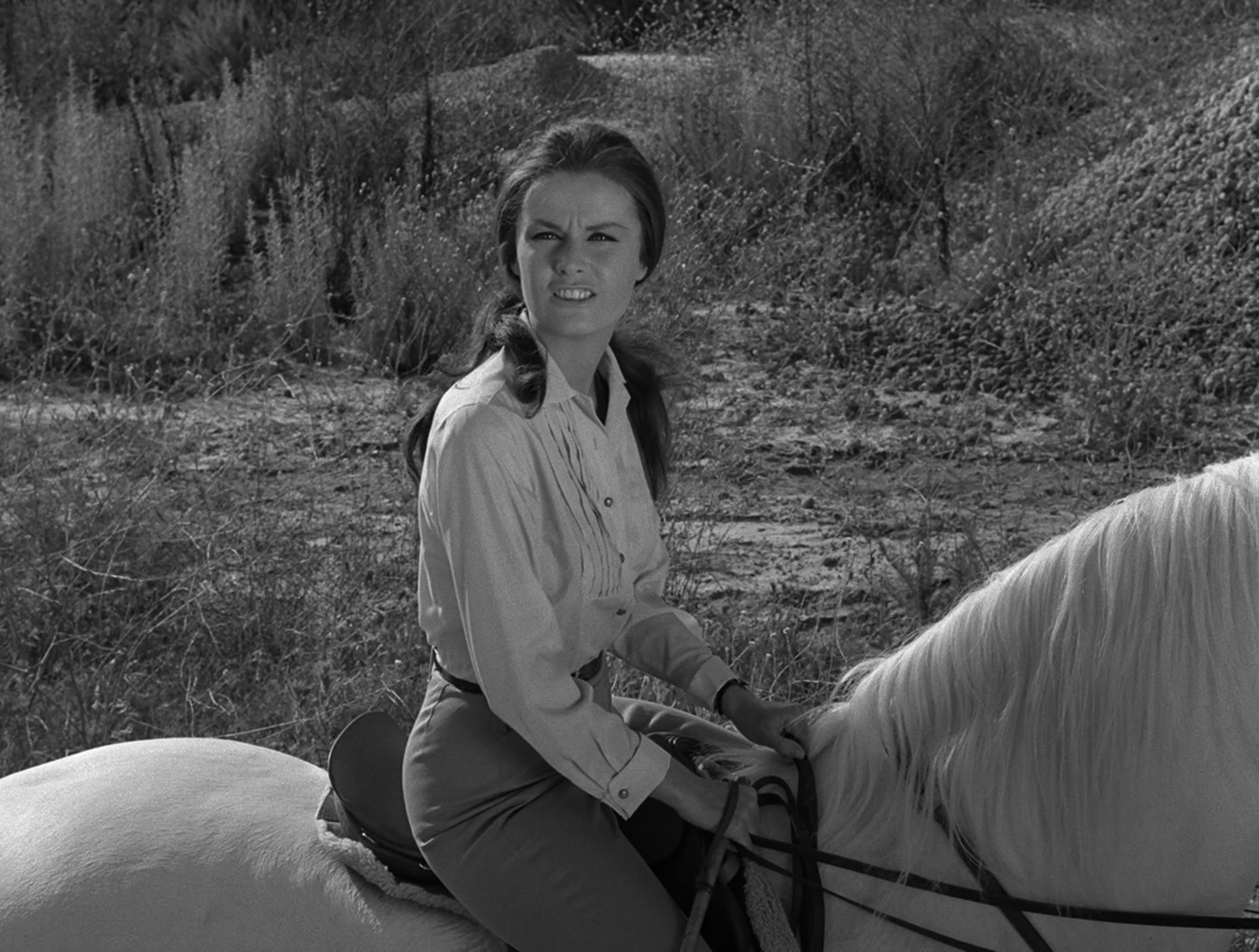
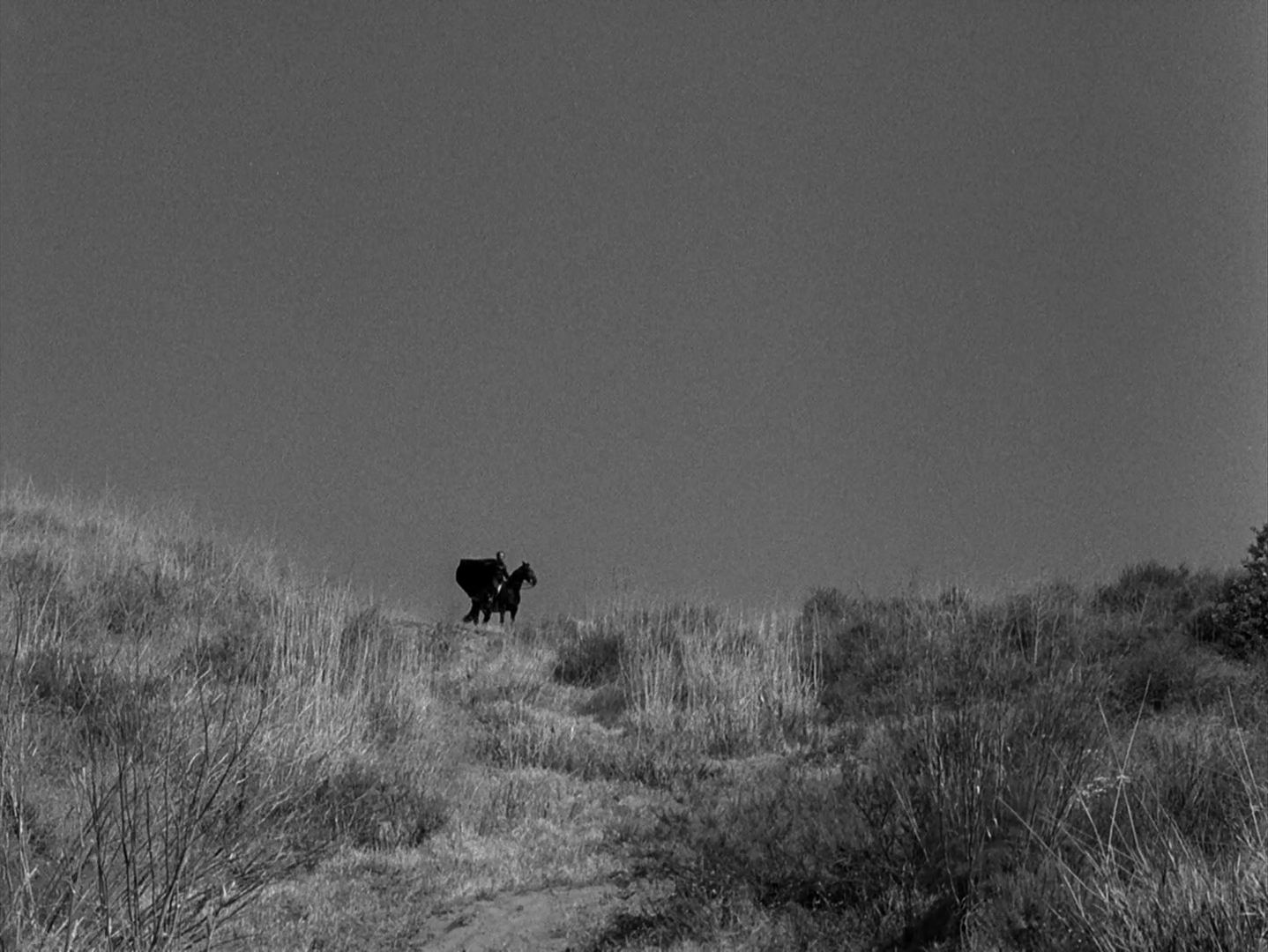
Young Anne Henderson is out for a relaxing horseback ride on her family’s sprawling Southern estate. Atop a hill, an ominous figure appears, also on horseback, clad in black and, with a blood-chilling shriek, tears down the hillside on an intercept course. Anne, naturally frightened, heads hurriedly for home. An exciting prologue, right? Who is this mysterious harbinger of doom? Is it a vicious demon? A vindictive ghost? Or maybe our old friend “The Hitch-hiker,” now traveling by horse instead of thumbing rides?


Viewers fifty years ago tonight quickly realized that it was none of those things. Thanks to a questionable (or, more to the point, stupid) directorial choice, we see the identity of Anne’s pursuer immediately. It’s herself, older and apparently really pissed off. 


Young Anne is about to marry Robert Blake, who has a bright future ahead of him and whom her parents approve of. However, her heartstrings are being seriously tugged on by no-good loafer David Mitchell, who implores her to run away with him, much to everyone’s chagrin.  

Meanwhile, 25 years in the future, the Henderson mansion is in a state of advanced disrepair and is about to be foreclosed upon. Nursing a stiff drink, Anne blames her dead father for spoiling her when she was young, which led to her choosing the wrong man. David enters, drunkenly taunting her. She flees the house, mounts her horse, and rides to the hilltop… and looks down at her younger self. She races down the hill and gives chase in what will be, as it always is, a futile pursuit.


Exceedingly melodramatic and painfully soapy, Richard Matheson's “Spur of the Moment” isn’t one of season five’s better offerings. Young Anne is excruciatingly annoying, a drama queen clearly desperate for attention. Future Anne is abrasive and bitter, blaming her shitty life on the fact that her father spoiled her as a child. Um, seriously? Marrying David was a bad choice, and maybe it happened partially because of her spoiled-child-rebellion-phase, but what’s prevented her from divorcing him at some point in the 25 years that he’s been making her life miserable? It’s her that’s opted to stay with his sorry ass, not her deceased father.

We only know the woman in black’s identity because the camera pans in for a close shot of her face, yet somehow Anne can see her “glaring” at her from the top of the hill (which would be impossible from that far away). By the same token, Future Anne couldn't possibly recognize her younger self from that distance; however, it’s more puzzling why she’d assume it’s her younger self at all (we know it’s The Twilight Zone, but she doesn’t).


Nitpicking aside, what exactly is happening here? Future Anne sees her young self… how, exactly? Is it the power of her own unhappiness, creating a kink in space and time, allowing her the opportunity to influence her younger self? I could buy it if it were a single event, in which she tries but fails to change the past, reinforcing the permanence of the past… but Anne indicates that she’s seen her younger self repeatedly, and does so again at the end of the episode. The opening scene is replayed, so apparently Future Anne’s created herself a time loop of sorts. She can apparently revisit this moment in her past as often as she likes, but she’ll never successfully get her younger self’s attention to sufficiently warn her away from marrying David…. but y’now, this is problematic too. She could easily opt to NOT scream like a banshee, and instead calmly descend the hill. Or maybe somehow, once they both occupy the same space, everything is locked into place, and Future Anne is helpless to change it. I dunno. We've seen characters interact with themselves before (“Nervous Man  In a Four-Dollar Room”; “The Last Night of a Jockey”), but here the Annes never actually get that opportunity, the maddening frustration of which is the whole point, I imagine.

Anne and Yang.


As repellent as both Annes are, the episode isn’t exactly a total loss. I suppose the production values are fine; I think this is the only time in the entire series that we see a full-on chase on horseback. The costuming choice to have Future Anne wearing all black and riding a black horse (symbolizing the darkness of her life) and Young Anne wearing all white and riding a white horse (symbolizing her relative purity) is a nice touch, if a bit obvious. The juxtaposition of the Henderson mansion in the two different time periods (pristine in the family’s happier, richer days, run down and almost devoid of furniture in the dark future) is effective.


When Future Anne throws her drink at David before running off for yet another attempt to warn her younger self, David breaks down into drunken tears. Is it just me, or does he look just like Dan Duryea in “Mr. Denton on Doomsday”?


THE MUSIC


“Spur of the Moment” features an original score by Rene Garriguenc which, like all season five scores, has never enjoyed an official soundtrack release. You’ll find it, however, isolated on its own track on the season five DVD/blu-ray sets. The score is overly melodramatic; it sounds like accompaniment for silent films (where’s the mustache-twirling villain?). Like everything else here, it grates on my nerves.


FAMILIAR FACES

Diana Hyland (Anne Henderson) only has a smattering of genre roles on her resume, among them two Alfred Hitchcock Hours (“To Catch a Butterfly” And “Beyond the Sea of Death”) and two episodes of The Invaders (“Vikor” and the two-part “Summit Meeting”… I guess that’s technically three episodes). She’s probably best remembered for her work on TV’s Peyton Place (1968-69), which this soap-operatic episode certainly prepared her for.


That no-account rascal David Mitchell is played by Roger Davis in his only Twilight Zone appearance. He’d cross paths with Rod Serling again in 1972 on Night Gallery (“You Can Come Up Now, Mrs. Millikan”). Other notable genre credits include 128 episodes of Dark Shadows (1968-1970; more soapiness!) and the hilariously awful Galactica 1980 (“The Night the Cylons Landed”).


The reliable and upstanding Robert Blake is played by Robert Hogan, who also popped up on Serling’s Night Gallery (1971’s “Brenda," a thoroughly stupid segment about a lonely girl and the swamp monster that befriends her. Yes, you heard that right; incidentally, the teleplay was written by TZ producer Buck Houghton under a pseudonym... can't say I blame him). Ahem, back to business. Hogan was also a regular on Peyton Place, so that connects him to Diana Hyland.


As Mr. Henderson, this is Philip Ober’s only TZ appearance; however, he showed up on both of Alfred Hitchcock’s TV series (“Burglar Proof” on Alfred Hitchcock Presents and “I Saw the Whole Thing” on The Alfred Hitchcock Hour) as well as his 1959 film North by Northwest. Mrs. Henderson is played by Marsha Hunt, who appeared on The Outer Limits just three weeks prior to “Spur of the Moment” (“ZZZZZ”). And finally, Reynolds (whom we only see from behind) is played by Jack Raine, who played an officer in season four’s “Passage on the Lady Anne.”


As you've probably gathered, I’m not a big fan of “Spur of the Moment.” Any story about time paradoxes has automatic potential in my book, but here the concept is hazily integrated and lazily developed. Toss in unlikable characters and… well, I check out pretty quickly. It’s not that I hate it, necessarily… I just don’t care. Your horse mileage, of course (of course) may vary.


Next week:
Mon Dieu! Le Twilight Zone passe en France!


Friday, February 7, 2014

Episode Spotlight: "Night Call" (2/07/1964)


Season 5, Episode 19 (139 overall)
Originally aired 2/07/1964
Cayuga Production # 2810


What if you could talk to your lost loved ones? Fifty years ago tonight, the dead reached out and touched the living… but unfortunately things didn't go well.

Miss Elva Keen is a crippled old woman who receives, quite out of the blue, several telephone calls in which the caller moans. Obscene calls? Maybe, but there’s no heavy breathing (which is something of a clue, actually). The moans change to two simple phrases: “Where are you?” and “I want to talk to you.”


The telephone company traces the problem to a set of downed telephone wires in the local cemetery. Elva has her housekeeper drive her out there, and is shocked to see the wires resting on the grave of Brian, the fiancé of her youth, who was killed in a car accident (Elva was driving and lost control of the car).

Elated at the prospect of talking with Brian once again, Elva tries to summon him through the telephone. He finally comes on the line: “You said to leave you alone. I always do what you say.” The line goes dead.


“Night Call” was written by Richard Matheson, based on his short story “Sorry, Right Number,” which was first published in 1953, then again in 1961 in Matheson’s short story collection Shock!  Here’s where things gets a bit weird. “Night Call” is similar to the season two episode “Long Distance Call” (which also depicts the dead placing telephone calls to the living), which originated with a script by William Idelson, one of Matheson’s friends. It was Matheson’s championing that led to Cayuga Productions buying it, and the resultant episode was broadcast in 1961, the same year that Matheson’s short story was republished under a different title: “Long Distance Call.”


The upward shot of the telephone wires stretching down to Brian’s grave is very effective; in fact, the entire cemetery sequence, brief though it is, is the best scene in the entire episode. The prologue, in which Elva receives the first mysterious call, is quite atmospheric and effective (it’s your basic “dark and stormy night” intro). Unfortunately, the bulk of the episode takes place in broad daylight, so there’s not a lot visually to sustain the moody dread that the script aspires to. At the helm is Jacques Tourneur, director of the noirish horror classics I Walked with a Zombie and Cat People (as well as 1947’s Out of the Past, widely considered one of the greatest film noirs ever made), so the relative dearth of shadowy ominousness is something of a disappointment.

So where (and what) is Brian, exactly? Is he a reanimated corpse, communicating through unknown means through six feet of earth and into the frayed telephone line? Or is he is a damned soul, suffering in his own right, torturing the living as his only means of relief?

I’ve never been a big fan of this episode. For me, there’s too little going on with too little payoff. So Brian starts calling Elva from beyond the grave, wanting to chat…. however, he never identifies himself and spends most of the time moaning unintelligibly. When she (understandably) freaks out and demands to be left alone, he bows out in a pretty severe example of passive aggression. Okay, yeah, she’s responsible for killing him all those years ago, but she’s spent most of her life a cripple because of it. Does she really deserve this on top of it? Nay, I say. What if instead she apologized profusely for the accident, and he forgave her, leading to many lively talks throughout whatever remains of Elva’s life? Wouldn't that be more in line with The Twilight Zone’s sensibilities? 


Honestly, “Night Call” would work better as an episode of Alfred Hitchcock Presents, in which the whole thing turns out to be an elaborate ruse by the housekeeper, Margaret, to drive Elva crazy for some reason or other.


FAMILIAR FACES

And speaking of Hitchcock, the entire cast (all three of ‘em) is made up of Hitch veterans…

Gladys Cooper is convincingly lonely and bitter as Miss Elva Keene in her third and final TZ appearance (she previously graved season three’s “Nothing in the Dark” and season four’s “Passage on the Lady Anne”); she also put in a single appearance on The Outer Limits (“The Borderland”). She did one episode of Alfred Hitchcock Presents (“The End of Indian Summer”), two episodes of The Alfred Hitchcock Hour (“Consider Her Ways” and “What Really Happened”), plus she appeared in Hitchcock’s 1941 film Rebecca.

Nora Marlowe plays Margaret Phillips in her second TZ appearance (she was also seen in season two’s “Back There”). Over on The Outer Limits, she memorably had her heart fatally stopped by the super-evolved Gwyllm Griffiths in “The Sixth Finger.” She did one episode of Alfred Hitchcock Presents (“I Killed the Count: Part 3”) and one Alfred Hitchcock Hour (“The Landlady”); she also played an uncredited housekeeper in 1959’s North by Northwest.


Miss Finch (the telephone operator) is played by Martine Bartlett, who appeared twice on The Alfred Hitchcock Hour (“The Star Juror” and “Nothing Ever Happens in Linvale”).


“Night Call” is by no means awful (something I can’t say about next week’s episode), but it’s not one of the better season five offerings. Like so many episodes in this final stretch, the moral center is skewed, uncomfortably so. It doesn’t feel much like The Twilight Zone around here anymore....


Next week:
All bets are off! "Mr. Bevis" isn't the most annoying Twilight Zone character anymore.


Friday, October 11, 2013

Episode Spotlight: "Nightmare at 20,000 Feet" (10/11/1963)


Season 5, episode 3 (123 overall)
Originally aired 10/11/1963
Cayuga Production # 2605


50 years ago tonight, a nervous air traveler came face to face with an impossible enemy: an otherworldly creature out on the wing, who apparently is determined to sabotage the plane and endanger everyone on board.


Richard Matheson’s “Nightmare at 20,000 Feet” is probably one of The Twilight Zone’s most recognizable episodes. It’s been spoofed repeatedly over the years (more on this below), and it had the (dubious) honor of being remade in 1983’s Twilight Zone: The Movie. After Captain Kirk, it’s probably William Shatner’s most famous screen role (well, maybe it’s a tie with T.J. Hooker), and well-deservedly so: he’s straight-up brilliant here, his characterization nuanced and complex. He’s completely convincing as a man struggling with two demons: the one out on the wing, and his own precarious grip on reality.


Bob Wilson has just spent six months in a sanitarium after experiencing a nervous breakdown on an airplane (the specifics aren’t given; did he see something on the wing that time too?). Evidently he’s recovered and, as a final breakthrough, he’s going home on a plane (is it just me, or is this approach kinda sorta asking for trouble?). Of course he’s got a window seat, and of course his seat just happens to be right next to an emergency hatch.


Oh, there’s also a wicked storm directly in the plane’s flight path, promising a rough ride. Jesus, this guy can’t catch a break.


Most of the episode is spent having Bob see the Gremlin, but only when nobody else is there to see it. We wonder if it’s all in his head (this argument seems pretty valid until the very end of the episode). His wife, the stewardess, and finally the pilot interact with him in a placating but skeptical manner, but wouldn’t we do the same? Even if there were a man (or whatever) out on the wing, he (or it) would’ve been blown off immediately upon takeoff... right? The fact that this Man Crying Wolf was very recently crazy (pardon my political incorrectness there) doesn’t help his case.


My only real gripe (other than the gigantic one directly below) is the fact that Bob easily (too damned easily) manages to get his hands on a nearby air marshal’s .38. I won’t spoil it, but trust me when I say it’s contrived and awkward, not to mention completely unbelievable. In Matheson’s original story, Bob is in the midst of experiencing a nervous breakdown and is contemplating suicide, so he has his own pistol in his carryon bag (wow, things are sure different now). Of course you couldn’t do suicide on TV at that time, so Matheson went this route. I’m not sure I could’ve thought of something better, but I still don’t like it.

However, the gun situation is negligible when you consider the true, fatal flaw of this episode. We must now discuss the elephant in the room. This particular subject has been touched on previously in the pages of this very blog, but it’s high time we tackle this beast head-on.  And as it turns out, “beast” is a pretty accurate descriptor. I’m of course referring to…

*Sigh* The Gremlin is, hands down, one of the stupidest creature designs I’ve ever seen, on The Twilight Zone or elsewhere. Matheson’s seminal short story describes it as follows: “It was a hideously malignant face, a face not human. Its skin was grimy, of a wide-pored coarseness; its nose a squat, discolored lump; its lips misshapen, cracked, forced apart by teeth of a grotesque size and crookedness; its eyes recessed and small --- unblinking. All framed by shaggy, tangled hair which sprouted, too, in furry tufts from the man’s ears and nose, in birdlike down across his cheeks.” Matheson was reportedly unhappy with its television incarnation, which is basically a giant teddy bear with a mongloidish face (crafted by William Tuttle and presumably cobbled together from leftover “Eye of the Beholder” prosthetics), and why wouldn’t he be? It looks utterly ridiculous, particularly when it swoops in and out of the frame on (hidden) wires. 

I fly through the air with the greatest of ease…


The Gremlin isn’t scary in the least, and severely undermines the tension that the episode is otherwise building quite successfully.  I’ll even go so far as to say that it pretty much ruins the episode. And look! Even the bottoms of its feet look dumb:


FAMILIAR FACES


This is William Shatner’s second TZ appearance. We saw him previously in season two’s “Nick of Time,” in which he played Don Carter, a somewhat-less neurotic slave to our old friend The Mystic Seer. I like to think of Don Carter and Bob Wilson as variations on the same basic character, and Bif Bang Pow! clearly agrees with me, as evidenced by their action figure of William Shatner, which comes with both characters’ outfits and accessories!


But Bif Bang Pow! didn’t stop there: they’ve released bobbleheads of both Bob Wilson and The Gremlin, a furry action figure of The Gremlin (which actually looks better than the “real” thing), and a diorama of the airplane with a li’l tiny Gremlin on the wing (my purchases of TZ collectibles have pretty much ground to a halt, but I must admit this last one’s kinda cool).


A 12-inch action figure of The Gremlin was released several years back by Sideshow Collectibles. Their work is usually superb, but something went horribly wrong here. I mean horribly. Just look at it. Just take a moment or two and gaze at its hideousness. What an utter piece of shit. It's a monstrosity (and not the good kind).


*Ahem* Back to the cast. Christine White is quite good as Ruth, Bob’s long-suffering wife (and fellow passenger on the plane).  She was also Ace Larson’s long-suffering girlfriend in season two’s “The Prime Mover,” so apparently she was quite adept at the whole long-suffering thing.  Ms. White passed away just two months ago, after which the NY Times wrote a very “Nightmare at 20,000 Feet”-centric story about her here


The stewardess is played by Asa Maynor, whose very first TV role was “Ginger Snap” on a 1960 episode of Mickey Spillane’s Mike Hammer. This is her only TZ appearance; however, she gets a special mention because she’s a bona fide TZ Babe.  Arrrrooooooogah!


The episode was remade in 1983 for Twilight Zone: The Movie (retitled “Nightmare at 35,000 Feet” to bring it up to modern aviation specs), this time featuring John Lithgow in the lead (though Shatner was certainly still young enough to reprise his role; I guess he was busy with the aforementioned T.J. Hooker at the time). The film’s Gremlin design is a gigantic improvement over its furry ancestor; however, the segment as a whole (directed by George Miller of Mad Max fame and, more recently, Happy Feet, which suggests a pretty bizarre career path) is much too frenetic to generate any true tension (many reviewers consider it the highlight of the film; I find it grating, personally, but I guess I kinda agree, which should give you an idea of my thoughts on the film as a whole).


Many of The Twilight Zone’s iconic, most widely-remembered episodes have been parodied by TV’s The Simpsons over the years, and “Nightmare at 20,000 Feet” is no exception. The 1993 episode “Treehouse of Horror IV” includes “Terror at 5½ Feet,” which moves the action from an airplane to Bart Simpson’s school bus. Interestingly, the framework of this particular episode is patterned after Rod Serling’s Night Gallery, with Bart introducing each segment using gallery paintings.


The episode was more recently parodied on Saturday Night Live in 2010, with Bobby Moynihan playing the Gremlin and the brilliant Bill Hader standing in for Rod Serling. It’s a bit dumb, but very well done on a technical level. I was going to embed the video directly into this entry, but I can't seem to find it anywhere (including SNL's own website), so.... sorry, mates.


Splice the ’83 Gremlin (not the car, dammit) into the ’63 episode and give Bob Wilson his own pistol (as in Matheson’s short story) and you’d have an undeniable classic.  As it stands, however, “Nightmare at 20,000 Feet” is still a classic… but not the masterpiece that it could’ve (and should’ve) been. That fucking Gremlin just wrecks it for me. Your air mileage may vary.


Coming up:
STOP everything and WATCH this. Ha, see what I did there?  No? Well, it’ll make more sense next week.