Showing posts with label Bernard Herrmann. Show all posts

Monday, November 1, 2021

4x12 "2Quarantine 2Confidential"

This week, host Craig checks out “Reap What You Sow,” a fan-made Twilight Zone episode in the spirit of the original series, then gazes backward at his own (sadly unrealized) dream of creating... well, something along the same lines. Friend of the show Carson Cohen returns for some much-needed fact checking, then we wrap up with some reportage on an exciting Rod Serling-related crowdfunding campaign. Oh, it’s also Hallowe’en, which we’re apparently not observing at all this year. Boo indeed. 

Theme: “Neither Here nor There (Yet Another Revision version)” by Twin Loops (used by permission). 

“Two Semi-Metallic Human Beings” composed by Howard Shore (from album David Cronenberg’s Crash: Original Motion Picture Soundtrack, copyright 1996 by Milan Records). 

“Babylon” performed by Control X (from the album To Abort Transmission, copyright 1995 by Instinct Ambient Records). 

As Timeless as Infinity: A Rod Serling Monument Kickstarter campaign:  https://bit.ly/3w1kcpH 

If you haven’t seen “Reap What You Sow,” go watch it before CBS issues a cease-and-desist notice!  https://youtu.be/f5GOQVgeAzk 

The Twilight Zone is a trademark of CBS, Inc. 

Between Light and Shadow: A Twilight Zone Podcast is a nonprofit podcast. Music clips and dialogue excerpts used herein are the property of their respective copyright owners; we claim no ownership of these materials. Their use is strictly for illustrative purposes and should be considered Fair Use as stated in the Copyright Act of 1976, 17 U.S.C. section 107.  

Sunday, March 29, 2020

4x03 "Bernard Herrmann at CBS"


This week Craig takes a break from social distancing and continuous hand-washing and goes spelunking into the depths of the cavernous CBS Music Library in search of sonic treasures from the greatest film and television composer of all time: Bernard Herrmann. It’s our longest episode to date, but only because it’s stuffed to the proverbial gills with music… thankfully our loquacious host lets the music do (most of) the talking.

Rondo Hatton Classic Horror Awards ballot: https://rondoaward.com/rondoaward.com/blog/?p=890

The Twilight Zone is a trademark of CBS, Inc.

Between Light and Shadow: A Twilight Zone Podcast is a nonprofit podcast. Music clips and dialogue excerpts used herein are the property of their respective copyright owners; we claim no ownership of these materials. Their use is strictly for illustrative purposes and should be considered Fair Use as stated in the Copyright Act of 1976, 17 U.S.C. section 107.

Sunday, October 6, 2019

3x11 "We All Scream for Jet Stream"


Check your bags and try to avoid a TSA cavity search as you board tonight’s double-feature flight into the unknown. Craig takes the yoke and performs aerial maneuvers over, under and through the classic Twilight Zone episodes “The Last Flight” and “The Odyssey of Flight 33.” In the final analysis, only one will emerge unscathed. Along the way Craig struggles with French pronunciations, extols the glory of stop-motion dinosaurs and powers through some kind of sinus malfunction. Mon dieu!


Theme: “Neither Here Nor There (9/22/2019 Revision)” by Twin Loops

“Sunny” performed by Dave Pike (from the album Jazz for the Jet Set, copyright 1966 by WEA International)

“Interlude” performed by Thievery Corporation (from the album The Richest Man in Babylon, copyright 2002 by Eighteenth Street/ESL Music)

“On Danse a la Villette” and “La Vraie Valse Musette” performed by Basil Bunelik (solo accordian)

“Royal Air Force March Past” performed by the Central Band of the Royal Air Force (from the album On Tour: Central Band of the Royal Air Force, copyright 1995 by Cala Records)

“Serenata” performed by The Jonah Jones Quartet (from the album Great Instrumental Hits, copyright 1961 by Capitol Records)

"The Return of the Red Baron" performed by The Royal Guardsmen (from the album Snoopy and His Friends, copyright 1967 by Laurie Records)

The Twilight Zone is a trademark of CBS, Inc.

Between Light and Shadow: A Twilight Zone Podcast is a nonprofit podcast. Music clips and dialogue excerpts used herein are the property of their respective copyright owners; we claim no ownership of these materials. Their use is strictly for illustrative purposes and should be considered Fair Use as stated in the Copyright Act of 1976, 17 U.S.C. section 107.

Sunday, July 16, 2017

2x02 Special Report: The Moat Farm Murder


Our pal Dr. Reba Wissner returns to further educate us on All Things Twilight Zone Music. The focus here is Bernard Herrmann’s chilling score for the classic radio drama “The Moat Farm Murder,” which would go on to appear in several Twilight Zone episodes. After the chat, stick around for the radio drama itself, an unsettling account of a murder that takes place, if the title is to be believed, on a farm of the moat variety.

Opening theme: “Neither Here Nor There (3.3)” by Twin Loops.

The Twilight Zone is a trademark of CBS, Inc.


Between Light and a Shadow: A Twilight Zone Podcast is a nonprofit podcast. Music clips and dialogue excerpts used herein are the property of their respective copyright owners; we claim no ownership of these materials. Their use is strictly for illustrative purposes and should be considered Fair Use as stated in the Copyright Act of 1976, 17 U.S.C. section 107.

Thursday, June 19, 2014

Episode Spotlight: "The Bewitchin' Pool" (6/19/1964)


Season 5, Episode 36 (156 overall)
Originally aired 6/19/1964
Cayuga Production # 2619


Fifty years ago tonight, a television legend came to an end as The Twilight Zone aired its 156th and final episode.  Sadly, the series ended with a soft, weak whimper instead of going out with a powerful, brilliant bang.


The Sharewoods are an unhappy bunch. Gil and Gloria have two modes of interaction: passive aggression and just plain aggression, and siblings Sport and Jeb are constantly caught in the crossfire. One day a young boy named Whit appears out of nowhere in their swimming pool and invites them to come with him. They dive in after him, and emerge in a lake.


There’s a charming cottage on the lake’s shore, and several children are playing in the yard. Whitt introduces Sport and Jeb to Aunt T, an elderly woman who explains that her home is a sanctuary of sorts for sad and neglected children. Sport insists that they aren’t neglected; that their parents do in fact love them despite their fighting. Aunt T tells them that they should go home if that's the case.


The next day, Gloria angrily orders Sport to find her brother (who is nowhere to be found), so that all four can have a family meeting. Sport returns to Aunt T’s home and finds Jeb there, who refuses to leave. Sport lies and tells him that things will be different now, that their parents have promised not to fight anymore, and that they’ll be a happy family at last. Jeb reluctantly goes home with her, on the understanding that they can probably never return to Aunt T’s place.


Gil and Gloria tell Sport and Jeb that they are getting a divorce, and that the kids can choose which parent they want to live with. Sport balks, and she and Jeb return to the pool, calling out for Aunt T to help them. They swim toward the bottom, prompting Gil to in after them... but he comes up empty. The kids are gone.


.


Earl Hamner Jr.’s “The Bewitchin’ Pool” (that’s right, the series finale wasn’t even written by Rod Serling) isn’t necessarily terrible… it’s just nothing special. Drop it in the middle of the third season and I wouldn’t bat an eye. But here, at the very end, it leaves me wanting… pretty badly, in fact. It’s yet another of Hamner’s down-home “city folk are wicked and country folk are good” efforts which, as a lifelong city-dweller, I find a bit offensive.


Occupying the director’s chair is Joseph M. Newman, who previously helmed “In Praise of Pip,” “The Last Night of a Jockey,” and the terminally goofy “Black Leather Jackets” (he also directed an impressive ten Alfred Hitchcock Hours). Sci-fi fans are probably aware that he also directed 1955’s This Island Earth, which co-starred TZ alums Russell Johnson (“Execution” and “Back There”), Jeff Morrow (“Elegy”), and Lance Fuller (“The Last Rites of Jeff Myrtlebank”). I can only assume this week’s episode was a quick paycheck for Newman and nothing more, since there’s really nothing notable about the episode’s direction. It just…. is.

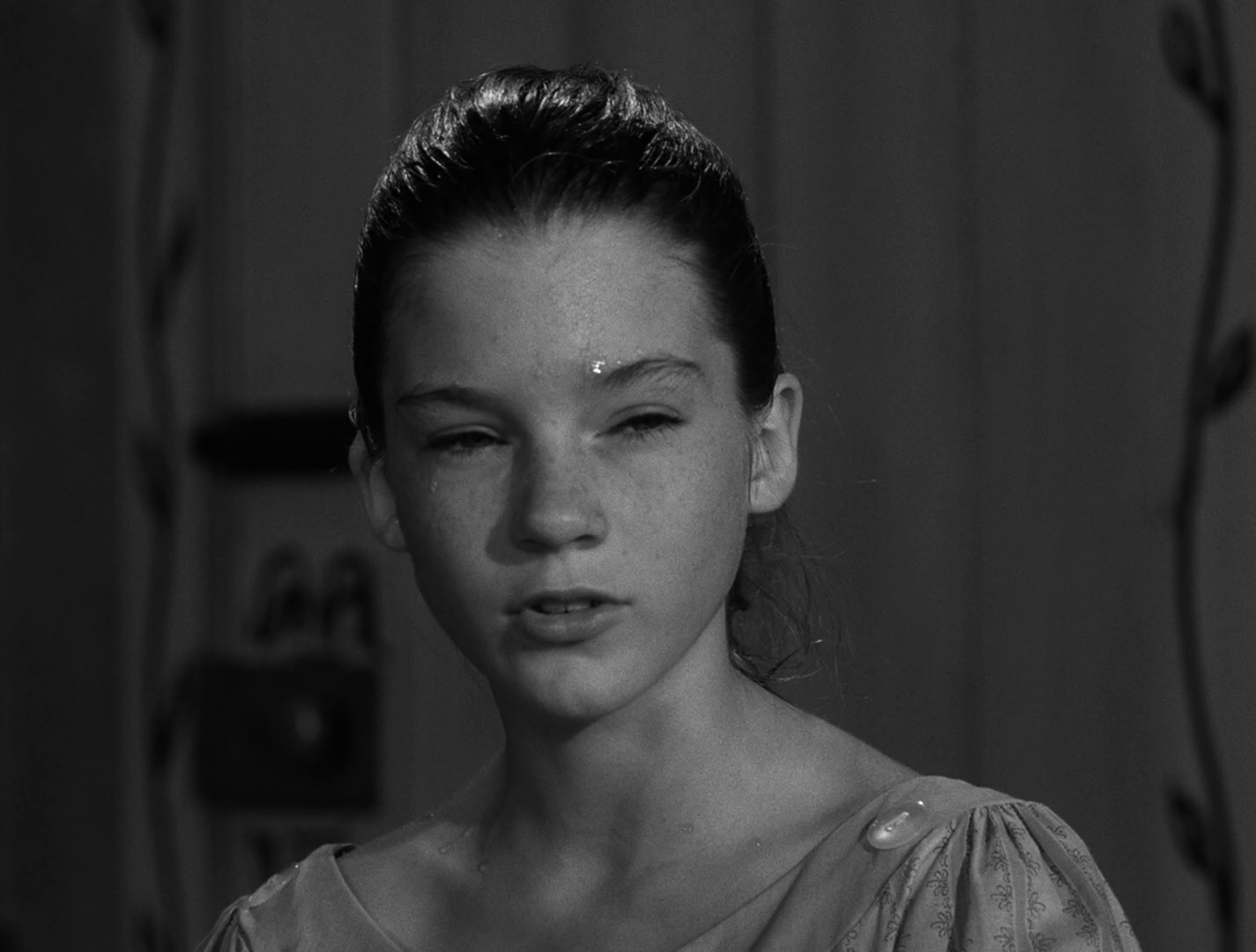
Some of Mary Badham’s dialogue is regrettably dubbed by June Foray, who provided the voice of Talky Tina earlier this season in “Living Doll” (I can’t help but wish she said “My name is Sport Sharewood, and I don’t think I like you” at some point in the episode, preferably to her asshole parents), as Badham’s southern accent was reportedly thick enough to make her semi-unintelligible. The dub job is obvious and, frankly, a bit confusing since all of Badham’s dialogue in the Aunt T segments --- which wasn’t replaced --- sounds fine. History also cites “backlot noise” as an additional culprit, so I dunno. In any case, the episode’s post-production took longer than anticipated and, rather than airing in March as originally planned, it was held back until the very end of the season. So at least we know why such a limp offering ended up being the series finale.


Leave it to The Twilight Zone to throw us a curve ball in the final play of the final game. The entire prologue segment isn’t a prologue at all; it’s what we generally call a “teaser” over on my Outer Limits blog, which means it’s a scene from the episode shown out of order and out of context, intended to (wait for it) tease the viewer. The Outer Limits used this practice for most of its first season (at ABC’s behest) in order to show the audience the alien/monster of the week as fast as possible. “The Bewitchin’ Pool” has no such beasts to speak of, so I’m guessing the episode ran several minutes short (in addition to the sound problems detailed above), necessitating some creative editing. We do get the customary Serling intro at the end of it, but we don’t get the customary whip pan leading into it; rather, Serling’s face emerges from the swirling waters of the Sharewood clan’s swimming pool, which is admittedly a cool effect, hearkening back to the imaginative and unexpected Serling appearances in the show’s second and third seasons.

Rod Swirling?

A further indication that the teaser wasn’t part of the original plan can be found at the start of act one, where we hear another chunk of Serling narration (this is the only time in the entire series we hear him during the first act). I’m guessing (I don’t have the script, so guessing is all I can do) that the teaser narration was written at some later time after principal photography had wrapped.


I find myself a a bit hung up on the concept of Aunt T’s Refuge for Neglected Tykes; specifically, what’s the long-term plan? Does she return them to the real world when they reach the age of majority, after she’s raised ‘em up right 'n all? Aunt T explains to Jeb and Whitt that “all children need chores” to teach them responsibility and so forth, so this certainly seems possible. However, I get a very strong Neverland vibe from the whole thing, which might keep the kids young forever. So I dunno.


I’m reminded of the X-files episode “Closure,” in which the mystery of FBI Agent Fox Mulder’s missing sister is finally (sort of) solved: it turns out she was taken by “The Walk-Ins,” spectral beings who saved her from imminent harm and relocated her to an ethereal paradise for lost children.  Is Aunt T such a being?  Is Samantha Mulder with her now???


.
THE MUSIC


“The Bewitchin’ Pool” is stock-scored with selections from the CBS Music Library, a few of which are vaguely familiar (meaning they probably appeared in other episodes). Two cues of note are “Hope" and "Act Ending" by Bernard Herrmann, both from his sublime Walt Whitman Suite. I’m really glad that ol’ Bennie, who scored the series pilot “Where Is Everybody?,” is heard one more time in the series closer; it’s a nice musical bookend of sorts. If you'd like to obtain said Walt Whitman Suite, you can find on Bernard Herrmann at CBS, Volume 2: American Gothic from Prometheus Records.


.
DRAMATIS PERSONAE


Mary Badham stars as Sport Sharewood in her only Twilight Zone appearance. Badham’s rĂ©sumĂ© is pretty sparse, but she did play Scout Finch (who is more or less a younger version of Sport) in 1962’s wonderful adaptation of Harper Lee's To Kill a Mockingbird, so color me impressed as hell.


The cherubic and adorable Jeb Sharewood is played by Tim Stafford, who now works under the name Jeffrey Byron. I couldn’t find any of the usual genre connections for him; however, he did appear on The Fugitive in 1964 (“Tiger Left, Tiger Right"; below), my favorite non-genre series of that time. More recently, he administered the Kobayashi Maru Scenario test in J.J. Abrams’ 2009 Star Trek reboot.


Aunt T is played by Georgia Simmons in her sole Twilight Zone excursion. Simmons has no other genre credits to speak of, but she did appear in Fellini’s , so at least she did something worthwhile with her career (“The Bewitchin’ Pool” sure as hell ain’t it).


The Huck Finn-ish Whitt is played by Kim Hector, who only worked as an actor for six short years. In that brief amount of time, he managed to score this TZ gig and an Outer Limits (he played the afflicted child Johnny Subiron in “The Inheritors”)…. but his most impressive credit came with his role as Cecil Jacobs in 1962’s To Kill a Mockingbird, so he already knew Mary Badham when he reported to the TZ set.

Kim Hector (right) squares off against Mary Badham.


If Dee Hartford (Gloria Sharewood) looks familiar, it may be because she also appeared on The Outer Limits (“The Invisibles,” which starred TZ alums Don Gordon and George MacReady). Hartford also showed up on The Alfred Hitchcock Hour (“Day of Reckoning”) and Batman (she played Miss Iceland in “Green Ice”/”Deep Freeze”). Is she a TZ Babe? I’d say yes, despite her bitchy demeanor here.

Dee Hartford (left) with TZ alum Don Gordon.

The rĂ©sumĂ© of Tod Andrews (Gil Sharewood) doesn’t contain any of the usual genre connections; however, he did appear as “Skipper” in 1970’s Beneath the Planet of the Apes, so there’s a very tenuous Rod Serling connection (since Serling worked on the screenplay for 1968’s original Planet of the Apes. Don’t look at me that way; I said it was tenuous). Andrews also starred in 1957’s From Hell It Came which, despite a promising title, concerns a wrongfully-executed man who is reincarnated… as an ambulatory tree stump monster.


.


The Twilight Zone served many functions during its five-year life span. It meted out cosmic justice by punishing the guilty, and allowed second chances to those deserving of them. It enlightened those who’d lost their way, and it provided escape for those desperate enough to seek it out. As its final noble act, it provided a haven for neglected children which, as a parent, I can definitely appreciate. But damn it, I wish the episode surrounding that promising theme was better. “The Bewitchin’ Pool,” taken strictly on its own, is mediocre at best. As the final Twilight Zone episode ever, it’s disappointing and anticlimactic.


Thursday, March 27, 2014

Episode Spotlight: "I Am the Night - Color Me Black" (3/27/1964)


Season 5, Episode 26 (146 overall)
Originally aired 3/27/1964
Cayuga Production # 2630


“The man I killed was the white knight.  He did what his other pals in this town wanted to but didn’t have the guts. He was the cross burner, the bomb thrower. He handled the whipping of some poor, scared colored guy.”

That’s Jagger, the town iconoclast, on the morning he is to be hanged. Sheriff Koch, Deputy Pierce, and Colbey (the editor of the local paper) ruminate about Jagger’s precarious conviction, and how all three of them may have skewed the facts to secure it. Odd meteorological detail: the sun hasn’t come up yet in their little town, even though it’s daylight everywhere else.


At 9:00, the townspeople gather at the gallows, and it’s still dark. Folks are starting to get concerned.


Jagger is finally brought to the gallows. Offered the opportunity to speak his last words, he vehemently refuses to apologize, incensing the crowd to demand that the hanging commence. Reverend Anderson, the only African American in sight, thanks Jagger for “sticking up for me and mine,” but does have a question: did he enjoy the killing? Jagger acknowledges that he did, satisfying Anderson’s lingering doubts of his guilt. Jagger is hung, at which point the darkness becomes thicker and more impenetrable. Anderson attributes it to the outpouring of hatred he’s witnessed in the Jagger case.

Back at the station, Colbey turns on the radio. The announcer reports that similar pockets of darkness have appeared all over the world: the Berlin Wall, North Vietnam, Dealey Plaza in Dallas… the list goes on and on.


.
Rod Serling’s script is one of the more obvious examples of his tendency to overwrite dialogue. The characters do express a number of interesting insights, but they’re less impressive when they’re buried under unrealistic verbiage. Still, there are enough powerful moments to carry the piece. It’s an interesting combination of themes addressed previously in season one’s “The Monsters Are Due on Maple Street” (the dangers of mob mentality) and season two’s “Dust” (the questionable morality of the death penalty), both of which were Serling efforts, but “I Am the Night – Color Me Black” never feels like a rehash. In the director’s chair is Abner Biberman, back for his fourth and final TZ stint (he previously directed “The Dummy,” “The Incredible World of Horace Ford” and, more recently, “Number 12 Looks Just like You.” He also directed “The Human Factor” over on ABC’s The Outer Limits as well as four episodes of NBC’s The Fugitive.


This of course isn’t The Twilight Zone’s first hanging. Season one’s “Execution” found an Old West outlaw being strung up, only to vanish in the nick to time (courtesy of a time-tampering scientist from the future). Season two’s “Dust” found a convicted murderer granted an unexpected reprieve when his rope snapped in the nick of time (thanks to a sprinkling of magic dust). But here the hanging occurs without supernatural intervention… it’s as if the third time, as the saying goes, was the charm.*

The crane shot late in act one as the townspeople gather around the gallows, the clock tower clanging in the distance, is effectively eerie. As they wonder aloud about the inexplicable darkness, it suddenly feels a lot like the aforementioned “The Monsters Are Due on Maple Street,” which featured a similar scene of neighbors discussing their sudden lack of electricity.


My favorite moment in the episode comes when Jagger, having incited the crowd to near-riot levels, turns and looks up the gallows. Everything goes completely and immediately silent. His face is framed in the noose, and the reality of the moment is suddenly very evident on his face.


. THE MUSIC


“I Am the Night – Color Me Black” is stock scored, almost exclusively with cues from earlier works by Bernard Herrmann


The first piece we hear, right at the beginning of the prologue, is Herrmann’s “The Cellar,” which sounds like a selection from his Outer Space Suite, but actually comes from his score for Collector’s Item, an unsold pilot from 1958. The Collector’s Item score was first released on vinyl in 1985 as part of Cerberus Records’ Bernard Herrmann: Music for Radio and Television album, the contents of which were released on CD in 2003 on Prometheus Records’ Bernard Herrmann at CBS, Volume 2: American Gothic


Next we hear a brief snippet from Herrmann’s radio score for “The Hitch-hiker," which was first released on vinyl in 1983 as part of Cerberus Records’ Bernard Herrmann: The Outer Space Suite album. The suite later appeared on CD in 1999 as part of Silva Screen’s 4-disc Twilight Zone 40th Anniversary Collection.


The bulk of the episode is scored with cuts from Herrmann’s score for “Where Is Everybody?” from season one, a score that has seen three distinct releases. First, it appeared on the second volume of TZ scores from Varese Sarabande (an album which was released on both vinyl and cassette in 1983, then on CD in 1992--- in Japan only). It also appeared on Varese Sarabande’s The Best of The Twilight Zone CD in 1990 and, finally,  the aforementioned 4-disc Twilight Zone 40th Anniversary Collection in 1999.

One non-Herrmann cue is heard a few times: “Now We Move” by Nathan Van Cleave, from his score for the “Alice” episode of Have Gun, Will Travel. This score has never been released to my knowledge, and since “I Am the Night – Color Me Black” doesn’t have an isolated music track on the Season 5 DVD and Blu-ray sets, this particular cue is unattainable…. or so a less dedicated blogger might have you believe. If you’re aching to possess Van Cleave’s “Now We Move” cue, it can be found on the isolated music track for “Of Late I Think of Cliffordville” on both the Definitive DVD and Blu-ray releases of Season 4. The cue is heard three different times, so you can’t miss it. So if your heart is set on assembling a complete soundtrack for this episode…. well, now you can. You’re welcome.


DRAMATIS PERSONAE

Sheriff Charlie Koch is played by Michael Constantine in his only TZ appearance. He'd cross paths with Rod Serling again in the Night Gallery episode "The Boy Who Predicted Earthquakes"  but, before that, he popped up on the "Counterweight" episode of The Outer Limits.


Rev. Anderson is played with appropriate gravitas by Ivan Dixon, whom we know better as boxer Bolie Jackson from season one's "The Big Tall Wish." Dixon also appeared twice on The Outer Limits ("The Human Factor" and the two-part "The Inheritors"... so maybe we should call that three appearances). He also directed six episodes of The Greatest American Hero, which was my favorite show when I was in the 6th grade (incidentally, I’m strongly considering doing a blog about it at some point).


Colbey, the newspaper editor, is played by Paul Fix, who is probably best remembered by genre fans as Dr. Piper in the "Where No Man Has Gone Before" episode of Star Trek, which is the only regular series episode of the series in which Dr. Leonard "Bones" McCoy does not appear.


If Terry Becker (Jagger) looks familiar to you, it may be that you enjoyed him as Chief Francis Ethelbert Sharkey) on TV's Voyage to the Bottom of the SeaElla Koch (the sheriff's wife) is played by Eve McVeagh, who previously appeared in season three's "Kick the Can." She did four stints on Alfred Hitchcock Presents "Coyote Moon," "The Gloating Place," "The Test" and "What Frightened You, Fred?" as well as two Alfred Hitchcock Hours ("Last Seen Wearing Blue Jeans" and "The Second Wife"). George Lindsey (Deputy Pierce) appeared in the memorably disturbing Alfred Hitchcock Hour episode "The Jar" (which co-starred TZ alum Collin Wilcox and was scored by Bernard Herrmann), but let's be honest: he'll always be Goober Pyle (of The Andy Griffith Show fame).


"I Am the Night - Color Me Black" is Serling's final leftist political rant of the series. I'm not knocking leftist politics (I'm pretty liberal myself), but when you get preachy... well, pointing at a racist and yelling "racist!" isn't going to open his/her mind. I totally agree with the sentiment, but.....

Ahem. It's still pretty decent, thanks mostly to powerful performances by Terry Becker and Ivan Dixon. And as you can see from the screen captures, the episode is beautifully dark and noirish. And speaking of going dark.... we now have ten episodes left.


Next week:
You might want to turn a deaf ear to next week's offering. No, seriously.


*Of course we also saw a successful hanging just a few weeks ago in “An Occurrence at Owl Creek Bridge,” but I’m not counting it since it’s technically not a Twilight Zone episode.