Showing posts with label Charles Beaumont. Show all posts

Saturday, March 14, 2020

4x02 "Harum-Scarab"


This week Craig drinks the alchemist’s longevity potion and spends an eternity analyzing the classic Twilight Zone episodes “Long Live WalterJameson” and “Queen of the Nile.” It’s a heady blend of Ken Burns-esque Civil War side trips, Nazi Germany flyovers, and ruminations on mortality. We Sphinx you’ll really like it.


Rondo Hatton Classic Horror Awards ballot: https://rondoaward.com/rondoaward.com/blog/?p=890


“Ashokan Farewell” performed by Russ Bareberg (from the album The Civil War: Original Soundtrack Recording, copyright 1990 by Nonesuch Records)

“Clyde Bruckman’s Final Repose: Dumpster” composed and performed by Mark Snow (from the album The X-files: Volume 2, copyright 2013 by La La Land Records)

“Entr’acte (Caesar & Cleopatra)” and “Taste of Death” composed and conducted by Alex North (from Cleopatra: The Original Motion Picture Soundtrack, copyright 1963 by 20th Century Fox Records)

“Smokey Sax” by Hollywood Trailer Music Orchestra (from the album Film Noir: Vintage Cinema Classics, copyright 2015 by Megatrax Music“Cleopatra” performed by The Skatalites (from the album Foundation Ska, copyright 1996 by Heartbeat Select Records)

“Like Egypt Was” performed by Michael Penn (from the album Resigned, copyright 1997 by Epic/57 Records)

The Twilight Zone is a trademark of CBS, Inc.

Between Light and Shadow: A Twilight Zone Podcast is a nonprofit podcast. Music clips and dialogue excerpts used herein are the property of their respective copyright owners; we claim no ownership of these materials. Their use is strictly for illustrative purposes and should be considered Fair Use as stated in the Copyright Act of 1976, 17 U.S.C. section 107.

Saturday, December 2, 2017

2x14 "Hella Hellish"


Heaven. Hell. What’s the difference? The lines are blurred this week as Craig spins the roulette wheel on the Twilight Zone classic “A Nice Place to Visit” and can’t decide between a halo or a brimstone necklace. He then descends to the cheap and cheesy bowels of 70’s hell for the Night Gallery quickie “Hell’s Bells.” It’s groovy, man.

Theme: “Neither Here nor There (3.5)” by Twin Loops

“Strange Girl” performed by Hubert Laws (from the album Flute By-Laws, copyright 1966 by Atlantic Records)

“Destroyer” performed by The Kinks (from the album Give the People What They Want, copyright 1981 by Arista Records)

“The Girl with the Long Black Hair” performed by Sandy Warner (from the album Fair and Warner, copyright 1961 by Mayfair Records)

“Sacrifice” performed by Elliot Murphy (from the album Unreal City, copyright 1993 by Razor & Tie Records)

“Hell Hotel” performed by They Might Be Giants (demo; copyright information unknown)

“Lighten Up” performed by Beastie Boys (from the album Check Your Head, copyright 1992 by Capitol Records)

“Hell” performed by Squirrel Nut Zippers (from the album Hot, copyright 1996 by Mammoth Records)

The Twilight Zone is a trademark of CBS, Inc.


Between Light and Shadow: A Twilight Zone Podcast is a nonprofit podcast. Music clips and dialogue excerpts used herein are the property of their respective copyright owners; we claim no ownership of these materials. Their use is strictly for illustrative purposes and should be considered Fair Use as stated in the Copyright Act of 1976, 17 U.S.C. section 107. 

Sunday, September 24, 2017

2x10 "Is That a Rocket in Your Pocket or Are You Just Happy to See Me?"


This week, Craig watches helplessly as two different spaceship crews make emergency landings and get themselves into all sorts of crazy unpredictable jams. Strap yourselves in, kids, ‘cuz it’s gonna be one helluva bumpy ride when we launch the Twilight Zone episodes “Elegy” and “People are Alike All Over” into orbit simultaneously and see which one comes back unscathed... and which one burns up on reentry. Along the way, Craig marvels at the fashion choices of future astronauts and struggles with the pronunciation of Liebfraumilch.
nscatathed.uch s as we

Marc Scott Zicree’s “Rod Serling and Ray Bradbury: The Untold Story”:

Marc Scott Zicree’s “Mr. Sci-Fi” YouTube channel:

Brandi Jackola reads ‘Brothers Beyond the Void’ (Tom Elliot’s The Twilight Zone Podcast):

Jim Moon Reads ‘Elegy’ (Tom Elliot’s The Twilight Zone Podcast):


Theme Music: “Neither Here nor There (3.3)” by Twin Loops

“Phoenix.beacon10” performed by SETI (from the album Pharos, copyright 1995 by Instinct Ambient Records)

“Is It Wrong” performed by Golden Suits (from the album Kubla Khan, copyright 2016 by Hit City USA)

“Don’t Wanna Fight No More” performed by Alabama Shakes (from the album Sound & Color,  copyright 2015 by ATO / Fontana North / MapleMusic Recordings)

“Bullet with Butterfly Wings” performed by Smashing Pumpkins (from the album Mellon Collie and the Infinite Sadness,  copyright 1995 by Virgin Records)

“Lost-Found” performed by Space Monkey Death Sequence (from the album People Are Alike All Over,  copyright 2015 by Space Monkey Death Sequence)

Check out Space Monkey Death Sequence’s full catalogue at:

Elton John’s “Rocket Man” performed by William Shatner (The Science Fiction Film Awards, 1978)


The Twilight Zone is a trademark of CBS, Inc.

Between Light and a Shadow: A Twilight Zone Podcast is a nonprofit podcast. Music clips and dialogue excerpts used herein are the property of their respective copyright owners; we claim no ownership of these materials. Their use is strictly for illustrative purposes and should be considered Fair Use as stated in the Copyright Act of 1976, 17 U.S.C. section 107.

Thursday, March 6, 2014

Episode Spotlight: "Queen of the Nile" (3/06/1964)


Season 5, Episode 23 (143 overall)
Originally aired 3/06/1964
Cayuga Production # 2626

Fifty years ago tonight, a curious cat fell victim to the attractive wiles of an alluring femme fatale. He really should’ve seen it coming, but he was clearly in de Nile.


Newspaper columnist Jordan Herrick arrives at the estate of actress Pamela Morris for an interview. After a bit of flirtatious banter, he gets down to brass tacks and asks her how old she is. She coyly avoids the questions, at which point her mother, Viola Draper, joins them for coffee. Ms. Draper is strangely sullen and resentful of her daughter and, on her way out, says a pointed “goodbye” to Herrick.


Pamela states that she’s 38 years old, contradicting Herrick’s research, which suggests she’s much older. She assuages his suspicions by more or less throwing herself at him, which he more than willingly laps up. They share a kiss, after which she agrees to have dinner with him that evening.  On his way out, Viola accosts him and insists that he never see her again. She then imparts a shocking and impossible piece of information to him: Pamela is not her daughter…. she’s her mother.


That night, Pamela dismisses Viola’s claim, stating that her mother is “disturbed.” After he leaves her, Herrick calls his editor and has him do some research on Pamela’s early film career. It turns out there was an identical actress, Constance Taylor (whose career pre-dates Pamela’s), who disappeared under mysterious circumstances right before Pamela appeared on the Hollywood scene.


Herrick brings his research materials to Viola, who confirms all of it. Viola states that she has no idea how old Pamela is, but she believes that her agelessness has something to do with the Egyptian scarab beetle, a symbol of renewal and regeneration. Pamela arrives and curtly dismisses her.

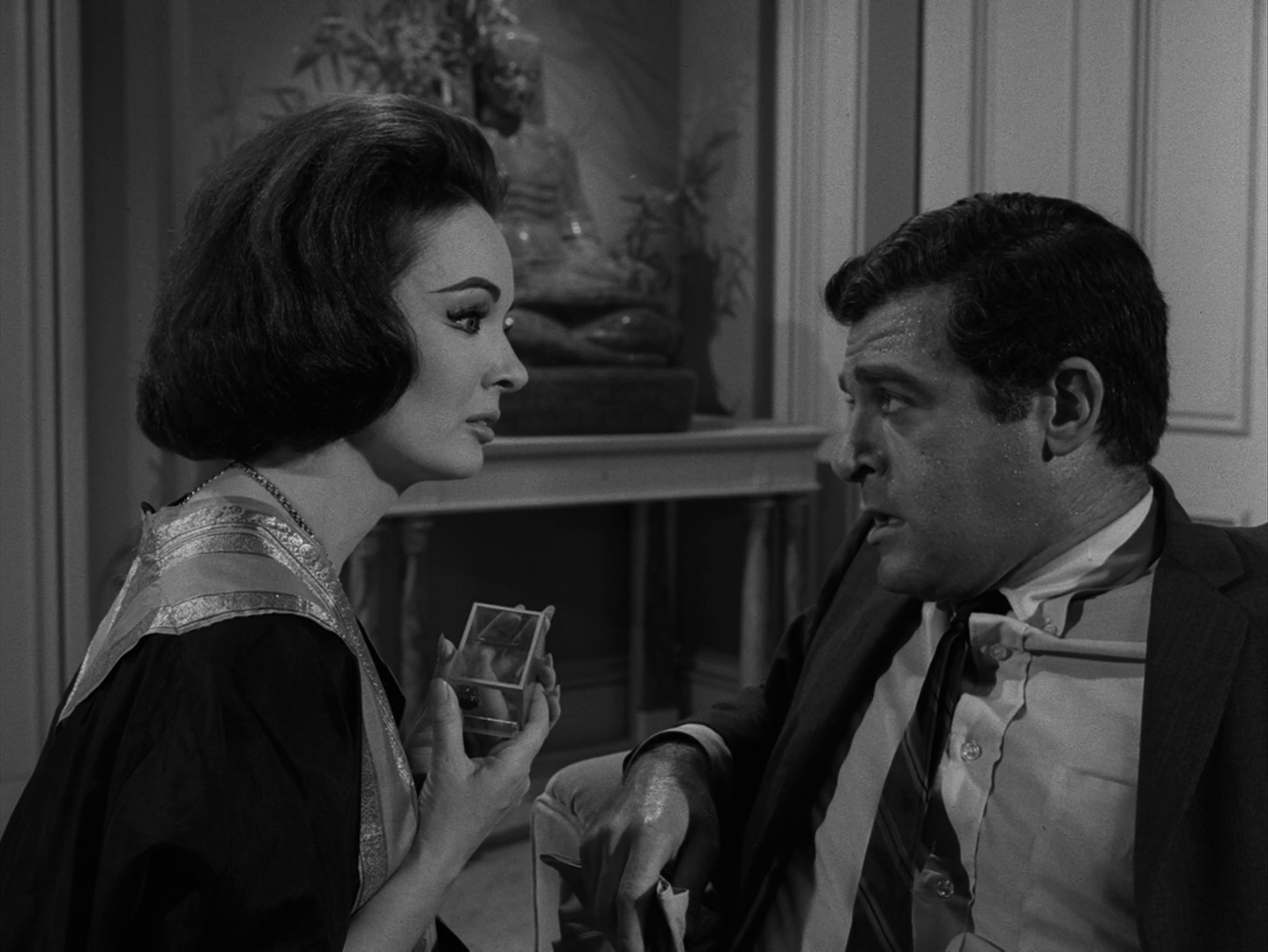
Herrick demands the truth, unaware that Pamela has slipped something into his coffee. She agrees to tell him everything, producing a small glass box, inside which is a live scarab beetle. As he becomes increasingly impaired, she reveals that, thanks to the scarab’s power, she has endured since the time of the Pharaohs. Jordan falls to the floor, unconscious, and Pamela places the beetle onto his chest.


Herrick rapidly ages, turning first to a skeleton, then finally to dust as the beetle saps the life force from him. Her immortality replenished, Pamela orders Viola to clean up the evidence.... just as another reporter arrives to interview her.


“Queen of the Nile” is the final Twilight Zone episode attributed to writer Charles Beaumont; however, like his other season five credits, he didn’t actually write it. Rapidly deteriorating from either Alzheimer’s or Pick’s Disease (it wasn’t easy to diagnose or differentiate them at that time; it’s a bit of a toss-up at this late date), Beaumont utilized a number of ghost writers; in this case he and Jerry Sohl blocked out the plot, and Sohl wrote the script. In this light, it’s easy to forgive the fact that the end result is quite similar to Beaumont’s earlier “Long Live Walter Jameson” from season one, particularly in the depiction of Herrick’s rapid aging and disintegration (the same color filter trick is used to achieve the first stage of both transformations). We do get a cool skull-crumbling bit this time around (see above); ultimately, both turn into an empty suit stuffed with dust.


The series has been borrowing from itself since the middle of the third season and, while “Queen of the Nile” is certainly guilty of that, it doesn’t bother me the way other guilty episodes do. For me, it serves at a decent bookend to “Long Live Walter Jameson” or, at the very least, an interesting variation on it. I’m comfortable acquitting it on the grounds that it’s entertaining, the acting is fine, there’s a nice sense of mystery that gradually changes to palpable dread, and it’s the only episode in the entire series with an Egyptian vibe. 

THE MUSIC


“Queen of the Nile” features an original musical score by Lucien Moraweck; however, we also hear a few selections from Bernard Herrmann’s “The Moat Farm Murders” during the climax (a suite of CBS library cues that originated from his radio days). The suite was first released by Cerberus Records as part of their 1986 vinyl album Bernard Herrmann: Music for Radio and Television and, more recently, on CD as part of Prometheus Records’ Bernard Herrmann: The CBS Years Volume 2: American Gothic. 


The Moraweck score, which is quite lovely and mysterious, has unfortunately never been released on any format, and is disappointingly not accessible as an isolated music track on the DVD and Blu-ray sets (as most TZ scores are).

DRAMATIS PERSONAE

In the director’s chair this week is John Brahm, who holds the distinction of directing more Twilight Zones than anyone else (including classics like “Time enough at Last,” “Mirror Image” and “Shadow Play”). “Queen of the Nile” is his twelfth and final contribution to the series.


Lee Philips (Jordan Herrick) returns for his second TZ appearance (he headlined last season’s “Passage on the Lady Anne”). He also co-starred in “The Galaxy Being,” the pilot episode of The Outer Limits, and he enjoyed multiple roles on both of Alfred Hitchcock’s TV series (“Alibi Me,” “The Deadly” and “Deathmate” on Alfred Hitchcock Presents and, later, “The Black Curtain” on The Alfred Hitchcock Hour).


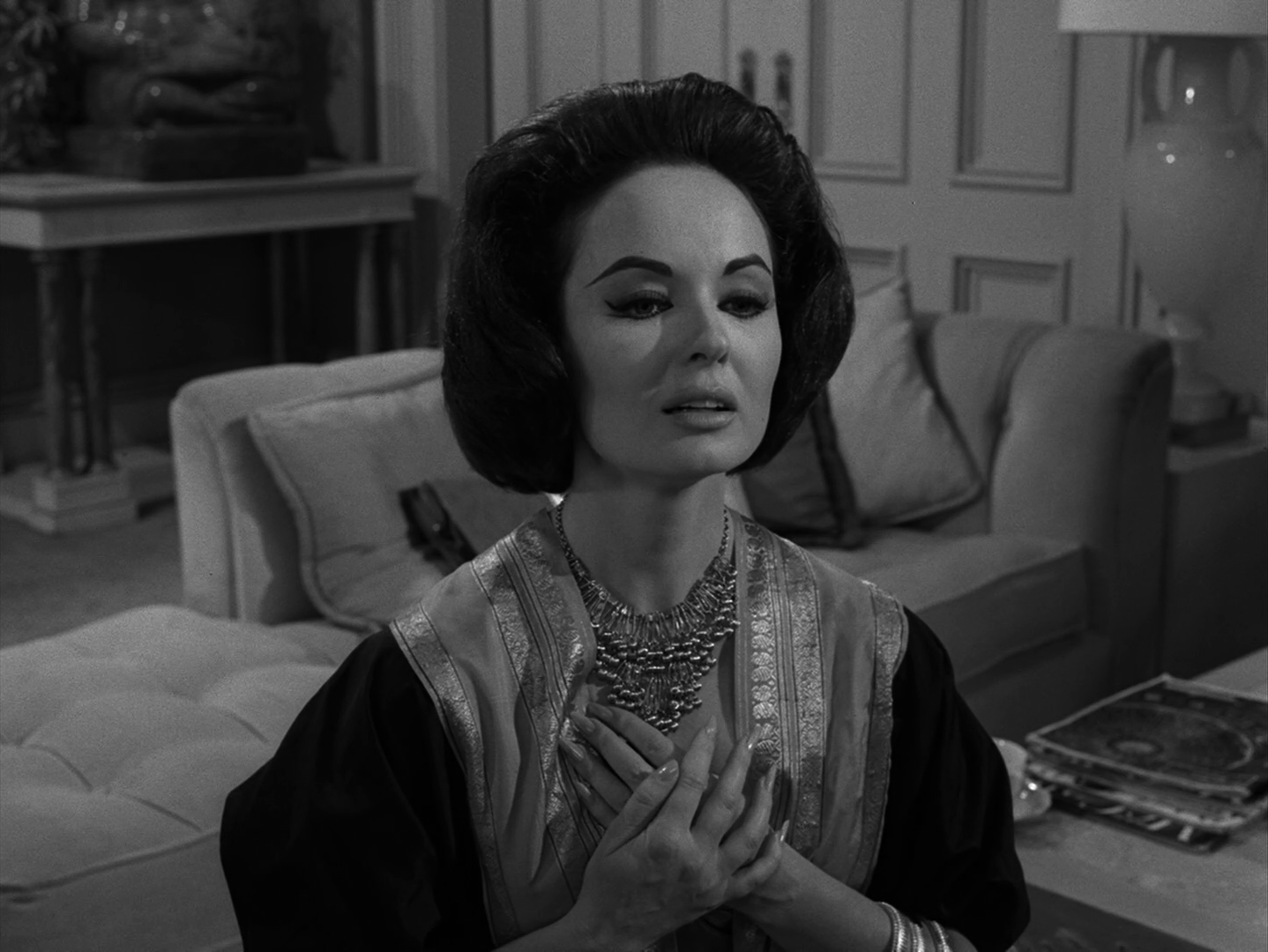
The beautiful Ann Blyth is radiant as Pamela Morris in her sole Twilight Zone appearance, which is also the only sci-fi/fantasy/horror credit on her resume. She did show up in a couple of notable film noirs in the 40’s, however (1945’s Mildred Pierce and 1947’s Brute Force). And yes, in case you were wondering, she qualifies as a TZ Babe.

Ann Blyth (right) with Joan Crawford.

Celia Lovsky is quite good as Viola Draper, Pamela Morris’s mother daughter, but of course genre fans will immediately recognize her as the Vulcan High Priestess T’Pau from the classic “Amok Time” episode of Star Trek. It’s also worth noting that she'd already crossed paths with Lee Philips, in the aforementioned Alfred Hitchcock Hour episode “The Black Curtain” in 1962.


After a fairly prolific film career in the 40’s and 50’s (including a few choice film noirs, among them 1942’s This Gun for Hire and 1952’s On Dangerous Ground, the latter of which, incidentally, was scored by frequent TZ music contributor Bernard Herrmann), Frank Ferguson (here playing Krueger, Herrick’s editor) enjoyed a fairly prolific TV career in the 60’s and 70’s; however, not much of it fell under the sci-fi/fantasy/horror genres. He did appear on one episode of The Alfred Hitchcock Hour (“Night of the Owl”), one Voyage to the Bottom of the Sea (“The Sky is Falling”) and one Land of the Giants (“The Marionettes”).

Frank Ferguson consoles TZ alum Ida Lupino.


“Queen of the Nile” is quite good by fifth season standards (if it had aired during the first season, I’d probably dismiss it as mediocre). The actors are engaging, the music is great, and it serves as a nice bookend to Beaumont’s earlier classic “Long Live Walter Jameson” (even though Beaumont didn’t actually write this one). 

That about wraps it up for this week, kids… as always, ankhs for stopping by.


Next week:
Yonkers! Yonkers! YONKERS!!!


Friday, January 24, 2014

Episode Spotlight: "Number 12 Looks Just Like You" (1/24/1964)


Season 5, Episode 17 (137 overall)
Originally aired 1/24/1964
Cayuga Production # 2618


50 years ago tonight, The Twilight Zone offered us a chilling glimpse of the future, where beauty really is only skin deep.


Marilyn is a troubled teen. She’s reached the optimal age to receive The Transformation, a government-sponsored program in which citizens are given beautiful faces and bodies. Those around her pressure her to choose a pre-designed model (her mother is Number 12, while her best friend Val is Number 8), but she fears the loss of individuality that will inevitably result. The Transformation is supposed to be optional, but nobody seems willing to let her remain herself.


Lana, Marilyn’s mother, finally sends her to a psychiatric clinic in the hopes that she’ll come to her senses. After an unproductive session, Marilyn attempts to sneak out… only to accidentally wander into the operating room, where the doctors are waiting to Transform her.


Lana and Val anxiously await her emergence. Marilyn bounds in the waiting room, full of smiling, empty joy. She’s now a Number 8. “And the nicest part of all, Val,” she coos, admiring herself in a mirror, "I look just like you!"


The smiling, vacuous characters surrounding Marilyn are similar to the denizens of François Truffaut’s 1966 adaptation of Ray Bradbury’s Fahrenheit 451: bereft of depth, relentlessly pro-conformity and chemically propped up. Their society has reached something of a zenith in plastic surgery technology; the next logical advancement would be in utero genetic intervention (a concept explored in 1997’s Gattaca, whose "Invalid" characters are those who haven't been genetically altered). In our world, however, I’m betting we’ll be resequencing DNA and predesigning babies before we ever figure out to perfect a boob job with no visible scarring.


I can’t help but imagine what lies behind the curtain of this future society. What kind of government are we dealing with here? I assume it’s some kind of dictatorship, given the push toward conformity (I’m reminded of The Leader’s speech in season two’s “Eye of the Beholder,” which shares common themes with this episode). I understand the overmedication approach, since a happy populace isn’t likely to ask questions or rise up against The Powers That Be. But why is it necessary to cosmetically modify the citizenry? It’s clearly a form of control, but to what end? They aren't all identical, since there are several “models” to choose from, so the goal isn’t absolute physical conformity. I dunno, maybe I’m looking too deep, when I should really just focus on the surface… wait, did someone slip some Instant Smile into my beer?


The costumes and dĂ©cor have a nice retro-futuristic flair; however, the lighting and staging of the episode is a fairly flat affair. That all changes in act two with Dr. Sigmund Friend’s shadowy office, which looks like something straight out of German expressionism (Friend’s German accent no doubt contributes to this). The institute's vast hallways appear to be the same as those seen in “The Long Morrow” two weeks ago.


The episode's teleplay is based on Charles Beaumont's 1952 short story “The Beautiful People.” However, like all Beaumont-credited episodes this season, he didn't actually write the teleplay: this one was written by John Tomerlin. Unlike other examples of Beaumont using ghostwriters, both get screen credit here.


THE MUSIC


The episode is stock scored; most of the music heard is from Bernard Herrmann’s “Brave New World” suite, which was originally composed for a radio adaptation of the Aldous Huxley classic. The suite was first released by Cerberus Records as part of their 1986 vinyl album Bernard Herrmann: Music for Radio and Television. It subsequently showed up on CD on Bernard Herrmann: The CBS Years Volume 2: American Gothic from Prometheus Records.

We also get a few snippets from Fred Steiner’s score for season two’s “A Hundred Yards Over the Rim,” which actually coexist quite nicely with the Herrmann stuff.


FAMILIAR FACES

Collin Wilcox is quite good as Marilyn in her only TZ appearance. Wilcox is best remembered as Mayella Ewell, who falsely accuses Tom Robinson of rape, in the 1962 big screen adaptation of Harper Lee’s To Kill a Mockingbird (which featured several TZ alums, among them William Windom, Robert Duvall, Frank Overton, and Mary Badham). She played a similar white-trash-type of character in “The Jar” on The Alfred Hitchcock Hour in 1964, which was written by Ray Bradbury and featured an original music score by frequent TZ contributor Bernard Herrmann.


TZ Babe alert! The lovely Suzy Parker is a treat for the eyes as the titular #12, the model inhabited by several characters in the episode (most notably Lana Cuberle, Marilyn’s mother). Parker would cross paths with Rod Serling again in 1970, in Night Gallery segment “The Housekeeper.”


Richard Long returns to The Twilight Zone as #17, which seems to the model every male in the episode chooses. We last saw him in season three’s “Person or Persons Unknown.”


And while Pam Austin (#8) doesn't seem to have any other genre connections, I'm gonna mention her because, yes, she's a TZ Babe (I'm assuming--- okay, hoping--- she was 18 when this episode was filmed).


“Number Twelve Looks Just like You” is a high point of The Twilight Zone’s fifth and final season. It succeeds as an effective meditation on beauty and conformity (and serves as a perfect bookend to season two’s “Eye of the Beholder”); however, on a more, ahem, surface level... well, it’s just plain fun to watch. You might say it brings an Instant Smile to my face.


Next week:
If The Fonz was from outer space… and there were three of him…


Friday, November 1, 2013

Episode Spotlight: "Living Doll" (11/01/1963)


Season 5, Episode 6 (126 overall)
Originally aired 11/01/2013
Cayuga Production # 2621


Fifty years ago tonight, a mean ol’ sumbitch matched wits with a doll… and lost miserably. Jeez, wotta wuss.


Erich Streator is your average everyday wicked stepfather. Overbearing and cruel, he makes life miserable for his wife Annabelle and stepdaughter Christie on a daily basis. When Annabelle buys Christie a new Talky Tina doll, Erich is clearly perturbed because, well, nobody in his house should ever enjoy anything. Kinda reminds me of my stepdad when I was a kid.


Hi Daddy! Meet your adorable new nemesis!

“My name is Talky Tina, and I love you very much,” coos Tina whenever her string is pulled. But whenever she’s alone with Erich, she says other, more interesting phrases: they start with “I don’t think I like you” and quickly escalate to “I’m going to kill you.” The aforementioned battle of wits escalates from there and, to borrow a catchphrase from Highlander: there can be only one.


ZICREE RAPED MY CHILDHOOD!


I was pretty new to the series when I first read Marc Scott Zicree’s The Twilight Zone Companion in 1982, and there were many episodes that I hadn't seen yet, one of which was “Living Doll.” Zicree’s comments on the episodes are as follows:

“Erich Streator is trying desperately not to alienate his wife and her young daughter. When the child brings home a doll that makes clear its murderous intentions --- but only when it's alone with him --- Erich is in one hell of a bind. If he tries to tell his wife of it, he sounds like a lunatic, and if he tries to protect himself by attempting (unsuccessfully) to destroy the doll, his actions seem those of a twisted mind striking out resentfully to hurt a helpless little girl. Poor Erich; it is clear early on that he hasn't much of a chance against this ruthless doll.” 

Whatchoo talkin' 'bout, Zicree?

This was all I knew about “Living Doll” until I finally saw it a few years later. I was expecting to see a basically decent guy get decimated unfairly by an evil doll; imagine my surprise to discover that said “decent guy” was actually the villain of the piece! Did Zicree even watch the episode before writing about it? He couldn't have possibly sympathized with Erich Streator AT ALL if he had; however, the excessive praise he heaps on it would seem to imply that not only had he seen it, but had deemed it absolute top tier Zone: “Masterfully written and superbly directed, acted, photographed and scored, it is an episode that can stand with the best of any season.”  It was at this point, at the tender of age of 13, that I had the sobering realization that Zicree was perhaps not the be-all-end-all Twilight Zone expert that I’d assumed he was. I mean, he’d written a goddamned book about it; how the hell could he have been so incredibly wrong?

I think, in describing this dark event in my TZ-formative years, I've figured out why I’m so hostile toward Zicree. Serling was my new idol (after outgrowing such childhood heroes as Spiderman and Luke Skywalker), but he died before I ever heard his name, so Zicree, having chronicled Serling’s wonderful TV series, was the closest I could get to him. And the son of a bitch let me down by being so blatantly wrong about something so obvious. Erich Streator was a bad guy; he deserved what he got. This was the cosmic justice that lay at the very heart of The Twilight Zone, which even I understood at that early age. If Zicree didn't understand that, then who was he to write the book in the first place?

Ahem. I think I might just have exorcised a serious demon here. Maybe now I can move on with my life. Maybe I can even forgive Mr. Zicree his egregious trespasses against my inner child. Maybe.

Okay, therapy session over. Let’s move on.


“Living Doll” has a great concept (which is unfortunately pretty clichĂ©d nowadays; I’m looking at you, Child’s Play franchise) which, coupled with Telly Savalas’s fantastic bad-guy-you-love-to-hate performance, makes for a highly entertaining half-hour (except for the last thirty seconds; see below). Unfortunately, it’s pretty flat on a visual level, the exception being when the action moves to Erich’s garage, where he attempts to dispose of Tina in a number of ways (she’s definitely more menacing in semi-darkness). Still, these scenes offer nothing on the level of, say, season three’s “The Dummy” (which features a menacing ventriloquist’s dummy framed by complex camera work with marvelous lighting).  And the final shot of the episode, in which slow-motion is abruptly employed for no apparent reason, does nothing to advance the mood (and was likely done to stretch out the ending to accommodate Serling’s closing narration, which suggests poor planning during filming).  

In fact, the ending is disappointing in general, since having Tina murder Erich is the easiest possible conclusion. Why not have Erich scared straight, so to speak, and forced to treat his family better under Tina’s ongoing supervision? Further, why the hell does Tina threaten Annabelle (Christie’s one and only champion) after Erich is dispatched? Up until this point, the episode was operating under the cosmic justice approach (discussed in detail last week) but, in the final moment, gears are abruptly switched over to something more akin to chaos theory. It seems Tina is just an all-around evil doll (yawn) instead of a protective shield for a mistreated child (infinitely more satisfying) after all.

One minor bid of weirdness. Annabelle says to Erich that “I know you got more than you bargained for when you married me; two for the price of one, wasn’t it?” Um… surely he was aware that she had a kid, right…? If he wasn’t, then I’m almost willing to cut him some slack for being such an asshole. On that note, surely she was aware that he was a profoundly mean bastard, so why the hell did she marry him in the first place? 


Jerry Sohl and Charles Beaumont

“Living Doll” is the first of three episodes credited to writer Charles Beaumont this season. Unfortunately, he didn't actually write any of them, as by this time his health was rapidly deteriorating (he passed away in 1967). In this particular case, Beaumont mapped out the plot with Jerry Sohl, who ghostwrote the script.


THE MUSIC


“Living Doll” features another great score from Bernard Herrmann. As a fan(atic) of his work, I find it fascinating to compare his Twilight Zone work with the film scores he composed around the same time (for example, his score for 1959’s Journey to the Center of the Earth shares similar instrumentation with TZ’s “The Lonely” from that same year). His sole film score in 1963 was Jason and the Argonauts which, now that I think about it, doesn’t really sound like “Living Doll” at all.  Here, Herrmann employs a very small ensemble (two harps, celesta and bass clarinet) to create moody, suspenseful cues that perfectly underline the escalating psychological warfare between Erich and Talky Tina. The original Herrmann recordings have never been properly released; however, they can be obtained via the isolated music tracks present on both the DVD and blu-ray sets of season five (from Image Entertainment).  


Additionally, Joel McNeely recorded all seven of Herrmann’s Twilight Zone scores in 1999 for a 2-CD set released by Varese Sarabande Records (which was the only game in town for 4/7ths of Herrmann’s TZ output before Image came along). I do have some issues with some of McNeely’s interpretations (some cues are too fast while others are too slow; further, much of “Where Is Everybody?” just sounds off to my ears); however, his take on “Living Doll” is quite good (though it’s no match for the original recording).


FAMILIAR FACES


Telly Savalas, who has a long history of imposing and often malevolent characters on his resume, is perfect as Erich Streator.  This is his only TZ appearance, but he does have another connection to the series: he appeared in 1962’s Cape Fear, which was scored by Bernard Herrmann (and co-starred TZ vets Martin Balsam, Edward Platt and Paul Comi). Savalas also played super villain Ernst Stavro Blofeld in 1969’s On Her Majesty’s Secret Service, one of my favorite James Bond films.


Mary La Roche (Annabelle Streator) previously entered The Twilight Zone as Mary, Gregory West’s mistress, in season one’s “A World of His Own.” Here she plays an unhappy wife, so I guess she got to play both sides of the extramarital fence (though I guess Erich isn't depicted as an adulterer; but honestly, would we be surprised?).


Tracy Stratford is convincingly sad and under-loved as Christie (she was also Tina in season three’s “Little Girl Lost,” which was also scored by Bernard Herrmann. Wait, so first she played Tina, then she had a doll named Tina… is it possible that Talky Tina came from the fourth dimension?). Additionally, Stratford provided the voice of Lucy Van Pelt in the 1960s Charlie Brown TV specials. So when Annabelle tells Erich to see a psychiatrist, I wonder if she meant….

Good grief! Uh, I mean... who loves ya, baby???

And hey, Telly Savalas and Charlie Brown are both bald. Coincidence?  I dunno… maybe Charles Schulz was a Twilight Zone fan…?


June Foray, probably the hardest working voice actor in Hollywood, provides the unforgettable voice of Talky Tina. She’ll also do some (slightly controversial) dubbing later this season in “The Bewitchin’ Pool,” but she has another less-obvious TZ connection as well.  80’s kids like me will have no trouble remembering the 1985 film Weird Science, but do you remember the TV spin-off, which lasted five seasons (1994-1998) on the USA Network? In the episode “Sci-Fi Zoned,” the main characters are trapped inside black and white episodes of their favorite TV show (a thinly-veiled TZ knockoff called The Sci-Fi Zone), one of which involves a murderous doll named “Talking Tammy,” who is voiced by…. yup, you guessed it, June Foray (she also voices a sentient candy bar named “Baby Ruth” in the same episode).


An iconic episode like this is almost guaranteed to spawn a parody somewhere along the line. Like “Nightmare at 20,000 Feet” a few weeks back, “Living Doll” got the Simpsons treatment in 1992’s “Treehouse of Horror III,” in which a Krusty the Klown doll menaces Homer Simpson (“Clown without Pity”). Also of interest to genre fans is the framing device employed in this episode, which is patterned after TV’s Alfred Hitchcock Presents and features the rotund Homer standing in for Hitch.

Good morn--- D'oh!


Bif Bang Pow! has immortalized Talky Tina in every conceivable form (a talking bobblehead, action figure, and a fully-functioning life-sized replica). The bobblehead seems to be sold out but, as of this writing, the action figure and life-size replica are still available through Entertainment Earth (but, as with any collectible, they won’t be around forever). I can’t comment on the life-sized replica since I don't own it (c'mon, how could I possibly justify buying a fucking doll? For over a hundred bucks, no less!), but I've reviewed the other two (see here and here).


Questionable ending aside, “Living Doll” is great fun and a definite highlight of The Twilight Zone’s fifth and final season. Other than the misfire “A Kind of a Stopwatch” two weeks ago, season five’s offerings have ranged from good to excellent… unfortunately, the quality is about to start dipping in a big way.  Stay tuned, but temper your expectations from here on out.


Next week: Hoo boy. Where’s Charles Bronson and Elizabeth Montgomery when you need ‘em?