Showing posts with label Robert McCord. Show all posts

Thursday, April 10, 2014

Episode Spotlight: "Caesar and Me" (4/10/1964)


Season 5, Episode 28 (148 overall)
Originally aired 4/10/1964
Cayuga Production # 2636


Fifty years ago tonight, The Twilight Zone brought us yet another pint-sized anthropomorphized terrorist.


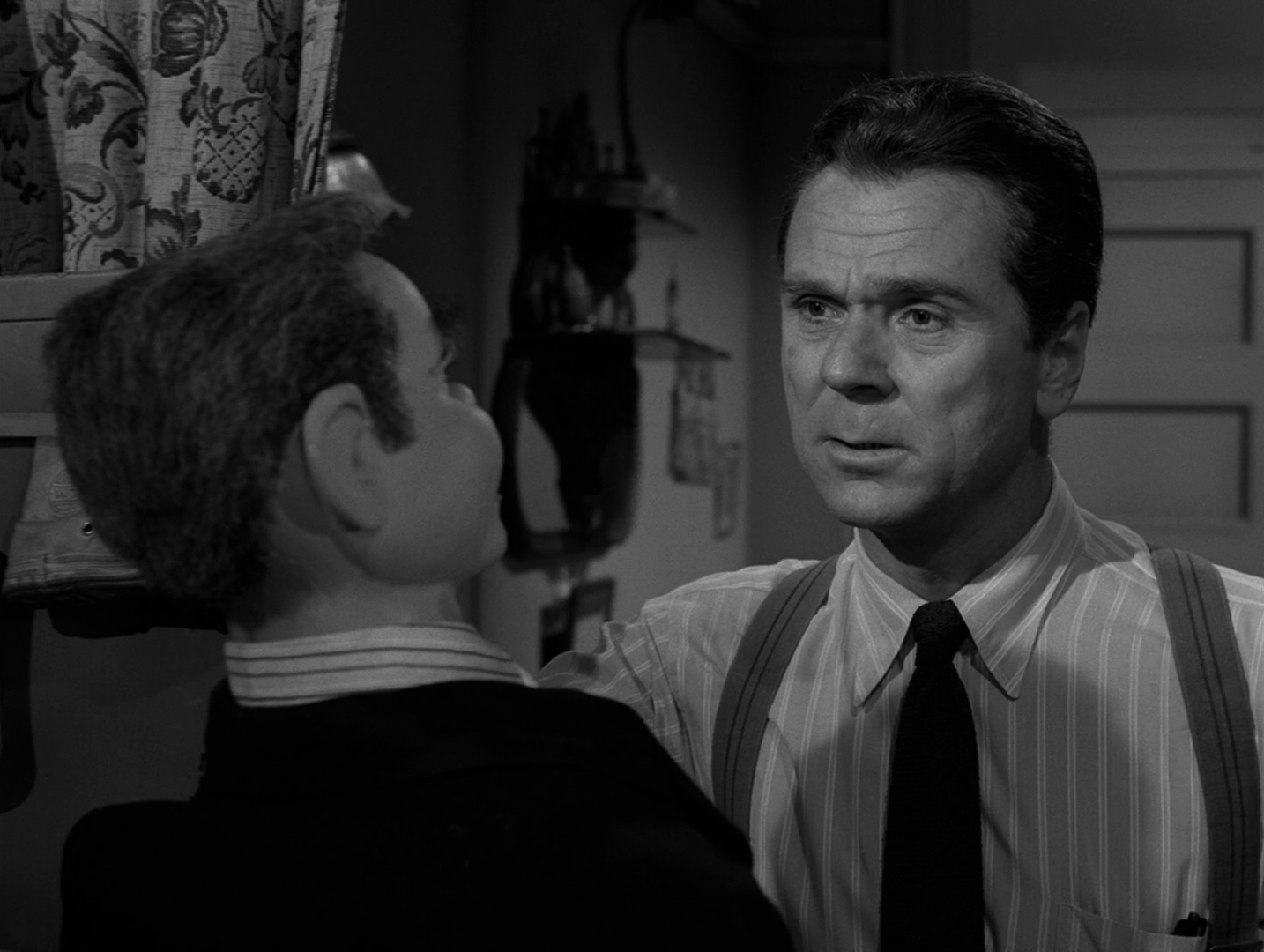
Jonathan West is an Irish immigrant trying to make a living as a ventriloquist and failing miserably. Susan, his landlady’s niece, torments him relentlessly. His dummy, Caesar, is inexplicably alive (and sounds like a bad Humphrey Bogart impersonator) and convinces him that he’ll have to stoop to petty theft in order to stay afloat. 


West successfully robs a local delicatessen and gets his rent caught up, much to Susan’s chagrin. With a full belly and a few belts of (presumably Irish) whiskey for courage, he cracks the safe of a local club. The night watchman spots him, but he’s able to charm his way out with Caesar’s help.


Susan is delighted to discover West’s guilt (she’s an expert eavesdropper) and promptly reports him to the authorities. He’s hauled away, leaving Caesar to start making plans with the scheming Susan…. he knows where West hid the loot, after all.


Dos Dummies: Willie (left) and Caesar. Are they the same exact dummy? They look awfully similar....


.
“Caesar and Me” is of course a second-rate copy of season three’s “The Dummy,” a Rod Serling effort that is superior in every respect. In that episode we witnessed an alcoholic ventriloquist on the verge of a nervous breakdown, locked in mortal combat with a dummy that would ultimately take over his life (and transform him into a wooden dummy in the process). Here we have a dummy that is alive for no apparent reason other than to ruin its puppeteer and take up with an evil little girl. When Caesar convinces the kid to murder her aunt and run away with him, it’s painfully clear that the series has completely given up doling out cosmic justice. The lunatics have taken over the asylum, and all bets are off.

“Caesar and Me” was written by Adele T. Strassfield who was series producer William Froug’s secretary (I could speculate about what she probably had to do in 1964 to get her “cute little script” produced… but I won’t), the sale of which launched an extremely brief career in which she sold a total of three television scripts. And yeah, this one sure as hell ain't great… but to put things in perspective, it’s quite a bit better than last week’s “Sounds and Silences,” which was a Serling script.


In the director’s chair is Robert Butler (who will also direct May’s “The Encounter”), who would go on to a few notable genre gigs: he directed three episodes of The Invaders (“Panic,” “The Enemy,” and “The Trial”) and the original Star Trek pilot (“The Cage,” most of which would be recycled as flashback footage in the two-part “The Menagerie”). I was especially tickled to learn that he directed the pilot episode of TV’s Moonlighting, which was my favorite TV show in the late 80’s.


.
THE MUSIC


The only positive aspect of “Caesar and Me” is the original score by Richard Shores, who is probably best remembered for his extensive compositional contributions to TV’s Perry Mason (though he isn’t responsible for that show’s famous theme; we have Fred Steiner, another TZ composer, to thank for that). His work here features some very effective dramatic and mysterious cues, and it’s a real shame that it’s never been released on any of the series’ myriad soundtracks. The DVD and Blu-ray sets include many isolated music tracks, which has historically been a great resource for obsessive TZ music collectors (like yours truly); however, as with several other season five episodes, “Caesar and Me” lacks this feature.

.
DRAMATIS PERSONAE

Top o' the morning to ya laddie! Jackie Cooper is sufficiently morose as the Danny Boy-stereotype Jonathan West. Genre fans might recognize him as the Daily Planet editor Perry White in all four Christopher Reeve Superman films (1978-1987).


Susanne Cupito is quite convincing as the vile little snot Susan. Cupito also appeared in season one’s “Nightmare as a Child” and season four’s “Valley of the Shadow”; she also popped up on The Outer Limits (“The Inheritors, Part 2”). She grew up to be breathtakingly beautiful and, when she turned 18, she changed her professional name to Morgan Brittany.


Stafford Repp (left) plays the unnamed pawnbroker in the prologue (we've seen him twice before: he was the auto mechanic in season two’s “Nick of Time,” and Ira Broadly in season three’s “The Grave”; below left). Mr. Smiles, the clerk at the unemployment office, is played by Olan Soule (right), who played the IRS agent in season two’s “The Man in the Bottle" (below, right).


The unnamed man watching West’s pathetic audition in act one is played by Robert McCord, who can be seen in over a third of the series’ 156 episodes, usually as an easy-to-miss extra (see my recent spotlight on “What’s in the Box” for more).


Ugh. I don’t hate “Caesar and Me,” but I sure as hell don’t like it much. Been there, done that, that's it, that's all there is.


Next up:
Martin Landau searches The Jeopardy Room, but can’t find Alex Trebek anywhere.


Thursday, March 13, 2014

Episode Spotlight: "What's In the Box" (3/13/1964)


Season 5, Episode 24 (144 total)
Originally aired 3/13/1964
Cayuga Production # 2635


Fifty years ago tonight, a miserable couple’s constant bickering escalated to violence and murder. So yeah, good times.


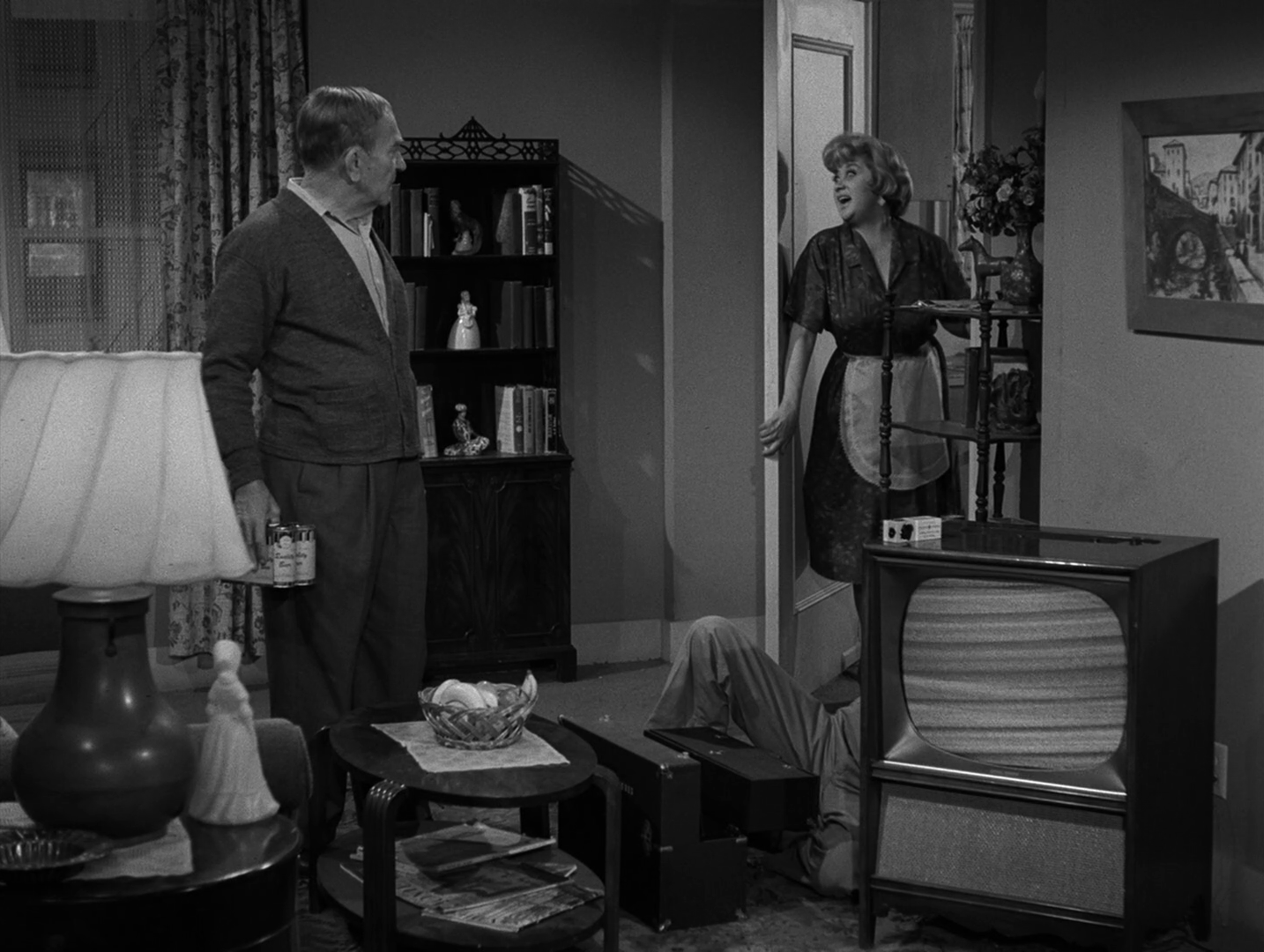
“What’s in the Box” finds NY cabbie Joe Britt impatiently waiting for a repairman to finish fixing his TV before his beloved wrestling comes on. The repairman’s response to Joe’s accusations of larceny is to give him the repair for free, which sounds incredibly nice… but there’s just something creepy about the guy.

Britt turns on the set and is shocked to see himself in the company of his mistress, a scene that occurred earlier that evening (he was late coming home from work, arousing his wife Phyllis’s suspicion). He immediately suspects that Phyllis is somehow in cahoots with the repairman (never mind that such a plot would be highly difficult, if not impossible, in 1964; it would actually be relatively easy to pull off today), escalating the tension between them.


The TV then shows him a scene in which he and Phyllis get in what amounts to an all-out brawl, culminating in her death. Shaken, Joe attempts to apologize to her for his philandering, which only serves to make Phyllis angrier. He then sees himself tried and sentenced to death for the murder and punches out the TV screen in dismay.


Phyllis then berates and humiliates him, which sets off the brawl he witnessed earlier. It ends the same, with him punching her through a window. The police bust in and, as Joe is hauled away, the TV repairman appears and asks that Joe recommend his “service” to others.


“What’s in the Box” is written by newcomer Martin M. Goldsmith (who will also contribute “The Encounter” in May). Goldsmith wasn’t terribly prolific during his twenty-year career, but he did write one of my all-time favorite film noirs, 1945’s Detour. In the director’s chair is Richard L. Bare, on hand for his seventh and final turn at the helm which is, sadly, his least impressive (his previous credits are as follows: “Third from the Sun,” “The Purple Testament,” “Nick of Time,” “The Prime Mover,” “To Serve Man,” and “The Fugitive”). If he’d only turned down this gig, he’d have an unblemished TZ record (he’d go on to direct a whopping 166 episodes of Green Acres, however, so I guess he was destined not to be taken too seriously).

Only Joe can see and hear the TV’s prognosticating broadcasts, which suggests that they may be hallucinations, his mind creating an elaborate construct through which to process guilt or trauma, something we've seen on The Twilight Zone before (“Nightmare as a Child,” “The Arrival”). However, we know that the repairman is real, and the events that unfold before Joe’s TV-addicted really do end up happening, so it's clearly not all in his head. So what’s really going on here, then?

Who is this TV repairman? He must be some supernatural force, but for what? His so-called “services” didn’t serve anyone: the Britts’ lives are destroyed, and why? Because Joe couldn’t keep it in his pants? Is that really cosmic justice? That’s a rhetorical question, because I’ll state for the record right here and now: it sure as hell isn’t. I’m not necessarily advocating infidelity, but I’m also very aware that relationships suffer for a variety of reasons, and people can be excruciatingly lonely within them. I’m not saying cheating is okay… I just understand how it can happen. So Joe’s getting some on the side. Does that mean he deserves to fry in the electric chair?  Absolutely not, but even if it did, the chain of events started by the TV repairman brought about Phyllis’s death too, so it’s a pretty goddamned moot point. This is chaos, plain and simple. I’ve talked at various points this season about the loss of the series’ moral compass as it winds down. “What’s in the Box” is yet another example of that.


There seems to be an attempt to lampoon the sillier aspects of television (the inanity of pro wrestling, the obnoxiousness of used car salesmen, etc.), which we also witnessed in season two’s “Static.” In that earlier effort, those isolated bits were appropriate since there was a clear effort to contrast radio with TV. Here, they just sorta hang there, unconnected to anything, for no apparent reason other than to fill time.

When Phyllis is berating Joe for sneaking around instead of coming home on time, she suggests that “maybe (he) went to Yonkers twice.” Is that intended as sexual innuendo? Is Phyllis implying that Joe in fact scored twice in one extramarital encounter? If so, I’ve gotta applaud Cayuga for getting it past the censors.


While Joe watches his climactic fight with Phyllis unfold on his TV, the musical cue (“Mistral #1” by Marius Constant) that will accompany the actual scene later is heard. This means that Joe can actually hear the underscore, which is pretty amazing when you think about it.  Or maybe it’s laziness on the editor’s part, I dunno.


Two police officers break into the Britt apartment, guns drawn, exactly 25 seconds after Phyllis crashes through the window to her death. We’re never told which floor they live on, but it’s safe to assume that it’s several flights up. Even if the officers happened to be passing by at the moment she kissed the sidewalk, and watched her entire fall, and knew the building well enough to pinpoint exactly which apartment she fell from… well, I think you know where I’m going with this. You've heard the old adage “there’s never a cop around when you need one”? Well, these cops are beyond fast. Maybe they had a future-telling TV at the precinct.  Or… maybe they’d already been called, since the Britts’ racket was undoubtedly disturbing several neighbors. Yeah, that’s much more probable, but much less fun to consider.


DRAMATIS PERSONAE

William Demarest plays Joe Britt in his only TZ appearance. Demarest appeared in the 1948 film noir Night Has a Thousand Eyes, plus he appeared on Alfred Hitchcock Presents (“And the Desert Shall Blossom”) in 1958.


Joan Blondell (Phyllis Britt) also has a classic film noir on her extensive resume (1947’s Nightmare Alley); however, my wife Teresa would most likely recognize her from her role as Vi in 1978’s Grease, one of her all-time favorite films.


Sterling Holloway plays the impish and slightly-malevolent TV repairman. He’s probably best remembered for his vocal work in several Disney films, most prominently The Many Adventures of Winnie the Pooh, in which he voiced the titular bear. His distinctive voice could also be heard in the “Atomic Shakespeare” episode of TV’s Moonlighting, one of my favorite 80’s shows.


We have a trio of TZ vets in the supporting cast. The judge who sentences Britt to death is played by Howard Wright, who last appeared in season three’s “The Jungle”). The prosecuting attorney (who is only heard, not seen) is played by Douglas Bank, who will return for “I Am the Night – Color Me Black” in two weeks. Finally, Britt’s unnamed chickadee on the side is played by Sandra Gould, who played another unnamed woman in season three’s “Cavender Is Coming.”

Robert L. McCord III appears in an uncredited role as one of the two guards that strap Britt into the electric chair in the TV’s final future scene. According to his IMDB page, McCord appeared in more than 60 (!) Twilight Zones, far more than any other actor, almost invariably in small, uncredited background roles. However, he did manage to land a few more visible characters, including the Burke wax figure in season four's "The New Exhibit," the sheriff in season two's "A Hundred Yards Over the Rim," the ice cream man in season one's "The Monsters Are Due On Maple Street," and the shooting gallery attendant in season five's "In Praise of Pip."


I've been a diehard TZ fan for over thirty years now. How the hell did I never know about McCord until now? I suddenly feel like an amateur. I hate discovering this fascinating item now, near the end... I would've done an ongoing "Robert McCord" alert every time he showed up (like I've done with my Forbidden Planet alerts). And here I was, thinking I was so clever with my David Armstrong sightings. Damn, damn, damn. The Twilight Zone Museum has a nice piece about this amazing individual here.


“What’s in the Box” is a textbook missed opportunity. What if Joe learned the error of his ways, thanks to the TV repairman’s ministrations, and salvaged his marriage to Phyllis? Then it starts sounding like the Twilight Zone we all know and love, doesn’t it? But it’s not. As it slips into its final death throes, it feels like a different show entirely.


Next week:
Speaking of death throes, Jason Foster is about to check out. But first…. revenge!