Showing posts with label Rene Garriguenc. Show all posts

Sunday, October 20, 2019

3x12 "Hit Me with Your Best Slot"


This week, Craig spins the cosmic roulette wheel in honor of the Twilight Zone classics “The Fever” and “The Prime Mover” while self-medicating an ongoing sinus malfunction with a single-malt Scotch. Take my advice and roll the dice, baby.

“Neither Here Nor There (Viva Las Version)” by Twin Loops

“The Hong Kong Triad” performed by Thievery Corporation (from the album The Mirror Conspiracy, copyright 2000 by ESL Records)

“Hanukkah in Vegas” performed by Richard Cheese and Lounge Against the Machine (from the album Cocktails with Santa, copyright 2013 by Coverage Records)

Watch Robert Florey’s The Life and Death of 9413: A Hollywood Extra at https://vimeo.com/212551702

The Goldsmith Odyssey Podcast: https://www.buzzsprout.com/159614

The Twilight Zone is a trademark of CBS, Inc.

Between Light and Shadow: A Twilight Zone Podcast is a nonprofit podcast. Music clips and dialogue excerpts used herein are the property of their respective copyright owners; we claim no ownership of these materials. Their use is strictly for illustrative purposes and should be considered Fair Use as stated in the Copyright Act of 1976, 17 U.S.C. section 107.

Sunday, October 6, 2019

3x11 "We All Scream for Jet Stream"


Check your bags and try to avoid a TSA cavity search as you board tonight’s double-feature flight into the unknown. Craig takes the yoke and performs aerial maneuvers over, under and through the classic Twilight Zone episodes “The Last Flight” and “The Odyssey of Flight 33.” In the final analysis, only one will emerge unscathed. Along the way Craig struggles with French pronunciations, extols the glory of stop-motion dinosaurs and powers through some kind of sinus malfunction. Mon dieu!


Theme: “Neither Here Nor There (9/22/2019 Revision)” by Twin Loops

“Sunny” performed by Dave Pike (from the album Jazz for the Jet Set, copyright 1966 by WEA International)

“Interlude” performed by Thievery Corporation (from the album The Richest Man in Babylon, copyright 2002 by Eighteenth Street/ESL Music)

“On Danse a la Villette” and “La Vraie Valse Musette” performed by Basil Bunelik (solo accordian)

“Royal Air Force March Past” performed by the Central Band of the Royal Air Force (from the album On Tour: Central Band of the Royal Air Force, copyright 1995 by Cala Records)

“Serenata” performed by The Jonah Jones Quartet (from the album Great Instrumental Hits, copyright 1961 by Capitol Records)

"The Return of the Red Baron" performed by The Royal Guardsmen (from the album Snoopy and His Friends, copyright 1967 by Laurie Records)

The Twilight Zone is a trademark of CBS, Inc.

Between Light and Shadow: A Twilight Zone Podcast is a nonprofit podcast. Music clips and dialogue excerpts used herein are the property of their respective copyright owners; we claim no ownership of these materials. Their use is strictly for illustrative purposes and should be considered Fair Use as stated in the Copyright Act of 1976, 17 U.S.C. section 107.

Friday, February 21, 2014

Episode Spotlight: "Spur of the Moment" (2/21/1964)


Season 5, Episode 21 (141 overall)
Originally aired 2/21/1964
Cayuga Production # 2608


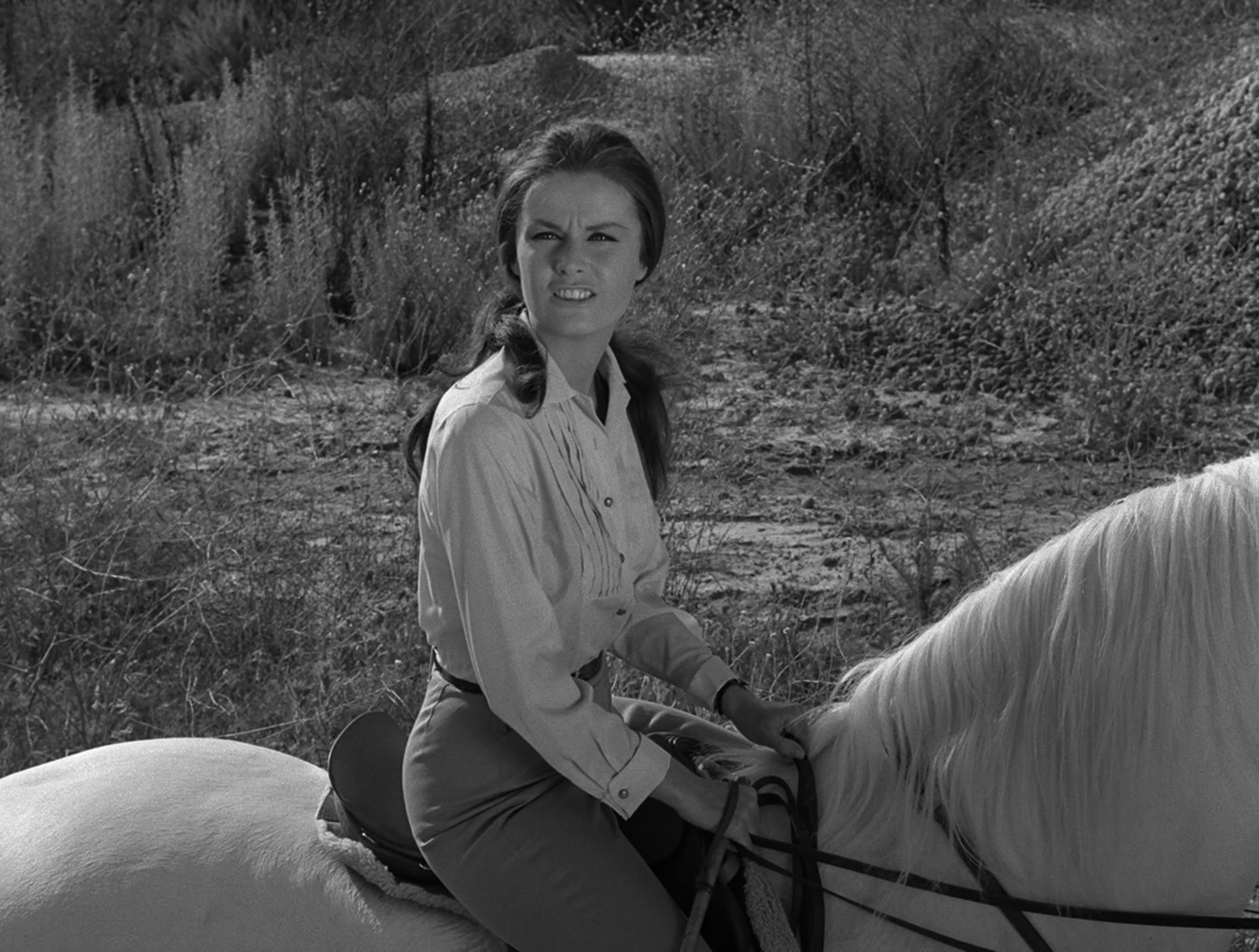
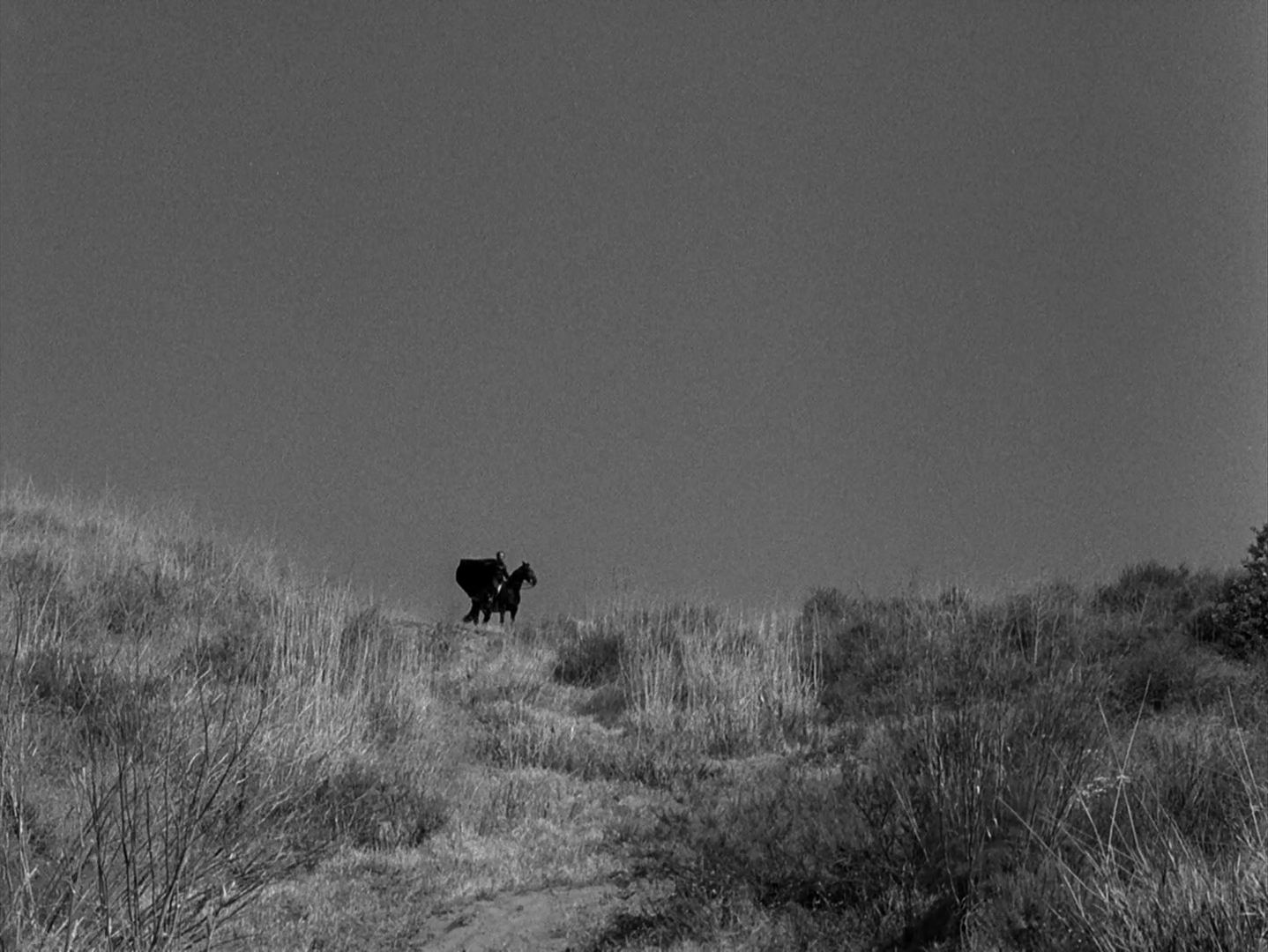
Young Anne Henderson is out for a relaxing horseback ride on her family’s sprawling Southern estate. Atop a hill, an ominous figure appears, also on horseback, clad in black and, with a blood-chilling shriek, tears down the hillside on an intercept course. Anne, naturally frightened, heads hurriedly for home. An exciting prologue, right? Who is this mysterious harbinger of doom? Is it a vicious demon? A vindictive ghost? Or maybe our old friend “The Hitch-hiker,” now traveling by horse instead of thumbing rides?


Viewers fifty years ago tonight quickly realized that it was none of those things. Thanks to a questionable (or, more to the point, stupid) directorial choice, we see the identity of Anne’s pursuer immediately. It’s herself, older and apparently really pissed off. 


Young Anne is about to marry Robert Blake, who has a bright future ahead of him and whom her parents approve of. However, her heartstrings are being seriously tugged on by no-good loafer David Mitchell, who implores her to run away with him, much to everyone’s chagrin.  

Meanwhile, 25 years in the future, the Henderson mansion is in a state of advanced disrepair and is about to be foreclosed upon. Nursing a stiff drink, Anne blames her dead father for spoiling her when she was young, which led to her choosing the wrong man. David enters, drunkenly taunting her. She flees the house, mounts her horse, and rides to the hilltop… and looks down at her younger self. She races down the hill and gives chase in what will be, as it always is, a futile pursuit.


Exceedingly melodramatic and painfully soapy, Richard Matheson's “Spur of the Moment” isn’t one of season five’s better offerings. Young Anne is excruciatingly annoying, a drama queen clearly desperate for attention. Future Anne is abrasive and bitter, blaming her shitty life on the fact that her father spoiled her as a child. Um, seriously? Marrying David was a bad choice, and maybe it happened partially because of her spoiled-child-rebellion-phase, but what’s prevented her from divorcing him at some point in the 25 years that he’s been making her life miserable? It’s her that’s opted to stay with his sorry ass, not her deceased father.

We only know the woman in black’s identity because the camera pans in for a close shot of her face, yet somehow Anne can see her “glaring” at her from the top of the hill (which would be impossible from that far away). By the same token, Future Anne couldn't possibly recognize her younger self from that distance; however, it’s more puzzling why she’d assume it’s her younger self at all (we know it’s The Twilight Zone, but she doesn’t).


Nitpicking aside, what exactly is happening here? Future Anne sees her young self… how, exactly? Is it the power of her own unhappiness, creating a kink in space and time, allowing her the opportunity to influence her younger self? I could buy it if it were a single event, in which she tries but fails to change the past, reinforcing the permanence of the past… but Anne indicates that she’s seen her younger self repeatedly, and does so again at the end of the episode. The opening scene is replayed, so apparently Future Anne’s created herself a time loop of sorts. She can apparently revisit this moment in her past as often as she likes, but she’ll never successfully get her younger self’s attention to sufficiently warn her away from marrying David…. but y’now, this is problematic too. She could easily opt to NOT scream like a banshee, and instead calmly descend the hill. Or maybe somehow, once they both occupy the same space, everything is locked into place, and Future Anne is helpless to change it. I dunno. We've seen characters interact with themselves before (“Nervous Man  In a Four-Dollar Room”; “The Last Night of a Jockey”), but here the Annes never actually get that opportunity, the maddening frustration of which is the whole point, I imagine.

Anne and Yang.


As repellent as both Annes are, the episode isn’t exactly a total loss. I suppose the production values are fine; I think this is the only time in the entire series that we see a full-on chase on horseback. The costuming choice to have Future Anne wearing all black and riding a black horse (symbolizing the darkness of her life) and Young Anne wearing all white and riding a white horse (symbolizing her relative purity) is a nice touch, if a bit obvious. The juxtaposition of the Henderson mansion in the two different time periods (pristine in the family’s happier, richer days, run down and almost devoid of furniture in the dark future) is effective.


When Future Anne throws her drink at David before running off for yet another attempt to warn her younger self, David breaks down into drunken tears. Is it just me, or does he look just like Dan Duryea in “Mr. Denton on Doomsday”?


THE MUSIC


“Spur of the Moment” features an original score by Rene Garriguenc which, like all season five scores, has never enjoyed an official soundtrack release. You’ll find it, however, isolated on its own track on the season five DVD/blu-ray sets. The score is overly melodramatic; it sounds like accompaniment for silent films (where’s the mustache-twirling villain?). Like everything else here, it grates on my nerves.


FAMILIAR FACES

Diana Hyland (Anne Henderson) only has a smattering of genre roles on her resume, among them two Alfred Hitchcock Hours (“To Catch a Butterfly” And “Beyond the Sea of Death”) and two episodes of The Invaders (“Vikor” and the two-part “Summit Meeting”… I guess that’s technically three episodes). She’s probably best remembered for her work on TV’s Peyton Place (1968-69), which this soap-operatic episode certainly prepared her for.


That no-account rascal David Mitchell is played by Roger Davis in his only Twilight Zone appearance. He’d cross paths with Rod Serling again in 1972 on Night Gallery (“You Can Come Up Now, Mrs. Millikan”). Other notable genre credits include 128 episodes of Dark Shadows (1968-1970; more soapiness!) and the hilariously awful Galactica 1980 (“The Night the Cylons Landed”).


The reliable and upstanding Robert Blake is played by Robert Hogan, who also popped up on Serling’s Night Gallery (1971’s “Brenda," a thoroughly stupid segment about a lonely girl and the swamp monster that befriends her. Yes, you heard that right; incidentally, the teleplay was written by TZ producer Buck Houghton under a pseudonym... can't say I blame him). Ahem, back to business. Hogan was also a regular on Peyton Place, so that connects him to Diana Hyland.


As Mr. Henderson, this is Philip Ober’s only TZ appearance; however, he showed up on both of Alfred Hitchcock’s TV series (“Burglar Proof” on Alfred Hitchcock Presents and “I Saw the Whole Thing” on The Alfred Hitchcock Hour) as well as his 1959 film North by Northwest. Mrs. Henderson is played by Marsha Hunt, who appeared on The Outer Limits just three weeks prior to “Spur of the Moment” (“ZZZZZ”). And finally, Reynolds (whom we only see from behind) is played by Jack Raine, who played an officer in season four’s “Passage on the Lady Anne.”


As you've probably gathered, I’m not a big fan of “Spur of the Moment.” Any story about time paradoxes has automatic potential in my book, but here the concept is hazily integrated and lazily developed. Toss in unlikable characters and… well, I check out pretty quickly. It’s not that I hate it, necessarily… I just don’t care. Your horse mileage, of course (of course) may vary.


Next week:
Mon Dieu! Le Twilight Zone passe en France!


Friday, September 27, 2013

Episode Spotlight: "In Praise of Pip" (9/27/1963)


Season 5, Episode 1 (121 overall)
Cayuga Production #2607
Originally aired September 27, 1963


The Twilight Zone returned for its fifth season with a heartbreaking bang: Rod Serling’s “In Praise of Pip” is an aching study of a man’s love for his son, and the lengths he’ll go to save his life.


Max Phillips (expertly played by TZ favorite Jack Klugman) is a low-rent bookie, living in semi-squalor in a boarding house, marking time between drinks and letters from his son Pip, who is serving in Vietnam.  When he receives word that Pip has been injured in combat and is hovering between life and death, he revolts against his crime lord boss and gets a bullet for his trouble.  Wounded, he wanders down to the locked gates of a nearby amusement park and asks God for the chance to talk --- just talk --- to Pip.  This is only the setup; the real story takes place during act two, inside the amusement park, where an unexpected visitor awaits him.  


“In Praise of Pip” resides squarely in TZ’s gentle fantasy category (other occupants of this sub-genre include “Walking Distance,” “The Trouble with Templeton” and “The Fugitive”); it’s also one of the series’ subtlest outings.  It could be argued that the events in act two are simply hallucinations experienced by Max as he slowly bleeds to death. If we take the episode at face value and accept that God grants Max’s request (actually requests, plural), then we’re moving outside of The Twilight Zone and into fundamentalist Christianity (which my agnostic self refuses to allow for). I suppose that the fact that Max specifically calls on God doesn't necessarily mean that it’s God who answers, so it’s not necessarily a conundrum after all.  And ultimately it doesn't really matter: emotion is driving the story, not the entity stimulating said emotion behind the machinations.


There’s a nice montage featuring Max and Pip taking in the assorted pleasures of the amusement park (rides, cotton candy, etc). We’re reminded of the carnival in season one’s “Perchance to Dream”; here, however, the nightmarish aspect is confined to the House of Mirrors, and even that is ultimately more disorienting than frightening.


Max voices regret about all the times he flaked on his parenting time with Pip, which indicates that Pip didn't live with him, but it’s interesting to note that there isn't a single mention of the child’s mother anywhere in the episode. I suppose it doesn't change anything, since we’re really only interested in the father-son relationship, but just a quick reference might’ve been nice.  Is she dead?  Remarried? We’ll never know.


THE MUSIC


“In Praise of Pip” features an original music score by Rene Garriguenc (conducted by Lud Gluskin). It’s fairly generic aside from a couple of nice jazzy cues but, overall, it supports the drama well enough (I almost wonder if using stock cues from “Walking Distance” might’ve been more effective…?). You won’t find Garriguenc’s score on any TZ soundtracks; however, it’s conveniently included as an isolated music track on both the Definitive DVD and blu-ray releases on season five from Image Entertainment.


FAMILIAR FACES


“In Praise of Pip” is Jack Klugman’s fourth and final TZ appearance: he previously headlined season one’s “A Passage for Trumpet” (in which his Joey Crown is something of a dry run for his Max Phillips here), season three’s “A Game of Pool” and season four’s “Death Ship.” Klugman is my favorite actor to ever appear on the series, so I was naturally devastated when he passed away this last Christmas Eve.


Pip is played by Billy Mumy, who attained TZ Legend status with his portrayal of the Godchild Anthony Fremont in season three’s “It’s a Good Life” (he also appeared in season two’s “Long Distance Call”). Observing how much Mumy changed over those three appearances (see pic below) effectively underlines Max’s lament over how quickly his son has grown up.


Several other TZ vets are on display in "In Praise of Pip." Max’s boss Moran is played by John Launer, the Lieutenant Colonel in season one’s “The Purple Testament” (memorable for his unfortunate “War stinks!” line; Launer also provided voice work in “And When the Sky was Opened” and “Third from the Sun,” both from season one).  That’s Ross Elliot as the doctor who first examines Private Pip in South Vietnam; he appeared briefly in season four’s “Death Ship” as Kramer, the hunter in Lieutenant Carter’s vision of home (Elliot never crossed screen paths with Jack Klugman, however, who had the lead in that particular episode). And Russell Horton, who we saw in season three’s “The Changing of the Guard,” is effectively twitchy and pathetic here as ol’ black-eyed George (for whom Max takes the fateful bullet).


Kreg Martin is sufficiently menacing as Moran’s silent, unnamed gunman. This is his only TZ appearance; however, he appeared three times on Alfred Hitchcock Presents and three times on The Alfred Hitchcock Hour.  The IMDB only lists acting credits for him in 1962 and 1963, so he evidently came out of nowhere, scored a bunch of TV roles, and abruptly dropped off the face of the earth. I can’t explain why, as I couldn't find anything in the way of biographical info on him.  Anyone?


“In Praise of Pip” is probably the single most heart-wrenching (and tear-inducing) episodes of The Twilight Zone, and Klugman’s performance is truly transcendent. There are several episodes that I count among my favorite filmed productions of all time for various reasons (writing, cinematography, performance, etc), but this particular episode is one I identify with on a very personal and visceral level. As a parent who has watched his children transform into adults (in what feels like mere moments instead of years), I experience a nostalgic twinge whenever I see pictures or videos of them when they were small, and… well, I’m reduced to tears every time I watch this. No other episode in the entire series hits me this hard.

Me and my kids, Isaac and Sierra, circa 1995.


Serling’s daughter Anne recently published As I Knew Him: My Dad, Rod Serling, an autobiographical account of her relationship with her famous (okay, legendary) father.  She reveals that some of the dialogue from “In Praise of Pip” was directly inspired by exchanges between the two of them, adding yet another layer of bittersweetness to the proceedings.


“In Praise of Pip” is Serling’s last truly great Twilight Zone script, on par with the general excellence of his work in the series’ glorious first season. There are a few decent Serling efforts still to come, but they won’t reach the heights he achieves here. Truth be told, I wish this episode had been the final episode to be aired this season (which would've made it the series finale). It would've been a nice bookend to close out the series.


Next week:  A three-round bout featuring the original Rock ‘Em Sock ‘Em Robots. Bet a fin, take your seat and tune in.


Thursday, May 9, 2013

TZ Promo: "Passage on The Lady Anne" (5/09/1963)


Season 4, Episode 17 (#119 overall)
Cayuga Production # 4869
Originally aired May 9, 1963


Ah, that thin line between love and hate.


50 years ago tonight, a couple suffering a disintegrating marriage quarreled and bickered their way onto the Lady Anne, a British cruise ship on its final voyage. What awaits them out on that open sea?  Reconciliation?  Death?  An iceberg??? 


I'm really sorry for this, folks.


Allan and Eileen Ransome snip at one another viciously, their exchanges bristling with resentment. Their mutual tension hangs in the air almost as palpably thick as the fog that perpetually engulfs the ship. Still, we see brief glimpses of affection; clearly love still exists beneath the bitterness (or at the very least lust: check out time stamp 14:10 to see Eileen bending over to look into a vanity mirror, and Allan blatantly checking out her ass).


The Lady Anne was, in its heyday, a luxury liner catering to young lovers. The Ransomes are surprised to discover that everyone else on the ship is at least 75 years of age, and all of them were married on the Lady Anne, and are on board to celebrate the old girl’s legacy on her final expedition before being decommissioned. Some are traveling alone, having already lost their partners, but all are united in their passionate devotion to the ship. 


The passengers initially object to the Ransomes’ presence, viewing them as interlopers, but they soon warm up to the young couple and (subtly) encourage reconciliation. The Ransomes submit to the Lady Anne’s romantic spell in fairly short order, and all seems well… until Allan notices that they’re sailing away from their destination. The engines abruptly stop, a pistol is drawn, and it becomes pretty goddamned evident that something is amiss.


On the surface, it appears that the Ransomes have stumbled innocently (and quite accidentally) into/under the Lady Anne’s enchantment; however, upon analysis it’s clear that they’re being maneuvered at every turn.  The events that unfold, along with the people they encounter, form a design that seems geared specifically toward saving their marriage. Said design seems to require repeated attempts by multiple characters to steer them away from the cruise, which invariably results in the Ransomes rebuffing them and barreling ahead with increased resolve (their mutual stubbornness is likely why they’re still together after six years of apparent misery). 


In other words, pushing them away only serves to draw them in further, a kind of reverse psychology approach, and virtually everyone in the episode, including the prologue’s travel agent, seems to be in on it… but whose design is this?  I get the how, I get the why…. I’m haunted by the who. Maybe it’s God, maybe it’s Cupid, or maybe it’s the spirit of the Lady Anne herself. And hey, maybe I’m overthinking this. Part of The Twilight Zone’s appeal, after all, is that element of the unresolved, the unexplained. 


The Lady Anne herself is a marvelous construct, a ridiculously ornate relic from an earlier time (it was a relic in 1963, so it’s even more so now). She’s spoken of so lovingly by her passengers, and what we see of her is so lavish and detailed (not to mention that sumptuous fog always swirling about her), that it’s difficult not to view her as a living, breathing character in the proceedings.


“Passage on the Lady Anne” feels at times like early Hitchcock (The Lady Vanishes and Suspicion come to mind), not in plot but tone. It’s a charming mystery, gentle and sophisticated (and veddy British), lightly sprinkled with bits of suspense throughout. It never really feels like a Twilight Zone, but that’s not necessarily a strike against it.  It’s a bit slow and overlong (a hallmark of most season four episodes), but our patience is rewarded with an absolutely delightful cast (Wilfrid Hyde-White in particular). It’s easy to spend an hour with this group, and most of their faces should be quite familiar to genre fans.


Lee Philips (Allan Ransome) stops by for his first TZ role; we’ll also see him next season in “Queen of the Nile.” Phillips also appeared in the pilot episode of The Outer Limits (“The Galaxy Being”) as radio-deejay Gene “Buddy” Maxwell.


Joyce Van Patten is quite good as Eileen Ransome in her only TZ appearance, but she was also seen on The Outer Limits (“A Feasibility Study”) the following year. I’m gonna go ahead and call her a TZ babe: she’s sufficiently attractive (and, um, sufficiently buxom as well), and she possesses a certain spark that I find quite endearing. It’s interesting to note that she was briefly married to TZ alum Martin Balsam (1958-1962).


This is Wilfrid Hyde-White’s only Twilight Zone appearance (as Toby McKenzie). I’m mentioning him because last week’s episode co-starred Tim O’Connor, who would go on to co-star on TV’s Buck Rogers in the 25th Century, a series which also featured Hyde-White (as Dr. Goodfellow). He’s also a supporting character in one of my all-time favorite films, 1949’s The Third Man.


Gladys Cooper (Millie McKenzie) previously appeared in “Nothing in the Dark,” and will appear again in season five’s “Night Call.” She also visited The Outer Limits as a medium-slash-con-artist in “The Borderland.”


Cecil Kellaway (Burgess) previously entertained us in season one’s “Elegy” as the murderous android Jeremy Wickwire. Cyril Delevanti shows up as an unnamed officer (brandishing a pistol, no less!) in this, his fourth and final TZ appearance (he previously graced “A Penny for Your Thoughts,” “The Silence,” and “A Piano in the House”). Alan Napier (Capt. Protheroe) only appeared on TZ this one time, but he subsequently showed up on Serling’s Night Gallery three different times. He’s probably best remembered as Alfred the butler on TV’s Batman


Mr. Spiereto, the travel agent who books the Ransomes on their trip, is played by Don Keefer. Keefer holds a special place in the pantheon of TZ alumni: he played Dan Hollis in season three’s “It’s a Good Life,” in which Anthony Freemont turned him in to a human jack-in-the-box before wishing him away into the cornfield. Happily, he's much less slobbery this time around. He’ll swing through The Twilight Zone one more time, in season five’s “From Agnes, With Love.”


“Passage on the Lady Anne” features an original musical score by Rene Garriguenc (one of four he would ultimately contribute to the series). There’s nothing really memorable here, but it does fit the proceedings (the underscore is a bit old-timey and melodramatic, which is totally appropriate).  Garriguenc’s score is isolated on both DVD releases (volume 40 and the season 4 Definitive Edition set) and the more recent blu-ray release of season 4, so you know where to go if you need music for your next Murder Mystery Party.


“Passage on the Lady Anne” is the final Twilight Zone episode written by Charles Beaumont (he adapted his 1960 short story “Song for a Lady”).  There will be three episodes in season five credited to him, but his involvement with them will be peripheral at best (ghostwriters will pen the actual teleplays, as we saw recently with “The New Exhibit” and season three’s “Dead Man’s Shoes”).  Interestingly, all three will be among the better offerings of the series’ final, wildly uneven season.


In two weeks: 
Bo ‘Bandit’ Darville tries to find his tertiary motivation and ends up getting decked by William Shakespeare.
Don’t believe me?  Tune in.