

Season
5, Episode 155
Originally
aired 5/29/1964
Cayuga
Production # 2633
On
March 25, 1964, a sad bit of Twilight
Zone history occurred when shooting wrapped on Cayuga’s final production.
It was no secret at that point that the series had been cancelled (CBS had
announced its fall schedule in January), so the crew certainly knew that their
work in the fifth dimension was coming to an end. I’d like to believe that Rod
Serling was there with them on the set to hear that final “Cut!” uttered, and
that in that moment he felt a rush of pride for his contribution to the
landscape of imaginative television. However, I think it’s far more likely that
he was nowhere near that set, and that he was too worn out to give much of a
damn. As fatigued as the series often felt as it wound down, Serling’s own
fatigue was magnified several times over.
That
final production, Serling’s “The Fear,” premiered on CBS a scant two months
later, exactly fifty years ago tonight.

Charlotte
Scott, a big city fashion editor who is on an extended sabbatical following a
nervous breakdown, is staying in a luxurious cabin near an unspecified mountain
village. State trooper Franklin visits her to follow up on a report of some
strange lights in the sky in the area.

The
two are beset by mysterious phenomena: bright lights appear and disappear
outside the house, high branches in the surrounding trees are broken, and all
communication with the outside world (his police radio and her telephone) is
cut off. His squad car rolls on its own
(despite the emergency brake being engaged) and flips onto its side.


Soon after, Franklin discovers that his car has been flipped back over…. and
a set of oversized fingerprints have been left on it. The next morning, the pair discovers
an enormous footprint in a nearby clearing and, overcome with terror, Ms. Scott
runs away screaming. She quickly comes face to face with the apparent source of
the strange happenings: a gigantic humanoid creature whose entire head is a
single eyeball.


Franklin
fires several rounds into the creature, which promptly deflates. It’s a
balloon! The pair then spies a small flying saucer nearby, inside which tiny
aliens are reporting to their superiors that their plan to frighten the giant
Earthlings has failed. The ship takes off with its proverbial tail between its
legs.

 “The
Fear” is written by Rod Serling, his
92nd (!) and final contribution to the legendary series that he unleashed upon
the world. I’d love to plumb the depths of his teleplay and analyze meanings
both surface and hidden, but the sad fact is… well, there aren’t really any
such depths or meanings to speak of. “The Fear” centers on a single theme,
revealed right up front in the episode’s title: fear. The episode’s about being
afraid in the face of the unknown… and that’s it. Serling tackled many
sociopolitical themes and their impact on the human condition throughout the series, and
the fact that his final Twilight Zone
makes no meaningful comment on anything is more than a bit deflating (ha! See
what I did there?) He misquotes FDR’s famous “the only thing we have to fear is
fear itself” in his closing narration and, if that’s the point he’s trying to
make, I would argue that it’s not appropriate to the story. I think it’s
entirely appropriate to be afraid if there’s a giant alien coming after
you, whether or not it turns out to be a hoax later.
“The
Fear” is written by Rod Serling, his
92nd (!) and final contribution to the legendary series that he unleashed upon
the world. I’d love to plumb the depths of his teleplay and analyze meanings
both surface and hidden, but the sad fact is… well, there aren’t really any
such depths or meanings to speak of. “The Fear” centers on a single theme,
revealed right up front in the episode’s title: fear. The episode’s about being
afraid in the face of the unknown… and that’s it. Serling tackled many
sociopolitical themes and their impact on the human condition throughout the series, and
the fact that his final Twilight Zone
makes no meaningful comment on anything is more than a bit deflating (ha! See
what I did there?) He misquotes FDR’s famous “the only thing we have to fear is
fear itself” in his closing narration and, if that’s the point he’s trying to
make, I would argue that it’s not appropriate to the story. I think it’s
entirely appropriate to be afraid if there’s a giant alien coming after
you, whether or not it turns out to be a hoax later.
In
the director’s chair this week is Ted
Post, who also helmed “Probe 7, Over and Out,” and “Mr. Garrity and the Graves” earlier this season and, way back in season one, “A World of Difference” (a favorite of mine). His work here is more or less workmanlike,
but there are a few nice touches (Franklin’s flashlight-armed searches outside
are effectively spooky, and hey, you’ve gotta love those huge fingerprints on
his car!). I do have an issue with the enormous footprint our protagonists
find, however: wouldn’t there be several of them? The fact that there seems to
be only one should have been a tipoff that things might not be as they appear.
And how the hell does Franklin’s car flip onto its side? Even if it struck
something as it was rolling, it wasn’t moving any more than five miles per
hour. Those enormous fingerprints don’t appear until after the car is returned to its upright position, so we can’t even
blame the aliens for this one. And Franklin’s estimation that the giant is "500
feet high" turns out to be a hilarious miscalculation, as we see when our heroes come face to face with it.

As
Franklin and Ms. Scott work through the mystery of the giant alien, the episode
feels like a companion piece of sorts for “Stopover in a Quiet Town” (how
awesome would it have been to end things with the giant alien girl looming over
Franklin and Charlotte, the sky booming with her mischievous giggling? It
wouldn’t have made much sense, but I think I would’ve preferred it to the
actual denouement). I guess we could also draw parallels to season three’s “The Little People” and, for that matter, “The Invaders.”

When I reviewed "The Brain Center at Whipple's" two weeks ago, I lamented the fact that the appearance of Robby the Robot signaled the final Forbidden Planet connection we'd see in the series. I love being proven wrong when it comes to stuff like this: while the tiny aliens' flying saucer isn't our beloved United Planets C-57D Space Cruiser, the stock shot (from "Death Ship") of the ship beating a hasty retreat most certainly is. So there you go,kids: one more Forbidden Planet alert for the road.
“There
are more things in heaven and earth, Horatio, than are dreamt of in your
philosophy,” says Franklin to Ms. Scott early in the episode. If this quote
from Shakespeare’s Hamlet seems a bit familiar, it’s because Richard Matheson also used it in season one’s “The Last Flight.”

A
couple of complaints: first, it seems contrary to Serling’s usual sympathetic
humanist ethic to have Franklin start shooting at the giant alien without even
attempting to communicate with it, particularly since the alien has never
exhibited any overt intent to bring harm or destruction. Hey Rod, remember “The Gift”? Second,
“The Fear” is probably the single most over-the-top example of Serling’s
notorious “purple prose” tendencies supplanting natural, realistic dialogue.
Zicree says it best in his Twilight Zone
Companion: “(M)uch of the dialogue sounds like two Rod Serlings talking to each
other.”

When
I reviewed the Outer Limits episode
“The Borderland” back in December, I described Mark Richman’s performance as a
“pretty impressive Rod Serling impression.” Here’s a short clip to illustrate:
Pretty uncanny, huh? Now,
Richman doesn’t act (much) like Serling in “The Fear,” but he definitely resembles him.

Bif Bang Pow! named their action figure of the big guy Cyclops, which is probably an appropriate name for it (it certainly sounds more ominous than “Alien Balloon”). I don’t have it, so I can’t comment on its merits (I stopped collecting Bif Bang Pow!’s TZ stuff about a year or so ago, which I probably should’ve mentioned before now; long story short: too many quality control problems on their end, plus the majority of their offerings just don’t interest me; I’ll try to elaborate in a separate post soon).
.
THE MUSIC
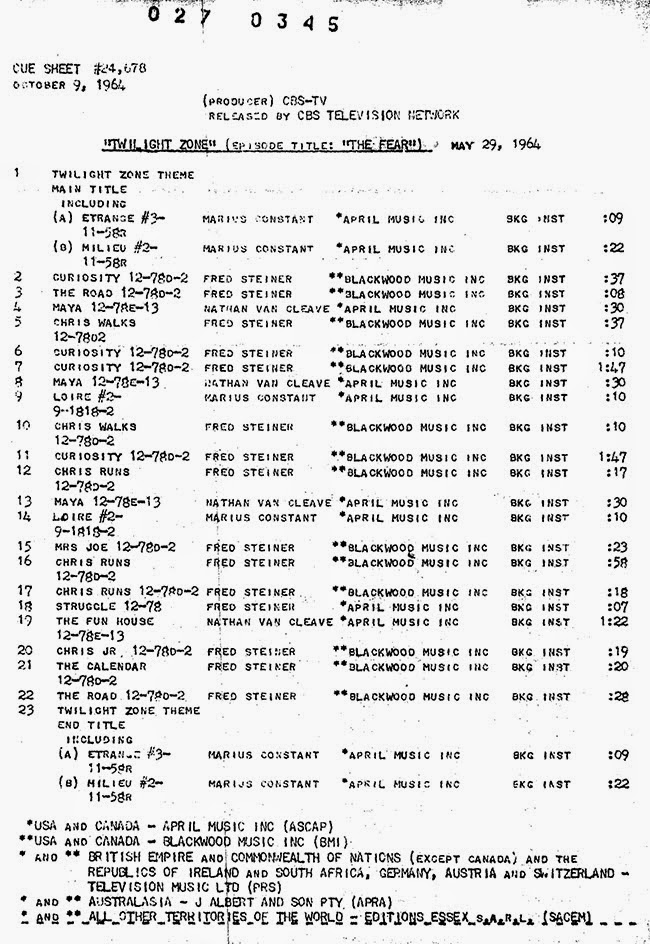
“The
Fear” is stock-scored, meaning that the underscore is a patchwork of
pre-existing recordings from the CBS Music Library, comprised mostly of Fred Steiner cues (from “King Nine Will Not Return” and “A Hundred Yards over the Rim,” both from season two). We also
hear “Maya” and “The Fun House” from Nathan
Van Cleave’s score for season one’s “Perchance to Dream.” Hearing music
from the show’s earlier days this close to the end is a welcome touch indeed
(though I doubt that was the intent), and I’m happy to report that the various
cues mesh pretty well together, despite originating from three different
scores. While “The Fear” doesn’t feature an isolated music track on the DVD and
Blu-ray releases of the series, all three of those earlier scores have been
released multiple times over the years, on both vinyl and CD, from both Varese
Sarabande and Silva Screen Records. The Definitive DVD and Blu-ray releases of
the first and second seasons also include isolated music tracks for all three
episodes, so if one wanted to piece together a soundtrack for “The Fear,” the
resources are easily obtained (except for that short little Marius Constant
bit, dammit).

.
DRAMATIS PERSONAE
 Trooper Robert Franklin is played by Mark Richman in
his only Twilight Zone appearance.
Richman has extensive genre experience, including roles on The Outer Limits (“The Borderland” and “The Probe”),
Alfred Hitchcock Presents (“Man with
a Problem” and “The Cure”), The Invaders
(“The Leeches” and “Inquisition”), The
Incredible Hulk (“Triangle) and, a bit more recently, Star Trek: The Next Generation (“The Neutral Zone”).
Trooper Robert Franklin is played by Mark Richman in
his only Twilight Zone appearance.
Richman has extensive genre experience, including roles on The Outer Limits (“The Borderland” and “The Probe”),
Alfred Hitchcock Presents (“Man with
a Problem” and “The Cure”), The Invaders
(“The Leeches” and “Inquisition”), The
Incredible Hulk (“Triangle) and, a bit more recently, Star Trek: The Next Generation (“The Neutral Zone”)..png)
Richman with TZ alum Susan Oliver.
 Charlotte Scott is
played by the beautiful Hazel Court
in her only Twilight Zone appearance.
Genre fans can spot her in four episodes of Alfred Hitchcock
Presents (“The Crocodile
Case,” “The Avon Emeralds,” “Arthur,” and “The Pearl Necklace”) and one episode
of Boris Karloff’s Thriller (“The
Terror in Teakwood”). On the big screen, Court can be seen in 1957’s The Curse of Frankenstein from Hammer
Films, not to mention a trio of Roger Corman adaptations of Edgar Allen Poe
stories (1962’s The Premature Burial,
1963’s The Raven, and 1964’s The Masque of the Red Death). Did I
mention that she’s beautiful? She’s definitely a TZ Babe, make no mistake. *Sigh*
Charlotte Scott is
played by the beautiful Hazel Court
in her only Twilight Zone appearance.
Genre fans can spot her in four episodes of Alfred Hitchcock
Presents (“The Crocodile
Case,” “The Avon Emeralds,” “Arthur,” and “The Pearl Necklace”) and one episode
of Boris Karloff’s Thriller (“The
Terror in Teakwood”). On the big screen, Court can be seen in 1957’s The Curse of Frankenstein from Hammer
Films, not to mention a trio of Roger Corman adaptations of Edgar Allen Poe
stories (1962’s The Premature Burial,
1963’s The Raven, and 1964’s The Masque of the Red Death). Did I
mention that she’s beautiful? She’s definitely a TZ Babe, make no mistake. *Sigh*+6.JPG)

The
part of the giant Cyclops “alien” is played by a BIG GODDAMNED BALLOON which,
to my knowledge, never worked in television again (though it would’ve been
positively smashing in the Macy’s Thanksgiving Day Parade, right?).

“The
Fear” was the final Twilight Zone episode
to be filmed (“The Bewitchin’ Pool,” the final episode aired, was shot earlier
but took longer to complete in post-production; more on this when we get to it), and it definitely feels like
the show is running on fumes as it lurches toward the finish line. It’s not
exactly terrible, but it’s nowhere near good: like the aliens’ giant balloon,
it’s ultimately a bit flat.
Next:
There’s
only one new episode left of the entire series… but you’re gonna have to wait
three
weeks for it. Talk
about cancelus interruptus….


.png)


.png)


