Friday, November 15, 2013

Episode Spotlight: "Uncle Simon" (11/15/1963)


Season 5, episode 8 (128 overall)
Originally aired 11/15/1963
Cayuga Production # 2604


Welcome, ladies and gentlemen, to tonight’s heavyweight bout. In this corner, hobbling with a cane and demanding hot chocolate, is Simon Polk, retired university professor and inventor of mechanical gizmos and gadgets. And in this corner: frumpy, bitter and beaten down after years of verbal abuse, let’s hear it for Barbara Polk, Simon’s niece, caregiver and sole heir to his estate. It’s a grudge match for the ages, folks. And now. without further ado… let’s get ready to rumble!


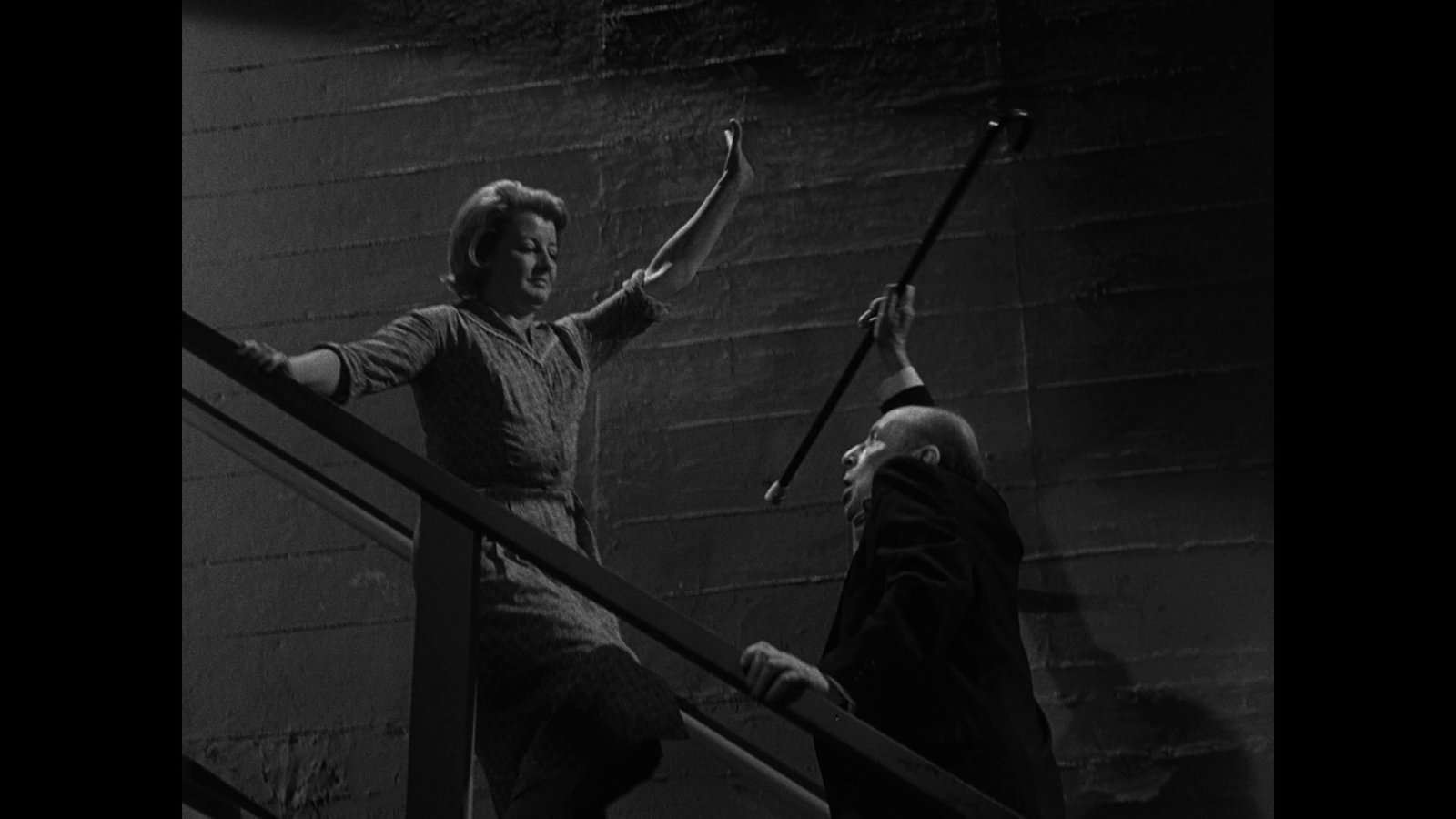
Rod Serling’s “Uncle Simon,” turning 50 years old tonight, finds the titular Simon and his niece Barbara locked in mortal emotional warfare.  They bicker, needle, sneer and shout their way through the first half of the episode. Seriously, nothing actually happens until Simon takes a fatal plunge down the stairs during an altercation with Barbara. 


Simon’s will dictates that, as his only living relative, Barbara is to inherit the entirety of his estate, on the singular condition that she provides ongoing care for his latest experiment, which just happens to be awaiting activation downstairs in his lab.  Kids, meet the third corner of this odd, uncomfortable triangle…
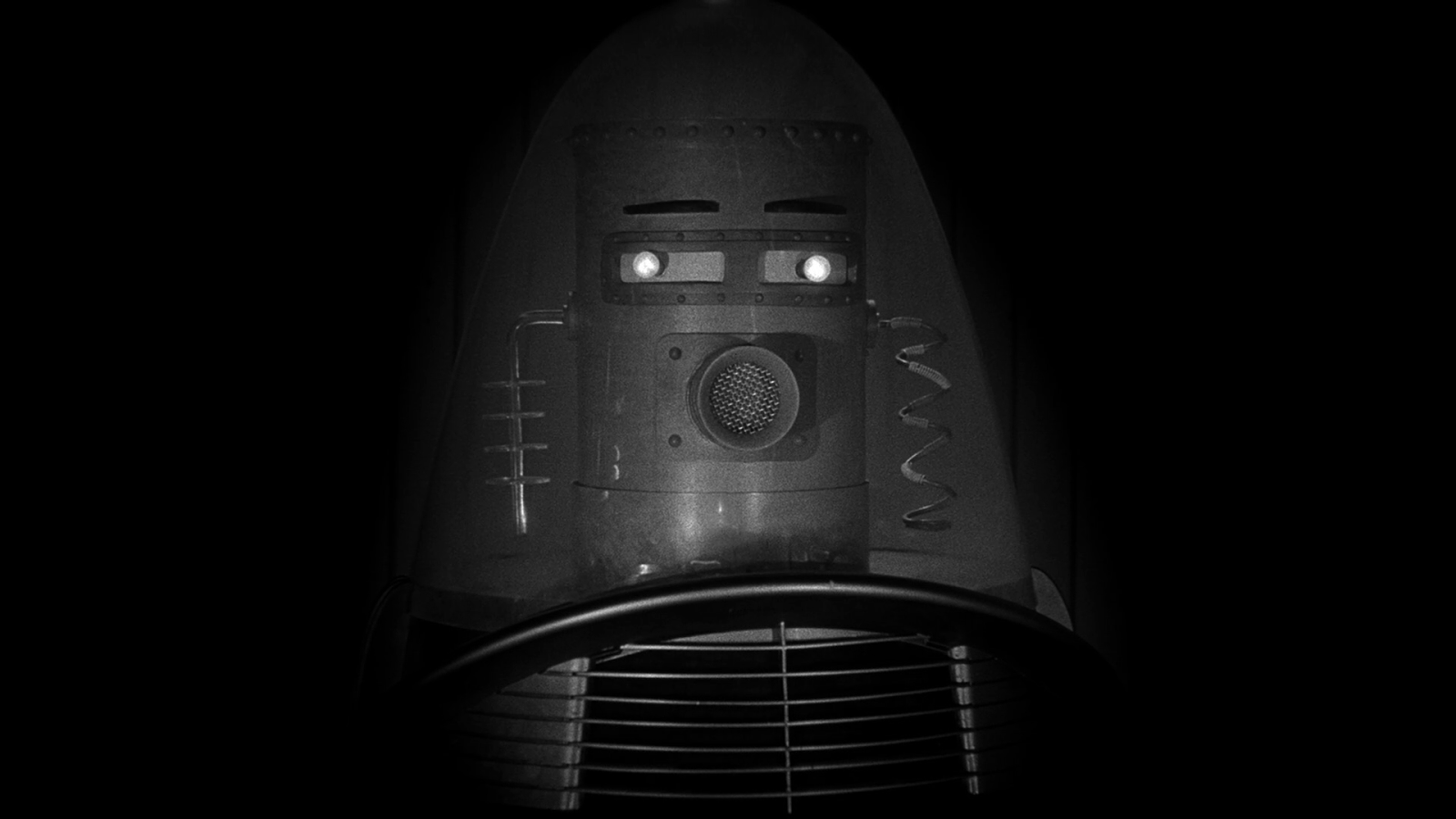
Ba-ba-ra!


Simon has created an automaton which, after a few days, begins to take on his mannerisms (not to mention his penchant for hot chocolate; odd that a mechanical being could ingest liquids, but whatever). Before you know it, its voice synthesizer starts to sound like Simon’s voice, at which point the vicious insults resume. When the robot demands that Barbara address him as “Uncle Simon,” well… it appears she’s stuck for good, unless she wants to be broke and homeless. So I guess that means that Simon, by far the more offensive and cruel of the two, wins….? Is this fitting? Is this justice? No, it’s another example of the show’s moral compass drifting out of whack, a disappointing hallmark of season five.


When I first discovered The Twilight Zone when I was in middle school, I used to tape record episodes and listen to them over and over again (this was a couple of years before we got our first VCR). I recall listening to my recording of “Uncle Simon” frequently (probably because my sarcastic nature was beginning to bloom at that age, so I would've found the over-the-top verbal abuse entertaining… I still kinda do, in all honesty). Naturally I've become a bit more discerning over the ensuing three decades, so the episodes flaws are much more apparent. The characters are drawn so thin that it’s impossible to really care about either one of them (though it seems Barbara may have been at least somewhat human in her youth, before Simon berated her into the “bovine crab” she’s become).


At the helm is Don Siegel, who also directed 1956’s Invasion of the Body Snatchers (which starred TZ alum Kevin McCarthy), one of my Top 20 favorite films of all time. Seeing as how “Uncle Simon” is bereft of any perceptible style aesthetic (excepting the inclusion of Robby the Robot, which adds significant production value), I think it’s safe to assume Siegel phoned this one in. Hell, I probably would've done the same.


Not to say “Uncle Simon” is a total loss. I do like the decision to have the robot develop and mature over time, à la Adam Link (from the “I, Robot” series of short stories by Earl and Otto Binder). And of course we have the always-welcome Forbidden Planet alert in the form of Robby the Robot, who can always be counted on to brighten things up, here playing Simon’s mechanized surrogate. And despite the drab, uninteresting direction, there’s a cool dissolve between a Barbara’s face and a clock face, which I guess is more an editing choice than anything else. It’s a nice visual, in any case.


Robby the Robot was given a custom head for this episode (a clever way to differentiate this from his other TV and film appearances), which looks convincingly homemade with its visible rivets and whatnot (the eyebrows are an odd choice, however). The man inside the costume is Dion Hansen, who will also inhabit the role (har har) in “The Brain Center at Whipple’s” later this season. Of special interest (to me, at least) is the fact that the robot is voiced by none other than Vic Perrin, whose day job at the time was narrating The Outer Limits as the Control Voice.


“Uncle Simon” is scored with stock music from the CBS Music Library. I've commented in past entries that the stock selections are generally made with commendable deftness; unfortunately, something went wrong here. Jerry Goldsmith’s “The Big Tall Wish,” with its wistful harmonica, is used in several key scenes (including the closing scene), and it sounds awkwardly out of place. Further, a couple of shock “stings” by D.B. Ray are employed in moments that really don’t call for them (Simon sneaking up on Barbara in the opening scene and, later, the robot uttering Barbara’s name for the first time; neither are anywhere near as earth-shatteringly urgent as the music would suggest).


FAMILIAR FACES


Sir Cedric Hardwicke is nasty, brutal and thoroughly detestable in his only TZ appearance, but he turned in a memorable performance as the blind servant Colas in The Outer Limits’ “The Form of Things Unknown.” He also appeared in several of Universal’s classic horror films, including 1942’s The Ghost of Frankenstein.


Constance Ford (Barbara Polk) is sufficiently unpleasant in her only TZ appearance. She never showed up on The Outer Limits, but she managed to appear on almost every other genre TV show in the 50’s and 60’s, including Inner Sanctum, Lights Out, Climax!, Suspense, and ‘Way Out. 


Ian Wolfe (Simon’s estate attorney Schwimmer) only graced the TZ set this one time, but he crossed paths with Rod Serling again in 1972 on Night Gallery (“Deliveries in the Rear”); however, genre fans will likely best remember him as the cosmic librarian Mr. Atoz in the Star Trek episode “All Our Yesterdays” (which also featured Mariette Hartley, who we’ll see later this season in “The Long Morrow”).


Marc Scott Zicree’s The Twilight Zone Companion (and the IMDB) lists John McLiam in the cast as a police officer but, unfortunately, you won’t see him anywhere because his scene was cut (thanks to Martin Grams’ exhaustive The Twilight Zone: Unlocking the Door to a Television Classic for this bit of trivia). McLiam appeared in three other TZ episodes (“The Shelter,” “The Midnight Sun” and as the sympathetic museum guard in “Miniature”), so I’m mentioning him despite his scene here getting the ax.


I can’t dismiss “Uncle Simon” outright, as much as I’d like to. Hardwicke and Ford are both fine in their underwritten and one-dimensional roles, and some of their combative dialogue is admittedly fun (albeit bizarre; try dropping “garbage head” or “bovine crab” into a conversation and see what happens). And of course there’s the wonderful Robby the Robot, who I fetishize almost as much as The Invader. File this one under “N” for Not Entirely Bad and scram, you angular turnips.


Next week (intended):
TZ alum Gladys Cooper is getting obscene phone calls. Okay, maybe they aren't exactly obscene,
but they’re definitely creepy.*


* The episode “Night Call” was scheduled to air on 11/22/1963.  On that date, at 12:30 in the afternoon in Dallas, Texas, President John F. Kennedy was assassinated. In light of the massive nationwide turmoil and grieving that ensued, most television programming was preempted, Twilight Zone included. To keep the series’ weekly schedule intact going forward, “Night Call” was moved to the next available slot (2/07/1964). Serling’s “next week” promos have been conveniently rearranged on Image Entertainment’s blu-ray release of Season Five to reflect this change.


In two weeks (actual):
Mars Meets Venus.  Again. *sigh*


Friday, November 8, 2013

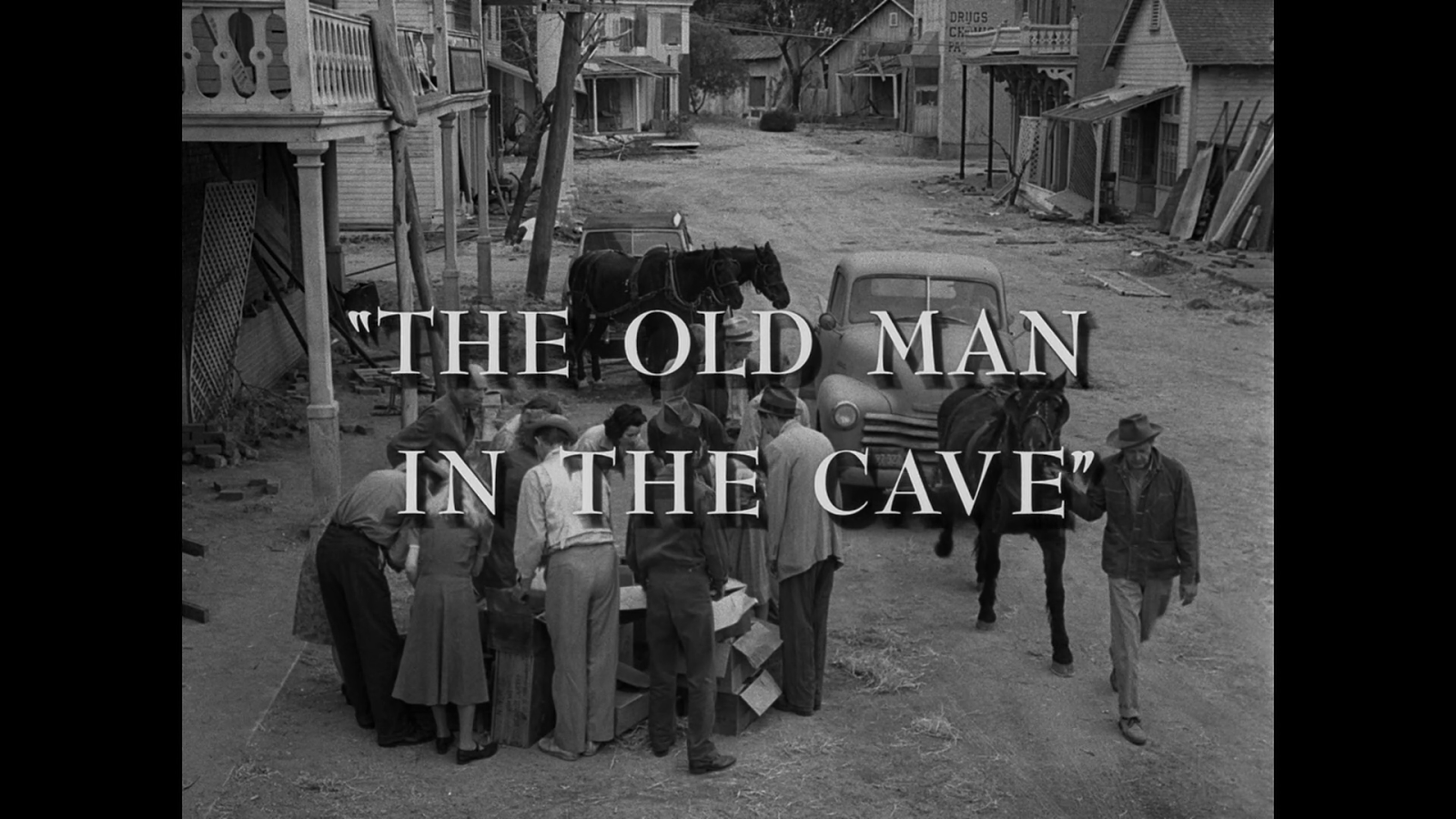
Episode Spotlight: "The Old Man In the Cave" (11/08/1963)


Season 5, Episode 7 (127 overall)
Originally aired 11/08/1963
Cayuga Production # 2603


Throughout The Twilight Zone’s run, Rod Serling has regaled us with many a cautionary tale of the dangers of the atom bomb. He’s depicted the threat of nuclear warfare (“The Shelter”), the imminence of nuclear warfare (“Third from the Sun”) and the actuality of nuclear warfare and its immediate aftermath (“Time Enough at Last”).  50 years ago tonight, however, Serling gave us a glimpse of yet another facet of this rich mine of story possibilities: the state of (what’s left of) mankind ten years later. Sound like a potent topic for exploration? Sure it does… but don’t get your hopes up.


The Earth of 1974 (well, the US anyway) is an irradiated patchwork of isolated tribes of survivors. “The Old Man in the Cave” introduces us one of these groups, led by the enigmatic Mr. Goldsmith, who takes his orders from the titular Old Man, whom no one (save Goldsmith) has ever seen. The group is disheartened to learn that the Old Man has deemed their stash of pre-war canned food to be contaminated. A quartet of quasi-military types, led by the arrogant Major French, rolls up in a jeep with a grand plan to consolidate the disparate colonies and reestablish order under martial rule. Goldsmith calmly indicates that his group doesn’t recognize French’s authority; that they've done just fine under the guidance of their Old Man. After establishing his dominance with a judo chop to Goldsmith’s face and a boot atop his prostrate chest, French mounts an expedition to “visit” the Old Man.


Up ‘til this point, things are looking pretty promising. The friction between Goldsmith and French is immediate and potent (think Benteen and Colonel Sloane in last season’s “On Thursday We Leave for Home”), and it’s certainly fun imagining the different directions that the story might take. Perhaps we’ll discover that Goldsmith and the Old Man are one and the same (think about it; you don’t have to proclaim yourself leader if you can successfully float the illusion of some wise old sage administering from a distance; another name for this is the “Man Behind the Curtain” method). Or perhaps “Old Man” is a code name for a consortium of surviving government officials, and the cave is actually a bunker inside of a mountain. Or hey, maybe the Old Man is some of super-intelligent mutant, á la Kuato from 1990’s Total Recall.


It’s none of the above, unfortunately. Turns out the Old Man is a super-computer (well, “super” as far as 1963 TV was concerned; that thing could probably fit in a USB thumb drive today), apparently still operating a decade after electricity disappeared (and since it’s housed in a cave, solar power is out too).  So what the hell is keeping this thing going? Why isn’t it being used for something more productive than weather prediction and food analysis? How did Goldsmith come to be its sole conduit for communication with the outside world? Did he build it? Where did it come from? Are there others like it, shepherding other small groups of survivors across the country?

WTF?

We don’t know. Serling doesn’t tell us. The whole thing remains an enigma, and not the good kind that The Twilight Zone drops on us from time to time. This, dear readers, is just lackadaisical bullshit. The real story is what ultimately becomes of French, his men and the survivors after the Old Man is revealed, but even this raises questions that Serling doesn’t feel like answering. The survivors’ attack on the Old Man could have been presented as man rising up against the technology that destroyed the world, signifying a post-apocalyptic rebirth of the species but, as you’ll see, a very different direction is taken. The ultimate moral seems to imply that man should follow blindly or suffer terrible consequences, which is far removed from the series’ typical cosmic justice ethic.


Maybe I’m being too hard on ol’ Rod, since his teleplay is merely an adaptation of an existing short story by Henry Slesar (the first of two Slesar stories Serling will adapt this season; the other is “The Self-Improvement of Salvadore Ross” which suffer similar plot contrivances). But hey, Serling chose the story despite its flaws and didn't really fix them, so I’m still holding him accountable.


Aside from the clever opening shot, in which an otherwise-inert convertible is being pulled by a horse, the episode doesn’t do nearly enough to depict life in this post-nuclear world. All we see is a shabby group of adults moping about in the middle of the street. Everything is quickly and clumsily sketched; there’s no real detail or nuance to speak of (think of the elaborate and intricate production design for season three’s “Two,” which very effectively depicted a post-war town). I would've liked to have seen a bit more of the survivors’ day-to-day lives. We’re told that they've cultivated crops, but we never see a single indication that they've done so. Where do they sleep? Do they have individual dwellings, or do they sleep in a huddle like a pack of wild dogs? And if contamination is such a big issue, where the hell is their water coming from?


FAMILIAR FACES


Mr. Goldsmith is played by TZ regular John Anderson (“A Passage for Trumpet,” “The Odyssey of Flight 33,” “Of Late I Think of Cliffordville”). Genre fans will also recall his marvelous turn as the Ebonite Interrogator in the “Nightmare” episode of The Outer Limits (which turns 50 next month on 12/02, on which date I’ll be spotlighting it over at my Outer Limits blog…. How’s that for cross-promotion?).


James Coburn is excellent as Major French (and really, he’s the only excellent thing about this episode). We've seen Coburn previously in season three’s “The Grave” and, more recently, “Steel” (Ha! Not really! I’m just using Coburn’s appearance as an excuse to trot out the Lee Marvin/James Coburn lookalike bit again).


This is actually Coburn’s only TZ appearance, but he does have another less obvious connection to the show: he played a Union Sergeant in an adaptation of Ambrose Bierce’s classic short story “An Occurrence at Owl Creek Bridge” on Alfred Hitchcock Presents in 1959.  We’ll see a very different adaptation of that same story right here later this season (more when we get to it in February).


John Marley is sufficiently brooding as Jason, one of the survivors under Goldsmith (we last saw him in season three’s “Kick the Can”). He too appeared on The Outer Limits (in “The Man with the Power,” which starred TZ alum Donald Pleasance). Marley is probably best remembered for finding a severed horse’s head in his bed in Francis Ford Coppola’s The Godfather.


Eh. I guess “The Old Man in the Cave” isn’t exactly terrible, but it’s nothing particularly special. It feels rushed and indistinct, and it reeks of squandered potential, which means it’s right at home in the series’ fifth and final season.


Next week:
After four years of Forbidden Planet prop sightings, Robby the Robot himself finally stops by
The Twilight Zone. Turns out he’s... well, kind of a dick.


Friday, November 1, 2013

Episode Spotlight: "Living Doll" (11/01/1963)


Season 5, Episode 6 (126 overall)
Originally aired 11/01/2013
Cayuga Production # 2621


Fifty years ago tonight, a mean ol’ sumbitch matched wits with a doll… and lost miserably. Jeez, wotta wuss.


Erich Streator is your average everyday wicked stepfather. Overbearing and cruel, he makes life miserable for his wife Annabelle and stepdaughter Christie on a daily basis. When Annabelle buys Christie a new Talky Tina doll, Erich is clearly perturbed because, well, nobody in his house should ever enjoy anything. Kinda reminds me of my stepdad when I was a kid.


Hi Daddy! Meet your adorable new nemesis!

“My name is Talky Tina, and I love you very much,” coos Tina whenever her string is pulled. But whenever she’s alone with Erich, she says other, more interesting phrases: they start with “I don’t think I like you” and quickly escalate to “I’m going to kill you.” The aforementioned battle of wits escalates from there and, to borrow a catchphrase from Highlander: there can be only one.


ZICREE RAPED MY CHILDHOOD!


I was pretty new to the series when I first read Marc Scott Zicree’s The Twilight Zone Companion in 1982, and there were many episodes that I hadn't seen yet, one of which was “Living Doll.” Zicree’s comments on the episodes are as follows:

“Erich Streator is trying desperately not to alienate his wife and her young daughter. When the child brings home a doll that makes clear its murderous intentions --- but only when it's alone with him --- Erich is in one hell of a bind. If he tries to tell his wife of it, he sounds like a lunatic, and if he tries to protect himself by attempting (unsuccessfully) to destroy the doll, his actions seem those of a twisted mind striking out resentfully to hurt a helpless little girl. Poor Erich; it is clear early on that he hasn't much of a chance against this ruthless doll.” 

Whatchoo talkin' 'bout, Zicree?

This was all I knew about “Living Doll” until I finally saw it a few years later. I was expecting to see a basically decent guy get decimated unfairly by an evil doll; imagine my surprise to discover that said “decent guy” was actually the villain of the piece! Did Zicree even watch the episode before writing about it? He couldn't have possibly sympathized with Erich Streator AT ALL if he had; however, the excessive praise he heaps on it would seem to imply that not only had he seen it, but had deemed it absolute top tier Zone: “Masterfully written and superbly directed, acted, photographed and scored, it is an episode that can stand with the best of any season.”  It was at this point, at the tender of age of 13, that I had the sobering realization that Zicree was perhaps not the be-all-end-all Twilight Zone expert that I’d assumed he was. I mean, he’d written a goddamned book about it; how the hell could he have been so incredibly wrong?

I think, in describing this dark event in my TZ-formative years, I've figured out why I’m so hostile toward Zicree. Serling was my new idol (after outgrowing such childhood heroes as Spiderman and Luke Skywalker), but he died before I ever heard his name, so Zicree, having chronicled Serling’s wonderful TV series, was the closest I could get to him. And the son of a bitch let me down by being so blatantly wrong about something so obvious. Erich Streator was a bad guy; he deserved what he got. This was the cosmic justice that lay at the very heart of The Twilight Zone, which even I understood at that early age. If Zicree didn't understand that, then who was he to write the book in the first place?

Ahem. I think I might just have exorcised a serious demon here. Maybe now I can move on with my life. Maybe I can even forgive Mr. Zicree his egregious trespasses against my inner child. Maybe.

Okay, therapy session over. Let’s move on.


“Living Doll” has a great concept (which is unfortunately pretty clichéd nowadays; I’m looking at you, Child’s Play franchise) which, coupled with Telly Savalas’s fantastic bad-guy-you-love-to-hate performance, makes for a highly entertaining half-hour (except for the last thirty seconds; see below). Unfortunately, it’s pretty flat on a visual level, the exception being when the action moves to Erich’s garage, where he attempts to dispose of Tina in a number of ways (she’s definitely more menacing in semi-darkness). Still, these scenes offer nothing on the level of, say, season three’s “The Dummy” (which features a menacing ventriloquist’s dummy framed by complex camera work with marvelous lighting).  And the final shot of the episode, in which slow-motion is abruptly employed for no apparent reason, does nothing to advance the mood (and was likely done to stretch out the ending to accommodate Serling’s closing narration, which suggests poor planning during filming).  

In fact, the ending is disappointing in general, since having Tina murder Erich is the easiest possible conclusion. Why not have Erich scared straight, so to speak, and forced to treat his family better under Tina’s ongoing supervision? Further, why the hell does Tina threaten Annabelle (Christie’s one and only champion) after Erich is dispatched? Up until this point, the episode was operating under the cosmic justice approach (discussed in detail last week) but, in the final moment, gears are abruptly switched over to something more akin to chaos theory. It seems Tina is just an all-around evil doll (yawn) instead of a protective shield for a mistreated child (infinitely more satisfying) after all.

One minor bid of weirdness. Annabelle says to Erich that “I know you got more than you bargained for when you married me; two for the price of one, wasn’t it?” Um… surely he was aware that she had a kid, right…? If he wasn’t, then I’m almost willing to cut him some slack for being such an asshole. On that note, surely she was aware that he was a profoundly mean bastard, so why the hell did she marry him in the first place? 


Jerry Sohl and Charles Beaumont

“Living Doll” is the first of three episodes credited to writer Charles Beaumont this season. Unfortunately, he didn't actually write any of them, as by this time his health was rapidly deteriorating (he passed away in 1967). In this particular case, Beaumont mapped out the plot with Jerry Sohl, who ghostwrote the script.


THE MUSIC


“Living Doll” features another great score from Bernard Herrmann. As a fan(atic) of his work, I find it fascinating to compare his Twilight Zone work with the film scores he composed around the same time (for example, his score for 1959’s Journey to the Center of the Earth shares similar instrumentation with TZ’s “The Lonely” from that same year). His sole film score in 1963 was Jason and the Argonauts which, now that I think about it, doesn’t really sound like “Living Doll” at all.  Here, Herrmann employs a very small ensemble (two harps, celesta and bass clarinet) to create moody, suspenseful cues that perfectly underline the escalating psychological warfare between Erich and Talky Tina. The original Herrmann recordings have never been properly released; however, they can be obtained via the isolated music tracks present on both the DVD and blu-ray sets of season five (from Image Entertainment).  


Additionally, Joel McNeely recorded all seven of Herrmann’s Twilight Zone scores in 1999 for a 2-CD set released by Varese Sarabande Records (which was the only game in town for 4/7ths of Herrmann’s TZ output before Image came along). I do have some issues with some of McNeely’s interpretations (some cues are too fast while others are too slow; further, much of “Where Is Everybody?” just sounds off to my ears); however, his take on “Living Doll” is quite good (though it’s no match for the original recording).


FAMILIAR FACES


Telly Savalas, who has a long history of imposing and often malevolent characters on his resume, is perfect as Erich Streator.  This is his only TZ appearance, but he does have another connection to the series: he appeared in 1962’s Cape Fear, which was scored by Bernard Herrmann (and co-starred TZ vets Martin Balsam, Edward Platt and Paul Comi). Savalas also played super villain Ernst Stavro Blofeld in 1969’s On Her Majesty’s Secret Service, one of my favorite James Bond films.


Mary La Roche (Annabelle Streator) previously entered The Twilight Zone as Mary, Gregory West’s mistress, in season one’s “A World of His Own.” Here she plays an unhappy wife, so I guess she got to play both sides of the extramarital fence (though I guess Erich isn't depicted as an adulterer; but honestly, would we be surprised?).


Tracy Stratford is convincingly sad and under-loved as Christie (she was also Tina in season three’s “Little Girl Lost,” which was also scored by Bernard Herrmann. Wait, so first she played Tina, then she had a doll named Tina… is it possible that Talky Tina came from the fourth dimension?). Additionally, Stratford provided the voice of Lucy Van Pelt in the 1960s Charlie Brown TV specials. So when Annabelle tells Erich to see a psychiatrist, I wonder if she meant….

Good grief! Uh, I mean... who loves ya, baby???

And hey, Telly Savalas and Charlie Brown are both bald. Coincidence?  I dunno… maybe Charles Schulz was a Twilight Zone fan…?


June Foray, probably the hardest working voice actor in Hollywood, provides the unforgettable voice of Talky Tina. She’ll also do some (slightly controversial) dubbing later this season in “The Bewitchin’ Pool,” but she has another less-obvious TZ connection as well.  80’s kids like me will have no trouble remembering the 1985 film Weird Science, but do you remember the TV spin-off, which lasted five seasons (1994-1998) on the USA Network? In the episode “Sci-Fi Zoned,” the main characters are trapped inside black and white episodes of their favorite TV show (a thinly-veiled TZ knockoff called The Sci-Fi Zone), one of which involves a murderous doll named “Talking Tammy,” who is voiced by…. yup, you guessed it, June Foray (she also voices a sentient candy bar named “Baby Ruth” in the same episode).


An iconic episode like this is almost guaranteed to spawn a parody somewhere along the line. Like “Nightmare at 20,000 Feet” a few weeks back, “Living Doll” got the Simpsons treatment in 1992’s “Treehouse of Horror III,” in which a Krusty the Klown doll menaces Homer Simpson (“Clown without Pity”). Also of interest to genre fans is the framing device employed in this episode, which is patterned after TV’s Alfred Hitchcock Presents and features the rotund Homer standing in for Hitch.

Good morn--- D'oh!


Bif Bang Pow! has immortalized Talky Tina in every conceivable form (a talking bobblehead, action figure, and a fully-functioning life-sized replica). The bobblehead seems to be sold out but, as of this writing, the action figure and life-size replica are still available through Entertainment Earth (but, as with any collectible, they won’t be around forever). I can’t comment on the life-sized replica since I don't own it (c'mon, how could I possibly justify buying a fucking doll? For over a hundred bucks, no less!), but I've reviewed the other two (see here and here).


Questionable ending aside, “Living Doll” is great fun and a definite highlight of The Twilight Zone’s fifth and final season. Other than the misfire “A Kind of a Stopwatch” two weeks ago, season five’s offerings have ranged from good to excellent… unfortunately, the quality is about to start dipping in a big way.  Stay tuned, but temper your expectations from here on out.


Next week: Hoo boy. Where’s Charles Bronson and Elizabeth Montgomery when you need ‘em?