Thursday, January 13, 2011

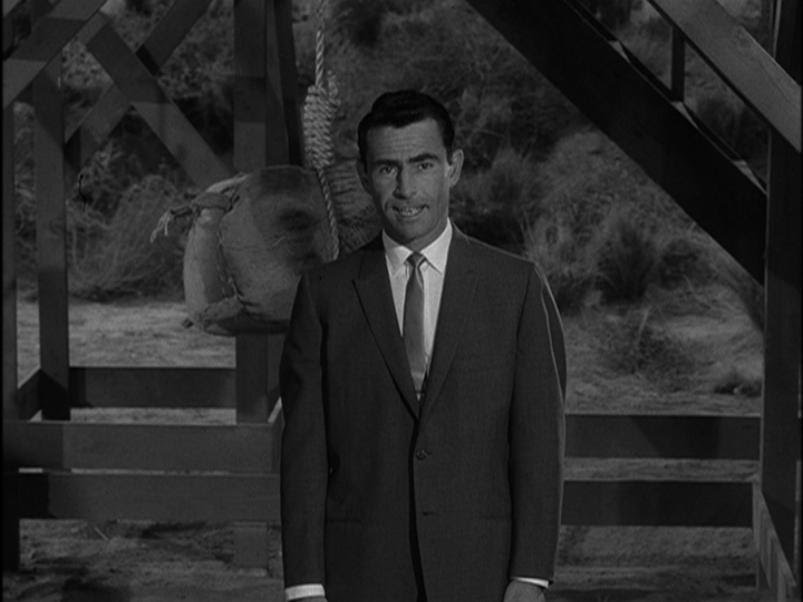
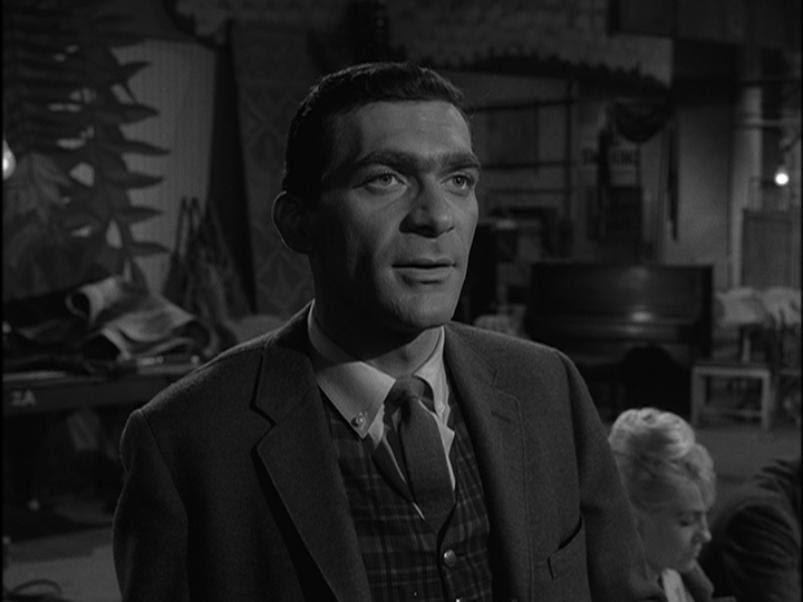
TZ Promo: “Back There” (1/13/1961)


“Back There”
Season Two, Episode 13 (#49 overall)
Cayuga Production # 173-3648


♪ The professor and Mary Ann ♪.... oh wait, wrong theme song. Ahem. 50 years ago tonight, the man best remembered as the Professor on Gilligan's Island found himself in the past, and compelled to change history.


Russell Johnson stars as Peter Corrigan in Rod Serling's "Back There," directed by David Orrick McDearmon. The plot is really easy to encapsulate. Guy finds himself inexplicably in the past, tries to prevent Lincoln's assassination, instead gets c-blocked by John Wilkes Booth. Fail.


"Back There" has all the makings of a good episode... however, two things stand in its way: first, there's not much in the way of actual tension. The Twilight Zone requires the viewer to suspend its disbelief... up to a point. Some things are just too much to ask. We know Corrigan won't be able to stop Lincoln's assassination, so the whole affair is ultimately pointless. Second, as much as I like Russell Johnson (he was great in season one's "Execution"), he totally overacts here.


The best thing about the episode is Jerry Goldsmith's haunting, harpsichord-tinged score. The more recognizable cues will be reused later, to great effect, in season three's "To Serve Man" and season four's "Death Ship." The score was first released on Varese Sarabande’s The Twilight Zone: The Original Television Scores, Volume 3 LP (and CD in Japan), and later appeared on Silva’s The Twilight Zone 40th Anniversary Collection. It’s also presented in isolated form (on an alternate audio track) on Image Entertainment’s The Twilight Zone, Season 2: The Definitive Edition DVD, and on the recently-released blu-ray edition as well.


* The Professor, incidentally, did have a name... it was Roy Hinkley. How many of you knew that?


Next week: another videotaped episode. Unfortunately, it's the worst of the bunch. It stinks like a cheap used car.


Thursday, January 6, 2011

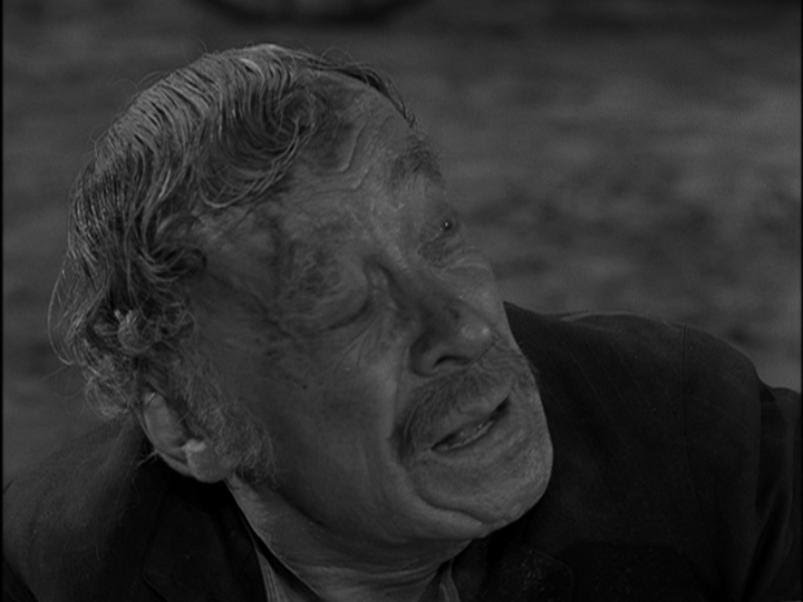
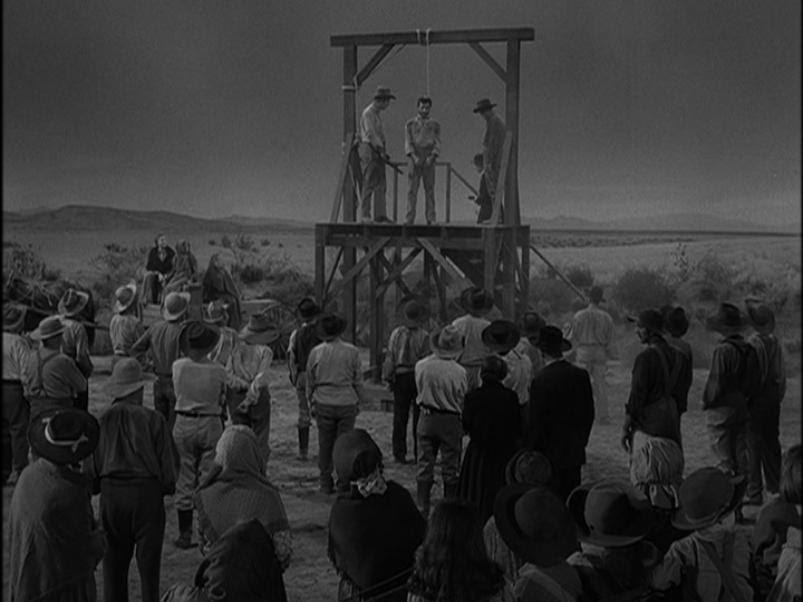
TZ Promo: "Dust" (1/06/1961)


“Dust”
Season Two, Episode 12 (#48 overall)
Cayuga Production # 173-3653

In a remote desert town in the Old West, a young Hispanic man is set to hang for accidentally killing a child. He waits in his cell, staring helplessly out the window as his gallows are readied. A grimy peddler named Sykes skulks around, offering to sell a pouch of magic dust that just might turn things around for all concerned.

Sounds like some twisted western noir but, despite its title, the episode fails to kick up much “Dust” at all. Everything seems lethargic, as if the entire thing was left out in the sun too long. Director Douglas Heyes, responsible for some of the series’ most innovative and visually exciting episodes (“The Howling Man” and “The Eye of the Beholder,” for example), took this approach intentionally to illustrate that the entire town has, in a way, become like the dust that covers it. Okay, fine, but it doesn’t make for an interesting episode. The script by Serling is good enough, but the problem here is the execution (no pun intended).

It also doesn’t help that the supernatural element is so vague as to be almost nonexistent. Really, there’s no evidence that there’s any “magic” going on at all. I’m all for subtlety, but here it just makes me yawn. The main players are all familiar TZ faces: Thomas Gomez (“Escape Clause”), John Larch (“Perchance to Dream”), and Vladimir Sokoloff (“The Gift”). The cast does its best, but ultimately the episode is a bit tedious to watch. However, like every other filmed episode, it looks spectacular in high definition on blu-ray, so it’s not a total loss.

Probably the best thing the episode has to offer is a brooding acoustic guitar score by Jerry Goldsmith, who composed many of the series’ most memorable scores (“The Invaders,” “Back There,” and a personal favorite of mine, “The Big Tall Wish”). His score for “Dust” was first released on vinyl in the 80's by Varese Sarabande (The Twilight Zone: The Original Television Scores, Volume 5; all 5 vinyl volumes were subsequently released on CD in Japan only). The score later appeared on CD in the US as part of Silva’s Twilight Zone 40th Anniversary Collection boxed set. And of course, it’s also available from Image Entertainment on both the Season 2 Definitive Edition DVD and its newly-released blu-ray counterpart, playing alongside the episode on an alternate music-only track.


Ultimately, "Dust" isn't necessarily bad, but it'll never make my favorites list. In a season filled with some of the series' finest offerings, it's average at best. Anyway, it celebrates its 50th birthday tonight.


Next week: Russell Johnson returns to The Twilight Zone for another time travel tale. He’ll find himself transported to a fateful night in April 1865, where a very special guest is attending a play at the Ford Theater. Get yourself a ticket and tune in.


Monday, January 3, 2011

RIP Anne Francis (9/16/1930 - 1/02/2011)


The Twilight Zone is filled with women. Unfortunately, many of them are drab and forgettable. There are a few shimmering gems that shine through, however... Suzanne Lloyd, extolled in previous entries, and of course Inger Stevens and Julie Newmar (come to think of it, Gail Kobe was pretty tasty too). But for me, one beauty stands above all others as the preeminent Twilight Zone babe. Her name is Anne Francis. And yesterday, tragically, she passed away.

Publicity shot for Forbidden Planet. God, she was gorgeous.

We've already seen her in the unforgettable "The After Hours" from season 1, and we'll see her again in a much richer, nuanced performance in season 4's "Jess-Belle," but she's probably best known as the naive young beauty who distracts Leslie Nielsen's entire crew in Forbidden Planet, a film with many TZ connections. Come to think of it, Nielsen just passed away in November.

Ms. Francis in 2002, at the first Twilight Zone Convention in Hollywood.

I'm sad to say I never got her autograph. I know my friend Andrew Ramage did... in fact, he had the distinct privilege of actually being friends with her. My condolences go out to him, and to her family.


Thursday, December 23, 2010

TZ Promo: "The Night of the Meek" (12/23/1960)


"The Night of the Meek"
Season Two, Episode 11 (#47 overall)
Cayuga Production # 173-3663


The second of season two's six videotaped offerings, "The Night of the Meek" manages to transcend its humble production limitations and offer something truly remarkable. It's transcendent, period. I watch it every year around the holidays, where it stands proudly alongside such venerable classics as It's a Wonderful Life, White Christmas, and Miracle on 34th Street. Tonight, this delightful episode turns 50.


There is literally nothing wrong with this episode, which is a bit of a surprise, given that it's a light comedy by Serling (Serling and comedy mix about as well as oil and water). Art Carney is utterly charming, swimming in pathos but eager to please, as Henry Corwin, a drunken bum who, once a year, works as a department store Santa Claus (how he survives the rest of the year is a mystery).


John Fiedler is equally impressive as the prickish department store manager who berates him, fires him, then sics the cops on him. We dislike him, but we never really hate him. C'mon, it's Christmas. We don't hate anyone this time of year. By the end of the episode, we'll actually kinda like him.


1994's The Santa Clause stole its basic premise from this episode, which is my way of telling you how this episode turns out without actually telling you. 2003's Bad Santa, meanwhile, stole the idea of a drunk who works as a department store Santa. However, Henry Corwin is nothing like the slimy criminal that Billy Bob Thornton portrayed. He's a decent guy, terminally sad, usually drunk. He reminds us of Jack Klugman's Joey Crown, from season one's "A Passage for Trumpet."


In a strange way, the blurry videotape look actually works in the episode's favor. There's an immediacy to it, like live TV, and a spontaneous vibe that adds to the magic. The impressive set, which looks about the size of a full city block, is perpetually blanketed in falling snow.


And there are reindeer! REAL LIVE reindeer!


Our friends at Bif Bang Pow! have a Henry Corwin/Santa Claus action figure in the works (a prototype was shown at Comic Con in July; he's in the background above), but we likely won't see it till late 2011.... just in time for the holidays, I imagine.


Next week: Repeat city, folks. Season One's "A Stop at Willoughby" gets its second showing. In two weeks: We're back to film again (man, season two's like a yo-yo!), where we find a young man on the eve of his execution. If you're still glowing with holiday cheer by then, this should take care of that.


Thursday, December 16, 2010

TZ Promo: “A Most Unusual Camera” (12/16/1960)


“A Most Unusual Camera”
Season Two, Episode 10 (#46 overall)
Cayuga Production # 173-3606


I have a simple rating system when it comes to The Twilight Zone: good-to-excellent, mediocre, or lousy. Fifty years ago tonight, an episode of the third, least-desirable variety premiered.

Written by Rod Serling and directed by John Rich, “A Most Unusual Camera” starts off with a pretty cool concept: an instant camera whose pictures depict events five minutes in the future. A trio of quarrelsome thieves comes into possession of the camera as part of their latest heist and, once they discover its unique properties, they form a plan to use it for their own financial gain. Well, of course they do. That’s not really the problem. The problem is that there’s never really any tension, particularly when the thieves become greedy (okay, greedier) and start turning on one another (a similar group-disintegration will occur later this season, much more effectively, in “The Rip Van Winkle Caper”).


The cast is comprised of the three thieves and a nosy hotel employee, and all four of them are gratingly unpleasant, particularly Jean Carson in the female lead. Again, the whole thing is just lousy. It’s not “Mr. Bevis” lousy, but it’s… just damned lame. Worse, the whole thing is played as a comedy, and like so many other Serling attempts at comedy, it just ain’t funny.

Ugh. What else can I say? There’s nothing redeeming to be found here. The idea of a camera that captures images from the future is immediate and promising, and it’s completely squandered. I can only wonder what Jack Finney would’ve done with such an idea.

On the subject of Finney: many of his short stories from the 50’s and 60’s (collected in The Third Level and I Love Galesburg in the Springtime, both out of print and well worth tracking down; I have worn copies of both and cherish them) would’ve made ideal The Twilight Zone episodes; however, none of them were ever adapted for the series. Much attention has been paid over the years to the fact that only one script by science fiction luminary Ray Bradbury was produced on the series but, for my money, The Finney Shutout (as I’ve come to call it) is even more shocking. “Of Missing Persons,” “Where the Cluetts Are,” “The Coin Collector,” “Lunch Hour Magic”... that’s four, right off the top of my head, and there are many more. It’s a damned, depressing shame that Finney and The Twilight Zone never crossed paths.


Next week: Just in time for Christmas! Art Carney stars as the original Bad Santa. A holiday perennial, and a great one at that. Don your stocking cap and mittens and tune in.


Thursday, December 9, 2010

TZ Promo: "The Trouble with Templeton" (12/09/1960)


“The Trouble With Templeton”
Season Two, Episode 9 (#45 overall)
Cayuga Production # 173-3649


Tonight’s episode, first aired on this date exactly fifty years ago, features a man in a morose state of nostalgia who somehow finds himself transported to his coveted past. No, his name isn’t Martin Sloan.

“The Trouble with Templeton” is a competent production, but in all honesty, I’ve never felt particularly warm toward it. Perhaps my “meh” feeling stems from the fact that, on a thematic level, nothing happens here that we haven’t already seen in previous episodes, most notably season one’s “Walking Distance”… and on every level, this episode is inferior to that gentle masterpiece. Like I said, it’s competent enough on its own, but there’s really nothing transcendent going on here.

Oh, except for one thing. There’s a jaw-droppingly beautiful shot late in the episode: Templeton has sought out his dead wife in a speakeasy, where he hopes for a sweet reunion with his lost love. He’s met instead with a raucous barrage of loud Dixieland jazz and general obnoxious behavior. He objects, gets himself slapped across the face, and flees. The ghosts of his past abruptly drop their drunken merriment act as they watch him go. The music stops, everyone stands still, and the lights go down… except for a single spotlight, which the beautiful Pippa Scott steps into, an incalculable longing in her eyes.

I guess that’s an interesting point, one that perhaps elevates the episode a bit. Templeton aches for the dead past, but it appears that dead past aches even more for him. A sobering thought.


“The Trouble with Templeton” is written by E. Jack Neuman, so at least it’s not Serling pilfering himself this time around (he’ll do enough of that as the series progresses). Buzz Kulik directs. Brian Ahern and the aforementioned Pippa Scott star.

Interesting cast note: the snooty theater director is played by a young Sydney Pollack, who would go on to a rather impressive directing career (he won an Academy Award for 1982’s Out of Africa). Pollack continued to act periodically as well, turning in memorable performances in Tootsie (which he also directed) and Eyes Wide Shut, among many others. He passed away in 2008. Here, he’s an arrogant ass… which is exactly what he’s supposed to be.

I would be remiss if I failed to mention the lovely score by Jeff Alexander. It's comprised mostly of fairly generic Dixieland-style jazz, but sprinkled throughout are some very lovely cues. One in particular, "Cerebellum," will reappear in season four's "Death Ship" and season five's "Probe 7 - Over and Out." It's a beautiful little piece of music.


Next week: A band of thieves gets their grubby mitts on a camera that takes pictures of the future. Intriguing concept, right? Don't get your hopes up. Say cheese and tune in.


Thursday, December 2, 2010

TZ Promo: "The Lateness of the Hour" (12/02/1960)


“The Lateness of the Hour”
Season Two, Episode 8 (#44 overall)
Cayuga Production # 173-3652


50 years ago tonight, something quite bizarre happened on The Twilight Zone, and it had nothing to do with the story being presented. The picture looked… well, different somehow. Perhaps viewers didn’t notice, given the low quality of TVs back then, but the filmed program they’d been enjoying every week for a year-and-a-half was suddenly not film at all.


Videotape. Oh god, the dreaded videotape. Six episodes were shot on video during season 2 as a cost-cutting measure. Videotape was a primitive format in 1960; it certainly wasn’t the high definition format of choice that it’s evolved into over the past 50 years. Back then, it looked terrible. It’s like watching the show through a fishbowl smeared with Vaseline. Thankfully, the cost-cutting wasn’t that consequential, so they stopped after six and returned to film. The experiment, unfortunately, yielded six episodes that are permanently and irrevocably inferior to their 35mm siblings; happily, though, most of them are actually fairly decent (and watchable) episodes despite their visual failings. One of them, however, is just plain awful… but we’ll get to that one next month. Another of them, meanwhile, is an absolute treasure that transcends its technical limitations… we’ll be checking it out in three weeks, just in time for Christmas (that’s a hint, folks).


The first of the six to be broadcast, “The Lateness of the Hour,” stars the lovely Inger Stevens (last seen in “The Hitch-hiker”) as Jana, the terminally unhappy daughter of Dr. Loren (John Hoyt), who has staffed their mansion with robot servants and apparently keeps her confined to the house at all times. Jana hates the robots, and demands that her father get rid of them. More unhappiness ensues.


Written by Rod Serling and directed by Jack Smight (who directed three of the six videotaped episodes, plus season 1's "The Lonely"), “The Lateness of the Hour” is infused with a palpable sense of claustrophobia, due in part to Jana’s confinement to the house, and also due to the limitations of shooting on video. The entire episode takes place in two rooms (and a staircase). Since this particular story is light on action and heavy on dialogue (it could easily translate to a stage play), not much is ultimately lost by shooting it on video.


Next week: Speaking of stage plays, we’ll spend some time with one Mr. Booth Templeton, a renowned thespian who yearns to escape to his younger days. Like Martin Sloan before him, he’ll get his chance… but with a catch.