Showing posts with label Jerry Goldsmith. Show all posts

Saturday, June 27, 2020

4x07 "Bolie à Deux"


This week Craig referees an epic bout between the classic Twilight Zone episodes “The Big Tall Wish” and “Steel.” One of ‘em will take home the championship belt, and the other will limp home with dashed hopes and shattered dreams. In between rounds, fan-favorite Dr. Reba Wissner pops in to give us the lowdown on the musical underscore. You can’t get this on Pay-Per-View, folks.


A goldmine of fake product labels: http://www.theearlhayspress.com/index.html

Get Dr. Reba Wissner’s essential A Dimension of Sound: Music in The Twilight Zone here:

While you’re at it, snag Ron Rodman’s Tuning In: American Narrative Television Music:


“Metal Health” performed by Quiet Riot (from the album Metal Health, copyright 1983 by Pasha Records).

 “This Is a Brawl” composed and conducted by Danny Elfman (from the album Real Steel: Original Motion Picture Score, copyright 2011 by Varèse Sarabande Records).

“Love theme from Chinatown (End Title)” composed and conducted by Jerry Goldsmith (from the album Chinatown: The Original Motion Picture Soundtrack, copyright 1974 by ABC Records)

The Twilight Zone is a trademark of CBS, Inc.


Between Light and Shadow: A Twilight Zone Podcast is a nonprofit podcast. Music clips and dialogue excerpts used herein are the property of their respective copyright owners; we claim no ownership of these materials. Their use is strictly for illustrative purposes and should be considered Fair Use as stated in the Copyright Act of 1976, 17 U.S.C. section 107. 

Sunday, November 24, 2019

3x14 "Through a Glass, Markie"


Sheesh, astral projection phantom kids can be SO annoying, am I right?  Join Craig as he sips some hot chocolate and digs into the classic Twilight Zone episode “Nightmare as a Child,” then jumps forward 25 years into the future to give the 80’s TZ effort “Little Boy Lost” the KID gloves treatment (ha! See what we did there?). Look (well, listen) for a guest appearance by Andrew Ramage of twilightzonemuseum.com fame, then revel in the triumphant return of Dr. Reba Wissner, our very own TZ Music Guru.

Theme: “Neither Here Nor There (9/22/2019 Revision)” by Twin Loops

“Twinkle Twinkle Little Star” and “The Hole/TV People” (from the Poltergeist soundtrack composed by Jerry Goldsmith, copyright 1982 by Polygram Records)

“Axel F” performed by Harold Faltermeyer (from the Beverly Hills Cop soundtrack, copyright 1984 by MCA Records)

“Escape (The Piña Colada Song)” performed by Rupert Holmes (from the album Partners in Crime, copyright 1979 by Infinity Records/MCA Records)

“Twinkle Twinkle” (from the album Nature Sounds: Forest Mystique, copyright 2018 by Simply Relaxing Tunes)

“Twinkle Twinkle Little Star” performed by Fabio Perry (music) and Dead-Rose (vocals) (copyright status unknown)

Terry Burnham Memorial Project 2016: 


Dr. Reba Wissner’s A DIMENSION OF SOUND: MUSIC IN THE TWILIGHT ZONE:


Craig’s Twilight Zone 16mm (Mis)Adventure:


The Twilight Zone is a trademark of CBS, Inc.

Between Light and Shadow: A Twilight Zone Podcast is a nonprofit podcast. Music clips and dialogue excerpts used herein are the property of their respective copyright owners; we claim no ownership of these materials. Their use is strictly for illustrative purposes and should be considered Fair Use as stated in the Copyright Act of 1976, 17 U.S.C. section 107.

Sunday, October 20, 2019

3x12 "Hit Me with Your Best Slot"


This week, Craig spins the cosmic roulette wheel in honor of the Twilight Zone classics “The Fever” and “The Prime Mover” while self-medicating an ongoing sinus malfunction with a single-malt Scotch. Take my advice and roll the dice, baby.

“Neither Here Nor There (Viva Las Version)” by Twin Loops

“The Hong Kong Triad” performed by Thievery Corporation (from the album The Mirror Conspiracy, copyright 2000 by ESL Records)

“Hanukkah in Vegas” performed by Richard Cheese and Lounge Against the Machine (from the album Cocktails with Santa, copyright 2013 by Coverage Records)

Watch Robert Florey’s The Life and Death of 9413: A Hollywood Extra at https://vimeo.com/212551702

The Goldsmith Odyssey Podcast: https://www.buzzsprout.com/159614

The Twilight Zone is a trademark of CBS, Inc.

Between Light and Shadow: A Twilight Zone Podcast is a nonprofit podcast. Music clips and dialogue excerpts used herein are the property of their respective copyright owners; we claim no ownership of these materials. Their use is strictly for illustrative purposes and should be considered Fair Use as stated in the Copyright Act of 1976, 17 U.S.C. section 107.

Sunday, October 6, 2019

3x11 "We All Scream for Jet Stream"


Check your bags and try to avoid a TSA cavity search as you board tonight’s double-feature flight into the unknown. Craig takes the yoke and performs aerial maneuvers over, under and through the classic Twilight Zone episodes “The Last Flight” and “The Odyssey of Flight 33.” In the final analysis, only one will emerge unscathed. Along the way Craig struggles with French pronunciations, extols the glory of stop-motion dinosaurs and powers through some kind of sinus malfunction. Mon dieu!


Theme: “Neither Here Nor There (9/22/2019 Revision)” by Twin Loops

“Sunny” performed by Dave Pike (from the album Jazz for the Jet Set, copyright 1966 by WEA International)

“Interlude” performed by Thievery Corporation (from the album The Richest Man in Babylon, copyright 2002 by Eighteenth Street/ESL Music)

“On Danse a la Villette” and “La Vraie Valse Musette” performed by Basil Bunelik (solo accordian)

“Royal Air Force March Past” performed by the Central Band of the Royal Air Force (from the album On Tour: Central Band of the Royal Air Force, copyright 1995 by Cala Records)

“Serenata” performed by The Jonah Jones Quartet (from the album Great Instrumental Hits, copyright 1961 by Capitol Records)

"The Return of the Red Baron" performed by The Royal Guardsmen (from the album Snoopy and His Friends, copyright 1967 by Laurie Records)

The Twilight Zone is a trademark of CBS, Inc.

Between Light and Shadow: A Twilight Zone Podcast is a nonprofit podcast. Music clips and dialogue excerpts used herein are the property of their respective copyright owners; we claim no ownership of these materials. Their use is strictly for illustrative purposes and should be considered Fair Use as stated in the Copyright Act of 1976, 17 U.S.C. section 107.

Sunday, August 27, 2017

2x09 Special Report: The Jazz Stylings of Jerry Goldsmith


This week Craig lets the music do the talking as we explore composer Jerry Goldsmith’s musical contributions to The Twilight Zone’s musical landscape, specifically his jazz compositions. You’ll want a drink or two for this one… three fingers of your best bourbon, or maybe a dirty martini with three olives. Cheers, mates.

The Twilight Zone is a trademark of CBS, Inc.

Between Light and a Shadow: A Twilight Zone Podcast is a nonprofit podcast. Music clips and dialogue excerpts used herein are the property of their respective copyright owners; we claim no ownership of these materials. Their use is strictly for illustrative purposes and should be considered Fair Use as stated in the Copyright Act of 1976, 17 U.S.C. section 107. 

Thursday, February 28, 2013

TZ Promo: "Printer's Devil" (2/28/1963)


 Season 4, Episode 9 (#111 overall)
Cayuga Production # 4864
Originally aired February 28, 1963


After entertaining us with multiple manifestations during the first two seasons of The Twilight Zone, His Satanic Majesty (a.k.a. Ol’ Scratch, Beelzebub, Lucifer, The Prince of Darkness, The Devil; he answers to all of them) apparently took last year off.  Happily (or not, depending on your religious/spiritual inclination), he/she/it makes up for it by appearing twice this season.


50 years ago tonight, The Evil One visited the city of Danzburg under the name “Mr. Smith.” His target?  One Douglas Winter, editor of the failing Danzburg Courier. Winter’s just lost his linotype operator to the competing Danzburg Gazette, effectively spelling the end of his paper. Full of self-loathing and liquor, Winter is poised to jump off a bridge… until Smith shows up out of nowhere, looking for a job.  It seems he’s an expert linotype operator and a crack reporter to boot.
  

With Smith on board, The Courier quickly becomes the town’s top newspaper, consistently scooping The Gazette. Winter’s long-suffering girlfriend Jackie doesn't trust Smith; in fact, she suspects he’s behind the very catastrophes he’s reporting. When Winter confronts him, Smith lays his cards on the table:  he’ll continue providing his services, guaranteeing permanent success for The Courier, in exchange for Winter’s soul.


Smith’s diabolical work on The Courier comes with an interesting twist: he isn't directly influencing events in Danzburg; rather, he’s “made some modifications” to the paper’s linotype machine that causes whatever is typed into it to come true. This ultimately causes Smith’s plans to unravel, as the linotype machine twists reality regardless of who uses it. Some may cry deus ex machina, but I think it’s a nice touch.


"Printer's Devil" is scored with an impressive array of CBS library cues, including selections from previous TZ scores "The Big Tall Wish" and "Nervous Man in a Four Dollar Room" (the latter is put to great use to build suspense during act four; both are composed by Jerry Goldsmith). CBS Music Director Lud Gluskin had an amazing knack for choosing preexisting music for episodes for which original scores hadn't been commissioned.  "Printer's Devil" is a perfect example of this: the entire score, stock though it is, is imminently listenable on its own (happily, it's isolated on the season four Definitive DVD and blu-ray sets for our listening pleasure).


This is the fourth and final TZ appearance by the great Burgess Meredith: he’s previously graced “Time Enough at Last” and “The Obsolete Man” (he also starred in the dreadful “Mr. Dingle, the Strong,” but we try not to talk about that ‘round here). He’s just marvelous as the (literally) devilish Mr. Smith, particularly in his completely unapologetic horndoggedness.  Note his unsubtle ogling of the waitress, about whom he observes: “She moves quick for a big one.”  Later, he whispers something (presumably highly inappropriate and/or offensive) into Jackie’s ear, which prompts her to slap him (after all these years, I still wonder what exactly he said!).  This is my favorite of Meredith’s four TZ performances (yes, even over his brilliant work as the obsolete Romney Wordsworth).  Meredith is probably remembered best as either The Penguin on TV’s Batman or as boxing trainer Mickey in 1976’s Rocky.


Robert Sterling is suitably morose as Douglas Winter in his only Twilight Zone appearance. Genre fans may remember him as Captain Lee Crane in 1961’s Voyage to the Bottom of the Sea.


The editor of the competing Danzburg Gazette is played by Ray Teal, who is probably best remembered as Sheriff Roy Coffee on TV’s Bonanza.


TZ babe alert! Winter’s girlfriend Jackie is played by Patricia Crowley, and she’s a fine looking specimen indeed; unfortunately, she spends the entire episode frowning and complaining. She appeared on TV’s Bonanza a mere four days before “Printer’s Devil” aired (“The Actress” on 2/24/1963); unfortunately Sheriff Coffee wasn’t in that episode.


The actor falling asleep at the wheel in act four is uncredited, but he looked damn familiar to me, so I tried tracking him down… to no initial avail (IMDB, Wikipedia, The TZ Café, even the ever-useful Martin Grams Jr. book…. nothing, nada, zip). However, after much digging, I’m convinced that he’s David Armstrong, who almost ran over the mechanical grandma in season three’s “I Sing the Body Electric” (Jesus, somebody revoke this guy’s driver’s license!). He also appeared as an uncredited extra in “To Serve Man” and was Simon Oakland’s stunt double in “The Rip Van Winkle Caper.”  His greatest TZ moment, however, came in “The Trade-Ins,” in which he had a speaking role as the surgeon who successfully turns Joseph Schildkraut into Edson Stroll.


“Printer’s Devil” is great fun, maybe not quite top-tier Zone, but quite good all the same (Meredith’s performance advances it several notches, just as Julie Newmar will do for “Of Late I Think of Cliffordville” in a few weeks).  If you’re keeping track, this puts us exactly halfway through season four.


Next week:  Dane Andrews tries to assassinate Hitler but burns down a school instead.  D’oh!


Thursday, November 10, 2011

TZ Promo: “Deaths-head Revisited” (11/10/1961)


Season 3, Episode 9 (#74 overall)
Cayuga Production # 4804


Two weeks ago, The Twilight Zone gave us a goosebumps-inducing tale involving a vengeful ghost. Tonight, we celebrate the 50th birthday of a different kind of ghost story. However, this time we’ll see more justice than vengeance.


“Deaths-head Revisited,” written by Rod Serling and directed by Don Medford, introduces us to one of the Zone’s most deplorable characters: Captain Gunther Lutze, a former Nazi officer who has the unbelievable gall to visit the ruins of a concentration camp to indulge his nostalgia (does this make him Martin Sloan's evil counterpart?). Playing Lutze is Oscar Beregi (last seen in season two’s “The Rip Van Winkle Caper." He’ll appear again in season four’s “Mute”), and it’s a spot-on performance. He manages to create a vivid portrayal of an arrogant, wicked bastard without even an ounce of scenery chewing.


We are also introduced to one of The Twilight Zone’s most compelling and sympathetic characters: Arnold Becker, a concentration camp ghost, played with convincing frailty (tinged with righteous anger) by Joseph Schildkraut (probably best remembered as Anne Frank’s father in 1959’s The Diary of Anne Frank). He'll appear again later this season in another outstanding episode, “The Trade-Ins.”


The two play off one another marvelously. The characters are clearly archetypal, meant to embody larger collectives, but both are nuanced enough that we invest in them as individuals (by contrast, a similar exercise in season five’s “The Encounter” won’t be as successful because those characters are more stereotype than archetype). The whole affair is a bit of a loaded argument, of course: Nazi versus Jew. Who will prevail, especially in a cosmic justice-oriented universe like The Twilight Zone? The episode manages to avoid coming off as a black and white argument for human rights, thanks to the aforementioned performances, plus a great Serling script. Mention should also be made of Medford’s directing… there are several shots that elevate the episode above the standard “talking head” TV approach (the dizzy POV shot with Lutze staring up the somber Dachau ghosts is quite nice). The episode looks particularly glorious on a big screen in high definition (thanks to Samsung and Image Entertainment for making this possible in my living room).


It’s not much of a spoiler to note that Lutze gets exactly what’s coming to him in the end. Watching Becker maneuvering him toward his unfortunate destiny…. well, that’s the fun. Odd using a word like “fun” in reference to such a deadly serious episode, which deals with such deadly serious themes, but there you go. “Deaths-head Revisited” is another one of those episodes in which everything works beautifully, and it’s one of my top 20 favorites.


THE MUSIC

“Deaths-head Revisited” is another stock-scored episode, which means existing cues from the CBS Music Library were re-purposed (versus commissioning a new, original score). The dominant cue, which appears throughout the episode, is called “Mysterious Storm” by Jerry Goldsmith. This cue, along with lots of other early Goldsmith TV work, can be found on Jerry Goldsmith: The Early Years from Prometheus Records.

Of course, "Mysterious Storm" (along with the rest of the music used in the episode) can also be accessed in isolated form on both the Definitive Edition DVD and more recent blu-ray release of season three from Image Entertainment. Folks, I'm gonna keep plugging these blu-rays till every last one of you caves in and buys 'em.


Next week: Damn, is it hot in here, or what? Hoo-boy!


Wednesday, October 12, 2011

TZ car CD (October 2011)


I’ve mentioned a couple of times lately that I keep a homemade Twilight Zone soundtrack CD in my car at all times. I redo it a few times per year, changing the lineup each time. I just finished the latest incarnation yesterday, so I thought I’d share the contents. I’ll probably post the tracks for future revisions as they occur.


01. The Lonely (selections) (Bernard Herrmann) (08:36)
  • Twilight Zone theme (first revision)
  • Intro
  • The Waiting
  • Alicia
  • Eleven Months
  • The Stars
  • Finale
02. The Big Tall Wish (Jerry Goldsmith) (11:56)

03. The Outer Space Suite: Prelude (Bernard Herrmann) (3:55)
04. The Outer Space Suite: Space Drift (Bernard Herrmann) (3:18)
05. The Outer Space Suite: Time Suspense (Bernard Herrmann) (4:27)
06. The Outer Space Suite: Starlight (Bernard Herrmann) (2:55)
07. The Outer Space Suite: Moonscape (Bernard Herrmann) (2:30)
08. The Outer Space Suite: Tycho (Bernard Herrmann) (2:03)

09. Two (Leonard Rosenman) (12:13)

10. The Passersby (Fred Steiner) (13:02)

11. Walking Distance (Bernard Herrmann) (12:32)

12. Where Is Everybody? (Finale; edit)/End Title Theme (Bernard Herrmann) (01:42)


Herrmann's Outer Space Suite is one of several he composed for the CBS Music Library, which provided the stock music for all TZ episodes lacking an original score. Several of the Outer Space cues were used quite extensively on the show.

*Sigh* That reminds me... I've gotta start working on my epic (okay, maybe not quite epic) spotlight of the show's musical identity. I meant to do it over the summer, but... well, you know, I got sidetracked. I need to at least spotlight Bernard Herrmann soon, before the end of the year (he turned 100 in June).


Thursday, January 13, 2011

TZ Promo: “Back There” (1/13/1961)


“Back There”
Season Two, Episode 13 (#49 overall)
Cayuga Production # 173-3648


♪ The professor and Mary Ann ♪.... oh wait, wrong theme song. Ahem. 50 years ago tonight, the man best remembered as the Professor on Gilligan's Island found himself in the past, and compelled to change history.


Russell Johnson stars as Peter Corrigan in Rod Serling's "Back There," directed by David Orrick McDearmon. The plot is really easy to encapsulate. Guy finds himself inexplicably in the past, tries to prevent Lincoln's assassination, instead gets c-blocked by John Wilkes Booth. Fail.


"Back There" has all the makings of a good episode... however, two things stand in its way: first, there's not much in the way of actual tension. The Twilight Zone requires the viewer to suspend its disbelief... up to a point. Some things are just too much to ask. We know Corrigan won't be able to stop Lincoln's assassination, so the whole affair is ultimately pointless. Second, as much as I like Russell Johnson (he was great in season one's "Execution"), he totally overacts here.


The best thing about the episode is Jerry Goldsmith's haunting, harpsichord-tinged score. The more recognizable cues will be reused later, to great effect, in season three's "To Serve Man" and season four's "Death Ship." The score was first released on Varese Sarabande’s The Twilight Zone: The Original Television Scores, Volume 3 LP (and CD in Japan), and later appeared on Silva’s The Twilight Zone 40th Anniversary Collection. It’s also presented in isolated form (on an alternate audio track) on Image Entertainment’s The Twilight Zone, Season 2: The Definitive Edition DVD, and on the recently-released blu-ray edition as well.


* The Professor, incidentally, did have a name... it was Roy Hinkley. How many of you knew that?


Next week: another videotaped episode. Unfortunately, it's the worst of the bunch. It stinks like a cheap used car.


Thursday, January 6, 2011

TZ Promo: "Dust" (1/06/1961)


“Dust”
Season Two, Episode 12 (#48 overall)
Cayuga Production # 173-3653

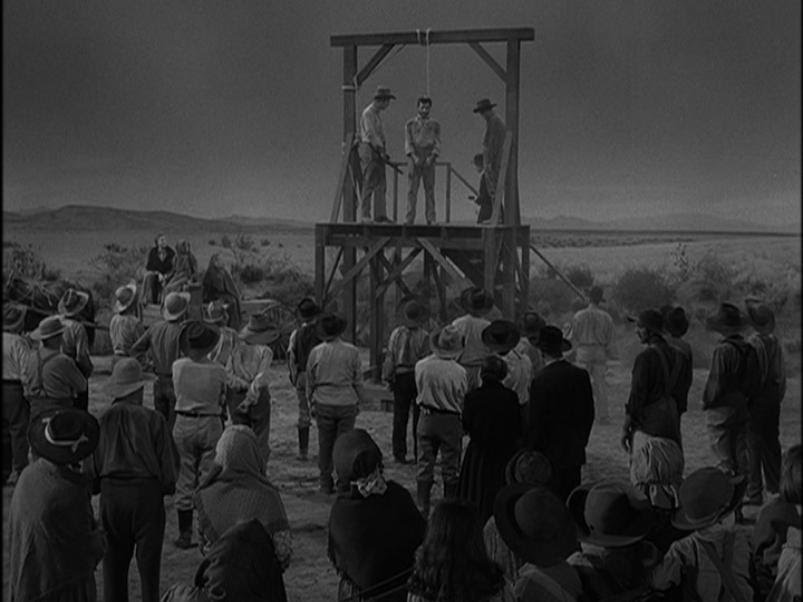
In a remote desert town in the Old West, a young Hispanic man is set to hang for accidentally killing a child. He waits in his cell, staring helplessly out the window as his gallows are readied. A grimy peddler named Sykes skulks around, offering to sell a pouch of magic dust that just might turn things around for all concerned.

Sounds like some twisted western noir but, despite its title, the episode fails to kick up much “Dust” at all. Everything seems lethargic, as if the entire thing was left out in the sun too long. Director Douglas Heyes, responsible for some of the series’ most innovative and visually exciting episodes (“The Howling Man” and “The Eye of the Beholder,” for example), took this approach intentionally to illustrate that the entire town has, in a way, become like the dust that covers it. Okay, fine, but it doesn’t make for an interesting episode. The script by Serling is good enough, but the problem here is the execution (no pun intended).

It also doesn’t help that the supernatural element is so vague as to be almost nonexistent. Really, there’s no evidence that there’s any “magic” going on at all. I’m all for subtlety, but here it just makes me yawn. The main players are all familiar TZ faces: Thomas Gomez (“Escape Clause”), John Larch (“Perchance to Dream”), and Vladimir Sokoloff (“The Gift”). The cast does its best, but ultimately the episode is a bit tedious to watch. However, like every other filmed episode, it looks spectacular in high definition on blu-ray, so it’s not a total loss.

Probably the best thing the episode has to offer is a brooding acoustic guitar score by Jerry Goldsmith, who composed many of the series’ most memorable scores (“The Invaders,” “Back There,” and a personal favorite of mine, “The Big Tall Wish”). His score for “Dust” was first released on vinyl in the 80's by Varese Sarabande (The Twilight Zone: The Original Television Scores, Volume 5; all 5 vinyl volumes were subsequently released on CD in Japan only). The score later appeared on CD in the US as part of Silva’s Twilight Zone 40th Anniversary Collection boxed set. And of course, it’s also available from Image Entertainment on both the Season 2 Definitive Edition DVD and its newly-released blu-ray counterpart, playing alongside the episode on an alternate music-only track.


Ultimately, "Dust" isn't necessarily bad, but it'll never make my favorites list. In a season filled with some of the series' finest offerings, it's average at best. Anyway, it celebrates its 50th birthday tonight.


Next week: Russell Johnson returns to The Twilight Zone for another time travel tale. He’ll find himself transported to a fateful night in April 1865, where a very special guest is attending a play at the Ford Theater. Get yourself a ticket and tune in.


Thursday, October 14, 2010

TZ Promo: "Nervous Man in a Four Dollar Room" (10/14/1960)


"Nervous Man in a Four Dollar Room"
Season Two, Episode #3 (overall #39)
Cayuga Production # 173-3641


His name is Jackie Rhodes. He's a small time crook, nickel and dime, scared of his own shadow. Tonight, his boss will scare him even more. He'll order Jackie to commit murder.


"Nervous Man in a Four Dollar Room," written by Rod Serling and directed by Douglas Heyes, first aired fifty years ago tonight. It is without question the first truly excellent episode of The Twilight Zone's second season. Seriously, there's virtually nothing to complain about here. Great script, innovative direction (which I'm not going to describe in detail, because doing so will give away too much of the plot, and I really try to avoid spoilers whenever possible), marvelous acting by the two leads (two leads, three distinct roles... uh-oh, there I go already, spoiling the surprise), a wonderful jazzy score by Jerry Goldsmith.... everything comes together beautifully. It sits comfortably in my top 40 favorite episodes of all time.

I love this episode. It feels like a stage play, but it never feels overly staged... if that makes sense. I once had aspirations of being a stage director (I was a proud member of the International Thespian Society in high school), and I remember thinking that this would be a great episode to adapt for the stage. Unfortunately, ours was a small school, and I'd need twins for the lead role... oops, there I go again, wrecking the surprise.

Never mind Michael Jackson. Jackie Rhodes is the original "Man in the Mirror."

Joe Mantell really shines as the two Jackies (damn it! See, it's impossible to talk about this episode without ruining it). We'll see him again in season five's "Steel." He's probably best known for his role in 1974's Chinatown, in which he utters the final line of the film to Jack Nicholson: "Forget it, Jake, it's... Chinatown."


Sadly, Mr. Mantell passed away just two weeks ago, on September 29. Rest in peace, Jackie. I mean John (you'll get it when you watch it).

William D. Gordon, here playing Jackie's slimy boss George, will be seen again much, much sooner. He'll appear as a much different character, a surgeon who wears his heart on his sleeve (and his face in the shadows), in "The Eye of the Beholder," a true classic that we'll be spotlighting in just a few short weeks.


The aforementioned Goldsmith score was first released on Varese Sarabande’s The Twilight Zone: The Original Television Scores, Volume 4 vinyl LP (and CD in Japan), subsequently collected in their The Best of The Twilight Zone (the first of two such "Best Of" volumes), and later appeared on Silva’s The Twilight Zone 40th Anniversary Collection. It’s also presented in isolated form (on an alternate audio track) on Image Entertainment’s The Twilight Zone, Season 2: The Definitive Edition DVD (the forthcoming blu-ray edition of Season 2 will also feature the score in isolated form).


Two weeks from tonight: If you rage against the machines... well, they might just rage back.