Season 4, Episode 1 (#103 overall)
Cayuga Production # 4851
Originally aired January 3, 1963
The revamped Twilight Zone launched
fifty years ago tonight with Charles Beaumont’s “In His Image.” There’s really
no way I can discuss the episode without spoiling it, so… fuck it, I won’t even
try. In fact, I’ll get it over with by
very quickly encapsulating the proceedings:
Guy murders a woman in a subway in what appears to be a brief psychotic
episode. Guy picks up girlfriend and drives to his hometown. Lots of details about the town don’t jibe
with his memory, and he has a couple more violent episodes as he tries to
figure out what the hell is happening.
He eventually tracks down a man who appears to be his identical twin,
but is actually his maker. It turns out
our troubled hero is a robot, one with an unfixable flaw that causes him to
periodically go crazy. Creator and
creation clash in an epic battle, from which only one of them will emerge.
See, I didn't spoil everything after all (I guess I could just
mentioned that Beaumont’s teleplay was based on his own short story “The Man
Who Made Himself,” which is a spoiler in itself).


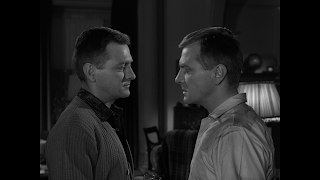
George Grizzard shines as both Alan
Talbot (the creation) and Walter Ryder, Jr. (the creator). The two are completely different
personalities (Alan is humored and gregarious, while Walter is bitter and
withdrawn), and Grizzard expertly inhabits both. Hands down, this is one of my favorite performances in the series' five-year run. Season two’s
“Nervous Man in a Four Dollar Room” featured a similar two-sides-of-the-same-coin performance by Joe Mantell,
but his excellent work was hampered by less-than-optimal rear projection. Here, things are technically perfect. If
there are split-screen seams, I sure as hell can't see them (not even under
Blu-ray’s high-resolution microscope).


Grizzard appeared in many television series throughout the fifties and sixties, and was an accomplished theater
performer (he won a Tony in 1996 for his work in the revival of
A Delicate
Balance (shown at left). Genre fans may have spotted him on
Alfred Hitchcock Presents, on which he appeared three times. More recently, he had a recurring role on TV's
Law and Order, and his last appearance on film was in Clint Eastwood's
Flags of Our Fathers in 2006, shortly before he passed away in 2007).
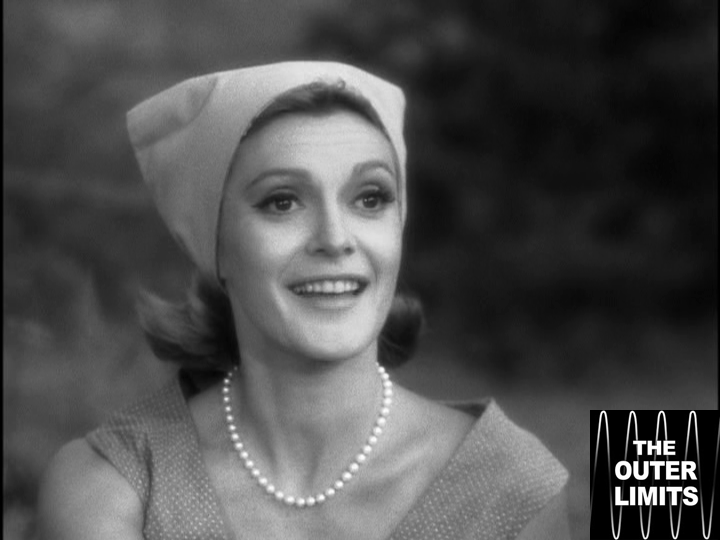
Alan's girlfriend Jessica is played by the lovely Gail
Kobe.
TZ babe alert! *sigh* We caught a brief glimpse of her in season
one’s
“A World of Difference,” and we’ll see her again in season five’s “The
Self-Improvement of Salvadore Ross.” She’s
equally delicious in two of
The Outer
Limits’ sillier endeavors (“Specimen: Unknown” and “Keeper of the Purple
Twilight;” the latter has to be seen to be believed).
At least The Outer Limits was kind enough to get her all wet for us.
Katherine Squire, last seen in season three’s
“One More Pallbearer,”
appears for a brief but memorable role as the crazy Christian lady who badgers
Alan in the subway, and good God is she repellent. This is "witnessing" at its most coarse and obnoxious; thankfully, Alan dispatches her by tossing her in front of an oncoming train. Sometimes murderous rages can be productive after all.
The onset of Alan’s violent fits are conveyed to us via a cacophony
of blips, bloops and buzzes (standard sci-fi gizmos-gone-crazy sound effects;
apparently inaudible to others), along with a bright light that comes over his
face (apparently invisible to others; it’s reminiscent of the “death light”
depicted in season one’s
“The Purple Testament”).
It’s all effective enough but, frankly, Grizzard’s tortured reactions
would have sufficed, and kept things a bit more subtle.
When Alan arrives at Walter's residence for what will become an epic showdown, we're treated to a nice atmospheric shot of Walter sneaking up behind him in the shadows. If this shot looks vaguely familiar, it may be because we've already seen Grizzard perform a very similar arrival in season one's
"The Chaser."
I'm sure this wasn't done intentionally, but it's a marvelous piece of visual continuity regardless (one that Arlen Schumer apparently missed in his amazing
Visions from The Twilight Zone coffee table book, in which he draws several visual parallels between images from various episodes. By the way, every true
TZ fan needs to own this book. It's about twenty years out of print, but can easily be tracked down on
Amazon or
eBay).
When viewed as a whole, The Twilight Zone is positively bristling with compelling and iconic images; here we get one of my personal favorites. Upon receiving a forearm injury right before
the midway act break, Alan slowly peels the skin back to reveal the first
concrete hint about the mystery of his identity.
Boom! You’re a robot, dude.

The idea of a simulacrum carrying on in ignorance of its own
artifice was almost certainly a sci-fi cliché by the time
The Twilight Zone tackled it (in season one’s
“The After-Hours” and
season two’s
“The Lateness of the Hour”), but in the capable hands of writer
Charles Beaumont, the concept never feels unoriginal or stale (Beaumont also
wrote another surprise-it’s-a-robot story called “Last Rites” in 1955, an
equally fine yarn that would've made a great
TZ episode). Harlan
Ellison would employ this device in his 1965
Outer Limits teleplay “Demon with a Glass Hand” (which happens to
be my all-time favorite
TOL episode;
maybe I’m a much bigger fan of surprise-robot stories than I
realized).

Walter Ryder Jr.’s basement lab is a pretty impressive set, complete
with the usual wall-sized computer terminals and assorted gadgetry. Particularly effective is what appears to be
a brick-lined incinerator unit in the wall, but is more likely some sort of
finishing/activation chamber for Ryder Jr.’s mechanical offspring (speaking of
which, check out those failed proto-Alans lying dormant on a double-wide gurney).

And hey,
Forbidden
Planet alert! The notorious bank of
Pac-Man lights, originally a piece of equipment in that film’s C-57D Space
Cruiser, makes yet another appearance on the series. This prop was used
previously in
“People Are Alike All Over,” “Elegy" and
“Third From the Sun." I'm betting we'll see it again before the series ends...
As the first double-length TZ
episode aired, “In His Image” never feels overlong or bloated (an attribute
which next week’s episode will sadly not share). It’s an absolute winner, one of my top 20
favorites of all time.
Next week: There’s something
scary inside that wrecked submarine, so whatever you do, don’t go down
there! No? Okay, whatever you do, don’t go down there
twice! Still no? Okay, can we at least agree that you won’t go
down there a third time? Oh come on,
seriously??!