Showing posts with label Elliot Silverstein. Show all posts

Friday, April 20, 2012

TZ Promo: “The Trade-Ins” (4/20/1962)


Season 3, Episode 31 (96 overall)
Cayuga Production # 4831

For a series whose stock in trade is suspense and fantasy, The Twilight Zone features a surprising number of stories steeped in sentimentality. Nostalgia and longing are recurrent themes, featured every bit as prominently as time travel, identity crises and alien invasions. A subdivision within said “nostalgia and longing” is the fear of growing old, of death itself. We witnessed a moving exploration of this theme earlier this season with George Clayton Johnson’s “Nothing in the Dark,” in which death is depicted as something to be embraced rather than feared. 50 years ago tonight, Rod Serling presented us with an enticing alternative.


“The Trade-Ins” introduces us to the New Life Corporation, a company in the not-too-distant future that can transfer the minds of the sick and/or old into new, youthful, semi-indestructible bodies. Their latest potential customers are John and Marie Holt, an elderly couple clearly nearing the end of their journey. John is crippled by pain; Marie dreamily imagines starting their lifelong courtship anew. They appear to be perfect clients for New Life; unfortunately, they only have half the money needed to undergo the transformation together.


In his promo for this episode (aired at the end of last week’s “Hocus-Pocus and Frisby”), Serling said the following: “It’s my personal feeling that of the various story areas we’ve tackled in The Twilight Zone, this has the most import, and carries with it the most poignance.” Thankfully Rod was putting his money where his mouth was: “The Trade-Ins” is a wonderfully sweet and moving entry, easily on par with the best from the show’s first (and best) season. You can’t help but love the Holts, particularly their evident and undying devotion to one another. The sacrifice that Marie is willing to make to save John from any further pain is heartbreakingly life-affirming, and the subsequent sacrifice that he makes for her is both devastating and beautiful.


Joseph Schildkraut, who stole the show earlier this season in “Death’s-head Revisited” as a spectral concentration camp custodian, is a revelation here. The age makeup is a bit obvious (particularly in high-definition; see the captures herein), but his interpretation of Holt is remarkable. Watch him as he speaks through pained sobs before the gangster who’s about to clean him out in a poker game, and contrast that with the warm, almost playful tenderness he displays when he strokes Marie’s cheek in the New Life showroom. This is expansive, nuanced work, pretty damned impressive for a three-day quickie stint on a TV show. Schildkraut’s wife died in the middle of production, and it’s a testament to his professionalism that he insisted on completing his scenes (it also makes watching his work here more than a little heartbreaking).


Elliot Silverstein directed “The Trade-Ins” and, for a brief moment, he appears to be giving us a sequel to season two’s “The Obsolete Man,” which he also directed:


Look at that huge dark room. Is there a chancellor on a perch somewhere just off camera…? Nope, it’s the New Life showroom, which houses several inert artificial humanoid bodies, on display.


The entire cast, save for Alma Platt (an endearing Marie Holt), is made up of TZ veterans. Edson Stroll, who played the hideous (by alien pig-people standards) Walter Smith in season two’s “The Eye of the Beholder,” is on hand here as the new-and-improved John Holt. He’s fine and all, but why doesn’t he sound like Holt? Even with new vocal cords, he should still possess Holt’s European accent… right?


And I’d be remiss if I didn’t mention those stylin’ short shorts; there’s some manly eye candy if that’s your thing (we’ll see Robert Lansing in similarly-minimal trunks in season five’s “The Long Morrow”).


Theodore Marcuse is great as the card shark/frustrated musician Farraday. We last saw him twirling a pencil as Gregori, the Russian ambassador in “To Serve Man.”


Mr. Vance, the New Life rep, is nicely played by Noah Keen, who popped up in “The Arrival” as Bengston, the airline executive who deftly (okay, impossibly) figures out that the entire mystery is nothing more than a guilt-fueled hallucination. Here he's surprisingly effective as a sympathetic salesman.


“The Trade-Ins” is just plain lovely, hitting all the right notes without crossing the saccharine line. Highly recommended.


Next week, “The Gift” tries to tell a sensitive tale of a young Mexican boy and his newfound alien friend. It sounds like E.T. in a sombrero, but it’s actually a stale tortilla. ¡Ay, caramba!


Thursday, October 6, 2011

TZ Promo: "The Passersby" (10/06/1961)


Season 3, Episode 4 (#69 overall)
Cayuga Production # 4817

I first discovered The Twilight Zone in middle school, at the tender of age of 13, and by the age of 21, I’d seen every single episode at least once. Some episodes I’ve seen dozens of times over the two decades since, but there are others that I haven’t seen in 20 years or more. When I started this 5-year celebration of the series’ 50th anniversary, one of the things that excited me was the prospect of seeing those lesser-viewed episodes with older eyes. Perhaps I’d discover a gem that I’d foolishly shunned in my youth. This possibility, frankly, excited me more than simply rewatching episodes that I already knew by heart.

It’s happened. I've discovered that hidden gem.


I saw “The Passersby” once and only once, back in high school when I home-videotaped most of the series. In my teenage estimation, the episode was boring and slow. Worse, the “surprise” ending was obvious from the beginning. I chalked it up as one of Serling’s missteps, certainly not as offensive as “Mr. Bevis” or “Mr. Dingle, the Strong,” but a stinker nonetheless. I might have never watched it again, were I not endeavoring to watch every episode on its 50th birthday.

I’m not a religious man, but thank god this wasn’t the case. “The Passersby” is truly remarkable, and the next time I revise my favorites list, it will most definitely be added.


Written by Rod Serling and directed by Elliot Silverstein, “The Passersby” takes place in the aftermath of The Civil War. A woman, Lavinia Godwin, sits on the porch of her house, which is in an advanced state of disrepair. She watches an endless stream of soldiers from both sides of the conflict lumber past in a smoky haze. One of them stops and asks for water. They talk. He plays his battered guitar.


A few other men stop by, including Lavinia's lost (and presumed killed) husband. Each interaction contributes to a dawning realization that all of them are in fact dead. Lavinia refuses to believe it, despite the mounting evidence. The stream of bodies dries up, save for one final passerby: Abraham Lincoln himself, newly assassinated, who stops to comfort her.


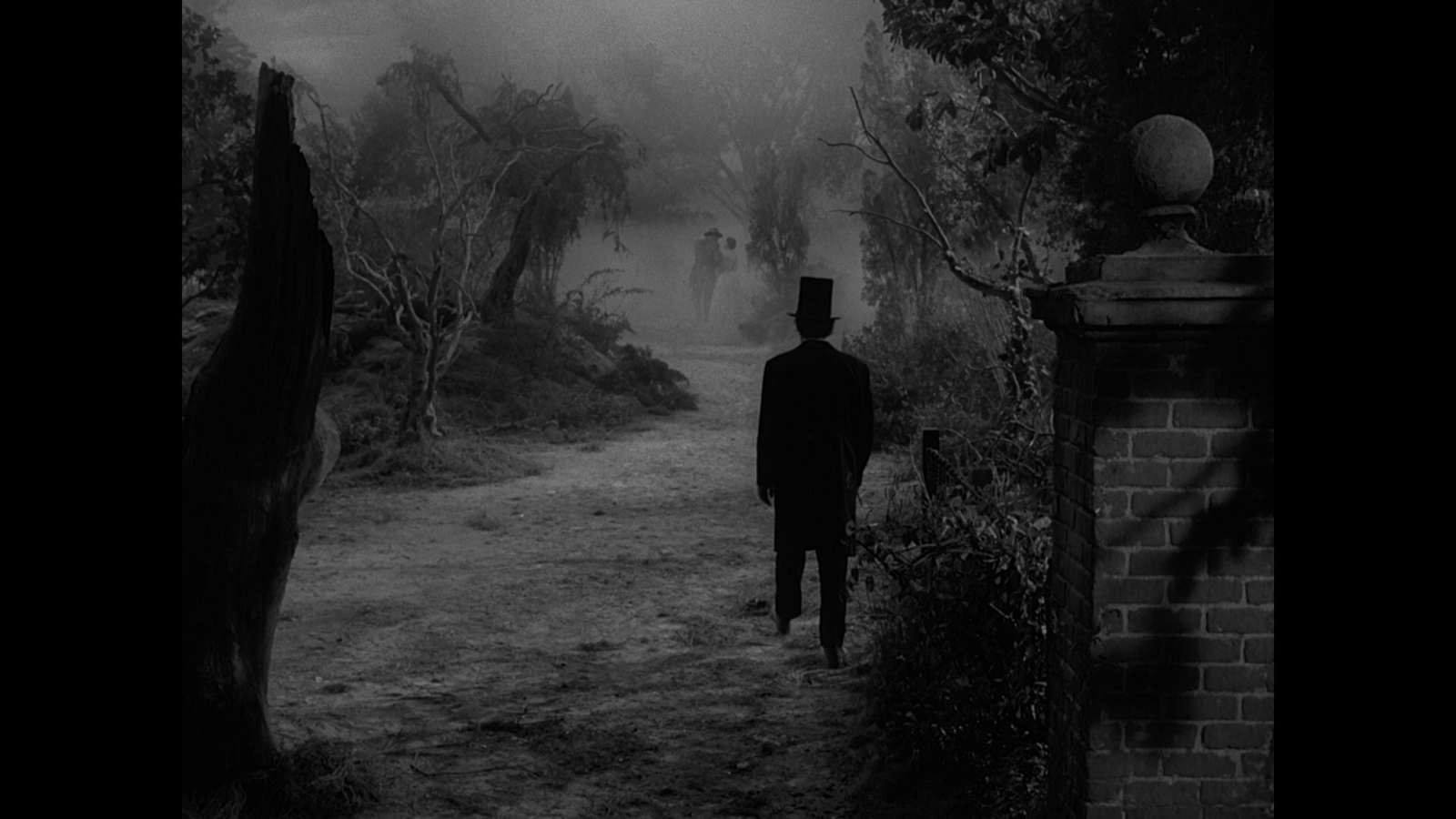
I normally eschew this level of spoilery, but the truth is pretty apparent from the opening moments. The soldiers, bathed in fog, are clearly the walking dead, and we're given several clues that support this truth. It does seem to take the main players a long time to deduce the obvious, but personally, I don’t think the ultimate truth is the point of the story. What we’re seeing is a meditation on the mind’s hesitation to accept a fundamental shift in the very nature of its existence. Wouldn't we need a lot of convincing, were this happening to us? We see this reluctance to let go of earthly reality at the core of the brilliant and visceral 1990 film Jacob's Ladder (a favorite of mine). Here in the Zone, season one’s “The Hitch-hiker” explored this same concept, as will the upcoming “Nothing in the Dark," but neither achieves the haunting grandeur of “The Passersby.” You can't argue with the episode's production design, either.... it's just damned gorgeous to look at.


Marc Scott Zicree, in his Twilight Zone Companion, dismisses “The Passersby” as “one of the weakest episodes of the first three seasons.” What a numbskull.

"The Passersby" features what must be the most beautiful closing shot in the entire series. Lavinia races down the fog-shrouded road to catch up with her deceased husband. Lincoln slowly follows. No more casualties of The Civil War shall pass here. Absolutely breathtaking.


THE MUSIC

“The Passersby” features one of the greatest original scores ever composed for The Twilight Zone. Fred Steiner’s music (heavy on the violins and harp) is beautiful and somber, mournful but ultimately hopeful. It rises slowly, almost liquidly (is that a word? It should be), growing in intensity like waves on a restless sea. It perfectly underlines the languid pace of the episode and, on its own, divorced from the visuals, is a moving and haunting listening experience.


Steiner's score has been made available many times. It was first released on vinyl in 1985 by Varese Sarabande (The Twilight Zone: The Original Television Scores, Volume 5). Varese Sarabande only released CD versions of their five LPs in Japan; in the US, they released two “Best of” CD compilations in 1990 (“The Passersby” was included on the second volume), which are both out of print. The score appeared on domestic CD again as part of Silva’s Twilight Zone 40th Anniversary boxed set in 1999, which is now out of print. I just checked iTunes, and it's not there. So the only way to get it is to buy either the Season 3 Definitive Edition DVD or the more recent blu-ray edition (both from Image Entertainment), both of which feature the score isolated on alternate music-only tracks. I happen to own all of the above items, so I’m planning on listening to the score tonight before I watch the episode… on vinyl, in a darkened room. Maybe with a glass of wine, or perhaps scotch.


A few weeks back, I mentioned that I keep a CD-R of favorite TZ music in my car at all times, and that I frequently revise it. I've been doing this for several years, and “The Passersby” has never once been rotated out.


REMAKES, KINDA SORTA


The 2001 film The Others (starring Nicole Kidman) seems to be a semi-remake of this episode (though it takes place in the aftermath of WWII, not the Civil War). It's a great film (it was recently released on blu-ray... I need to pick it up). The 2002-2003 UPN Twilight Zone revival spawned a semi-remake called “Homecoming,” which moved the action into the present, during the War in Iraq (I can’t comment on it, since I’ve never seen it, but what I have seen of the UPN series leaves me less than optimistic).


RANDOM HILARITY
16 minutes and 10 seconds into the episode, a fly lands on James Gregory’s right suspender strap and nonchalantly crawls down his torso. I guess the little guy died in The Civil War too. I'm imagining a prequel story in which the fly is Gregory's ersatz Jiminy Cricket, keeping him on the straight and narrow while he navigates his way through the horrors of war.... hey, it couldn't be worse than George Lucas's ill-conceived prequels, right?


This is the kind of stuff you can’t get with VHS or DVD, folks. Only the pristine clarity of high definition can reveal delightful little details like this. Invest in the blu-rays. C'mon, take the damn plunge already. I’m gonna keep harping on you till you do.


Next week: TZ veteran Jack Klugman challenges Jonathan Winters to a deadly game of… pool?


Thursday, June 2, 2011

TZ Promo: “The Obsolete Man” (6/02/1961)


“The Obsolete Man” (6/02/1961)
Season Two, Episode 29 (65 overall)
Cayuga Production # 173-3661


“There is no God. The State has proven that there is no God!”


The Chancellor bellows pro-State sentiments from his impossibly high lectern. A meek librarian stands below, the reality of the situation sinking in. He has been found obsolete. He is to be executed.


TZ alums Burgess Meredith (“Time Enough at Last,” “Printer’s Devil,” and, sadly, “Mr. Dingle, the Strong”) and Fritz Weaver (“Third from the Sun”) return as the librarian and the chancellor, respectively, and both turn in excellent performances. When we meet them, the chancellor is vicious and predatory, while the librarian is weak and fearful. By the end of the episode, the tables aren’t so much turned as flipped over and smashed.


The first half of the episode takes place in a futuristic courtroom, which looks like something out of a German Impressionistic nightmare (was director Silverstein channeling Fritz Lang?). The door that Meredith enters through is impossibly tall, for no apparent reason other than to amp up the ominousness quotient.


Rod Serling’s “The Obsolete Man,” directed by Eliot Silverstein, is an absolute classic. This is one of those episodes in which every component operates at maximum greatness, and the combined result is transcendent. “The Eye of the Beholder” is frequently cited as the all-time greatest episode of The Twilight Zone but, for my money, “The Obsolete Man” trumps it. I recently revised my Top Ten Favorites list to include it, and I can’t wait to watch it tonight, on its 50th anniversary, in glorious high definition (thanks, Image Entertainment!).


In 1995, a local theater company called Hellfire Productions performed “The Obsolete Man” (along with “A Game of Pool” and “Nothing in the Dark”), complete with an actor performing Rod Serling’s narration. I was fortunate enough to attend, and I thoroughly enjoyed it. I still have the program:

Front.

Inside.

Back, for completeness' sake.

In between episodes (okay, acts), they had a TZ trivia contest. As I recall, one of the questions asked which two actors starred in the most episodes. The answer is, of course, Jack Klugman and Burgess Meredith, which I’m happy to say I answered correctly (I don’t recall getting a prize, however). After the play, I got myself on their mailing list. They produced nine more episode adaptations over the next 3 years... but for some unfathomable reason, I never saw them. I still have the postcards they sent me advertising each production, which I'll scan and post sometime soon. In fact, I'm hoping to track down somebody connected with the production for an interview...

The music in “The Obsolete Man,” is sourced from Bernard Herrmann’s score for the CBS Radio Workshop’s 1956 adaptation of Aldous Huxley’s “Brave New World.” This score (like much of Herrmann’s radio work) was subsequently added to the CBS Music Library, and its various cues found their way into several TZ episodes. The score was released on vinyl in the early 80s by Cerberus Records (Bernard Herrmann: Music for Radio and Television), and on CD in 2003 by Prometheus (Bernard Herrmann: The CBS Years Volume 2: American Gothic).


Next week: The summer rerun season kicks off with a bang. We return to where it all started: Earl Holliman stars as a lonely man with no memory, wandering through an empty town and wondering… say it with me now… “WHERE IS EVERYBODY?”