Showing posts with label Long Live Walter Jameson. Show all posts

Saturday, March 14, 2020

4x02 "Harum-Scarab"


This week Craig drinks the alchemist’s longevity potion and spends an eternity analyzing the classic Twilight Zone episodes “Long Live WalterJameson” and “Queen of the Nile.” It’s a heady blend of Ken Burns-esque Civil War side trips, Nazi Germany flyovers, and ruminations on mortality. We Sphinx you’ll really like it.


Rondo Hatton Classic Horror Awards ballot: https://rondoaward.com/rondoaward.com/blog/?p=890


“Ashokan Farewell” performed by Russ Bareberg (from the album The Civil War: Original Soundtrack Recording, copyright 1990 by Nonesuch Records)

“Clyde Bruckman’s Final Repose: Dumpster” composed and performed by Mark Snow (from the album The X-files: Volume 2, copyright 2013 by La La Land Records)

“Entr’acte (Caesar & Cleopatra)” and “Taste of Death” composed and conducted by Alex North (from Cleopatra: The Original Motion Picture Soundtrack, copyright 1963 by 20th Century Fox Records)

“Smokey Sax” by Hollywood Trailer Music Orchestra (from the album Film Noir: Vintage Cinema Classics, copyright 2015 by Megatrax Music“Cleopatra” performed by The Skatalites (from the album Foundation Ska, copyright 1996 by Heartbeat Select Records)

“Like Egypt Was” performed by Michael Penn (from the album Resigned, copyright 1997 by Epic/57 Records)

The Twilight Zone is a trademark of CBS, Inc.

Between Light and Shadow: A Twilight Zone Podcast is a nonprofit podcast. Music clips and dialogue excerpts used herein are the property of their respective copyright owners; we claim no ownership of these materials. Their use is strictly for illustrative purposes and should be considered Fair Use as stated in the Copyright Act of 1976, 17 U.S.C. section 107.

Thursday, March 6, 2014

Episode Spotlight: "Queen of the Nile" (3/06/1964)


Season 5, Episode 23 (143 overall)
Originally aired 3/06/1964
Cayuga Production # 2626

Fifty years ago tonight, a curious cat fell victim to the attractive wiles of an alluring femme fatale. He really should’ve seen it coming, but he was clearly in de Nile.


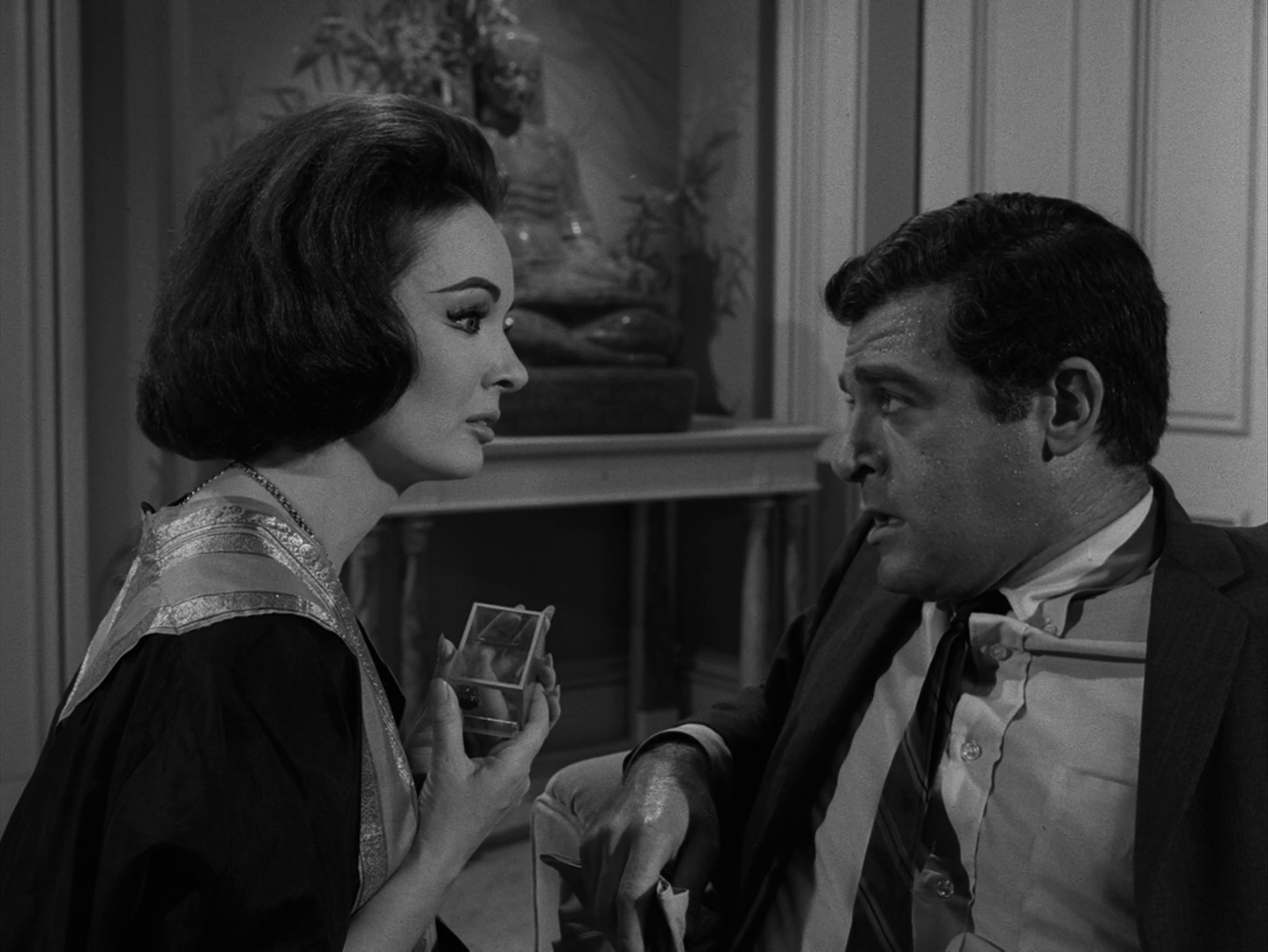
Newspaper columnist Jordan Herrick arrives at the estate of actress Pamela Morris for an interview. After a bit of flirtatious banter, he gets down to brass tacks and asks her how old she is. She coyly avoids the questions, at which point her mother, Viola Draper, joins them for coffee. Ms. Draper is strangely sullen and resentful of her daughter and, on her way out, says a pointed “goodbye” to Herrick.


Pamela states that she’s 38 years old, contradicting Herrick’s research, which suggests she’s much older. She assuages his suspicions by more or less throwing herself at him, which he more than willingly laps up. They share a kiss, after which she agrees to have dinner with him that evening.  On his way out, Viola accosts him and insists that he never see her again. She then imparts a shocking and impossible piece of information to him: Pamela is not her daughter…. she’s her mother.


That night, Pamela dismisses Viola’s claim, stating that her mother is “disturbed.” After he leaves her, Herrick calls his editor and has him do some research on Pamela’s early film career. It turns out there was an identical actress, Constance Taylor (whose career pre-dates Pamela’s), who disappeared under mysterious circumstances right before Pamela appeared on the Hollywood scene.


Herrick brings his research materials to Viola, who confirms all of it. Viola states that she has no idea how old Pamela is, but she believes that her agelessness has something to do with the Egyptian scarab beetle, a symbol of renewal and regeneration. Pamela arrives and curtly dismisses her.

Herrick demands the truth, unaware that Pamela has slipped something into his coffee. She agrees to tell him everything, producing a small glass box, inside which is a live scarab beetle. As he becomes increasingly impaired, she reveals that, thanks to the scarab’s power, she has endured since the time of the Pharaohs. Jordan falls to the floor, unconscious, and Pamela places the beetle onto his chest.


Herrick rapidly ages, turning first to a skeleton, then finally to dust as the beetle saps the life force from him. Her immortality replenished, Pamela orders Viola to clean up the evidence.... just as another reporter arrives to interview her.


“Queen of the Nile” is the final Twilight Zone episode attributed to writer Charles Beaumont; however, like his other season five credits, he didn’t actually write it. Rapidly deteriorating from either Alzheimer’s or Pick’s Disease (it wasn’t easy to diagnose or differentiate them at that time; it’s a bit of a toss-up at this late date), Beaumont utilized a number of ghost writers; in this case he and Jerry Sohl blocked out the plot, and Sohl wrote the script. In this light, it’s easy to forgive the fact that the end result is quite similar to Beaumont’s earlier “Long Live Walter Jameson” from season one, particularly in the depiction of Herrick’s rapid aging and disintegration (the same color filter trick is used to achieve the first stage of both transformations). We do get a cool skull-crumbling bit this time around (see above); ultimately, both turn into an empty suit stuffed with dust.


The series has been borrowing from itself since the middle of the third season and, while “Queen of the Nile” is certainly guilty of that, it doesn’t bother me the way other guilty episodes do. For me, it serves at a decent bookend to “Long Live Walter Jameson” or, at the very least, an interesting variation on it. I’m comfortable acquitting it on the grounds that it’s entertaining, the acting is fine, there’s a nice sense of mystery that gradually changes to palpable dread, and it’s the only episode in the entire series with an Egyptian vibe. 

THE MUSIC


“Queen of the Nile” features an original musical score by Lucien Moraweck; however, we also hear a few selections from Bernard Herrmann’s “The Moat Farm Murders” during the climax (a suite of CBS library cues that originated from his radio days). The suite was first released by Cerberus Records as part of their 1986 vinyl album Bernard Herrmann: Music for Radio and Television and, more recently, on CD as part of Prometheus Records’ Bernard Herrmann: The CBS Years Volume 2: American Gothic


The Moraweck score, which is quite lovely and mysterious, has unfortunately never been released on any format, and is disappointingly not accessible as an isolated music track on the DVD and Blu-ray sets (as most TZ scores are).

DRAMATIS PERSONAE

In the director’s chair this week is John Brahm, who holds the distinction of directing more Twilight Zones than anyone else (including classics like “Time enough at Last,” “Mirror Image” and “Shadow Play”). “Queen of the Nile” is his twelfth and final contribution to the series.


Lee Philips (Jordan Herrick) returns for his second TZ appearance (he headlined last season’s “Passage on the Lady Anne”). He also co-starred in “The Galaxy Being,” the pilot episode of The Outer Limits, and he enjoyed multiple roles on both of Alfred Hitchcock’s TV series (“Alibi Me,” “The Deadly” and “Deathmate” on Alfred Hitchcock Presents and, later, “The Black Curtain” on The Alfred Hitchcock Hour).


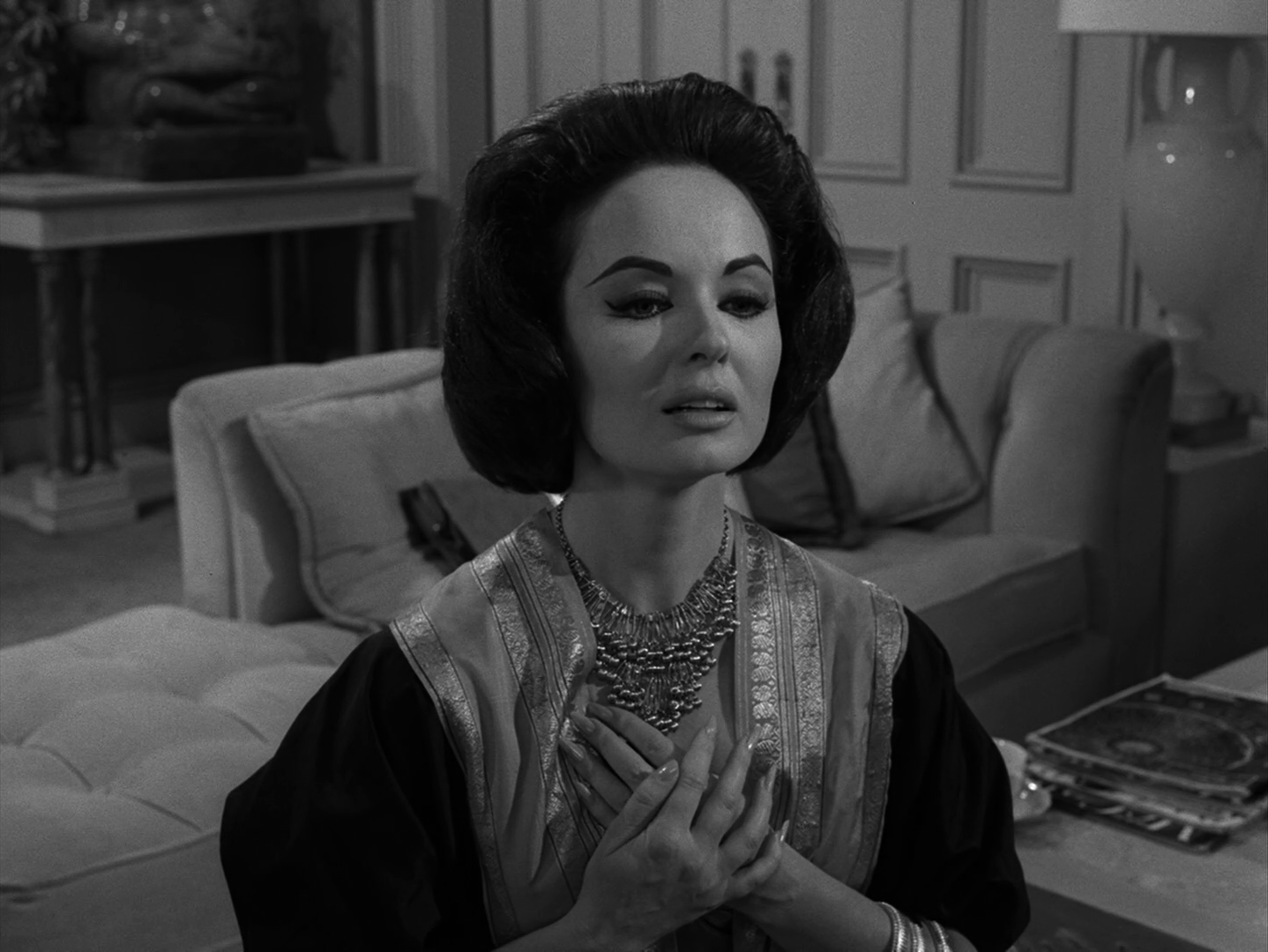
The beautiful Ann Blyth is radiant as Pamela Morris in her sole Twilight Zone appearance, which is also the only sci-fi/fantasy/horror credit on her resume. She did show up in a couple of notable film noirs in the 40’s, however (1945’s Mildred Pierce and 1947’s Brute Force). And yes, in case you were wondering, she qualifies as a TZ Babe.

Ann Blyth (right) with Joan Crawford.

Celia Lovsky is quite good as Viola Draper, Pamela Morris’s mother daughter, but of course genre fans will immediately recognize her as the Vulcan High Priestess T’Pau from the classic “Amok Time” episode of Star Trek. It’s also worth noting that she'd already crossed paths with Lee Philips, in the aforementioned Alfred Hitchcock Hour episode “The Black Curtain” in 1962.


After a fairly prolific film career in the 40’s and 50’s (including a few choice film noirs, among them 1942’s This Gun for Hire and 1952’s On Dangerous Ground, the latter of which, incidentally, was scored by frequent TZ music contributor Bernard Herrmann), Frank Ferguson (here playing Krueger, Herrick’s editor) enjoyed a fairly prolific TV career in the 60’s and 70’s; however, not much of it fell under the sci-fi/fantasy/horror genres. He did appear on one episode of The Alfred Hitchcock Hour (“Night of the Owl”), one Voyage to the Bottom of the Sea (“The Sky is Falling”) and one Land of the Giants (“The Marionettes”).

Frank Ferguson consoles TZ alum Ida Lupino.


“Queen of the Nile” is quite good by fifth season standards (if it had aired during the first season, I’d probably dismiss it as mediocre). The actors are engaging, the music is great, and it serves as a nice bookend to Beaumont’s earlier classic “Long Live Walter Jameson” (even though Beaumont didn’t actually write this one). 

That about wraps it up for this week, kids… as always, ankhs for stopping by.


Next week:
Yonkers! Yonkers! YONKERS!!!


Saturday, August 20, 2011

Long Live William Shatner


I follow several comedians via Twitter, and one of my favorites is Patton Oswalt. The other day, he Tweeted the following:

"Don Rickles is only 5 years older than William Shatner. SORRY FOR BLOWING YOUR MIND."

I chuckled to myself, then headed straight over to IMDB to confirm. Rickles was born 5/08/1926, and Shatner was born 3/22/1931. That's actually about six weeks shy of 5 years!

In season one's "Long Live Walter Jameson," aging professor Sam Kittridge laments how he has grown old while his best friend, Walter Jameson, well... hasn't. Jameson's response? "It happens that way sometimes." Spoiler alert: Jameson is immortal.


Both Rickles and Shatner appeared on The Twilight Zone in 1961, so we can easily compare them. First, here's Rickles in "Mr. Dingle, the Strong":

Rickles is 35 here. His thinning hairline suggests a man somewhat older, but... okay, 35. Meanwhile, here's Shatner, age 30, in "Nick of Time":

Good God. He could pass for 20, easy.

Flash forward 50 years. Here's Rickles today:


And here's Shatner today:


"It happens that way sometimes," indeed. Could Shatner outlive us all?


Sunday, September 12, 2010

RIP Kevin McCarthy (2/15/1914 - 9/11/2010)


I'm deeply saddened to report that Kevin McCarthy, star of my all-time favorite Twilight Zone episode "Long Live Walter Jameson," passed away yesterday at the age of 94. Here's the NW Times article. Mr. McCarthy is best known for his starring role in the original Invasion of the Body Snatchers (1956).


I was very fortunate, some years back, to acquire a personalized autograph from Mr. McCarthy through my good friend Bill Huelbig, who met Mr. McCarthy in person and thought of me.


Rest in peace, good sir.

Thursday, March 18, 2010

TZ Promo: "Long Live Walter Jameson" (3/18/1960)


I’ve been waiting for this day since I first embarked on my five-year Twilight Zone anniversary celebration. Tonight marks the 50th anniversary of my all-time favorite episode, “Long Live Walter Jameson.”


Walter Jameson (Kevin McCarthy) and Samuel Kittridge (Edgar Stehli) are college professors, the best of friends. They're so close, in fact, that Jameson is engaged to marry Kittridge’s daughter Susanna. But as the years have passed, Kittridge has noticed something disturbing: as he himself grows older, his friend never seems to age. One evening during a game of chess, Kittridge corners Jameson on the issue. The truth, at once amazing and devastating, is revealed.


“Long Live Walter Jameson” is essentially a two-character drama (which would translate quite nicely to the stage, come to think of it). The script by Charles Beaumont is flawless, and the performances by McCarthy (Invasion of the Body Snatchers) and Stehli are top notch, refined and nuanced, utterly believable. In their hands, the fantastic nature of the tale never seems… well, fantastic. Director Tony M. Leder (Children of the Damned) wisely stays out of the way for the most part, allowing the actors to sell the story without much visual flourish, save for the finale, a brilliant technical feat of lighting and makeup (special mention must be made of William Tuttle’s work here; he’d go on do more elaborate work in TZ’s “Eye of the Beholder,” not to mention George Pal's The Time Machine).


The script contains one of my favorite dialogue passages in the entire series, eloquently spoken by Kevin McCarthy as the tragic Walter Jameson:

I was like you, Sam: afraid of death. I thought of all the things that there were to know, and the miserable few years a man had to know them, and it seemed senseless. Every night I dreamed as you dream, of immortality....only if a man lived forever, I thought, would there be any point in living at all...


"Last stop on a long journey, as yet another human being returns to the vast nothingness that is the beginning and into the dust that is always the end."

Several years back, my friend Bill Huelbig met Kevin McCarthy at a convention. He obtained the following for me, which I still display proudly in my office to this day. Thanks Bill!


McCarthy recorded an audio commentary for this episode for the (wonderful) Definitive Edition DVD, in which he states that, aside from Invasion of the Body Snatchers, the bulk of his fan mail concerns this episode. He celebrated his 94th (!) birthday last month, and has joked in interviews that he just might be immortal after all. Time will tell....


Next week: Roddy McDowell crash-lands on Mars. He cowers inside his wrecked ship, afraid of who (or what) is awaiting him outside. Are they people? And if they are, are they just like him...?

Saturday, October 24, 2009

Afterthoughts ("The Sixteen-Millimeter Shrine")

If I had to guess, I'd say I haven't watched "The Sixteen-Millimeter Shrine" in at least 10 years, probably closer to 15. However, I watched the entire series several times over throughout my teenage years, so my memories of most of the episodes are still pretty strong.* My 50th anniversary viewing hasn't changed my opinion of it: it's a damned good episode, perhaps falling just short of actual greatness (the kind of greatness I would attribute to episodes such as "Long Live Walter Jameson" or "Death Ship").

It should be noted that writer (and series creator) Rod Serling didn't care much for the finished episode. In fact, in a letter to Raymond Frye (whoever that is/was) a few weeks after the episode's premiere, Serling stated that he "disliked" the episode "intensely." I'm gonna have to disagree with the master on this one.

The parallels to Sunset Boulevard are a bit obvious but never distracting. The performances are top notch (I'm a fan of both the leads, Ida Lupino and Martin Balsam), and the script has that Serling bite that we all know and love. The cinematography is excellent (the projection room scenes, with the cigarette smoke mingling with the flickering glow of the projector, are pure noir beauty). The ending is happy, but with that Zone twist.

Final score: 8.5 out of 10. I don't know why Serling hated it so much.


* There are always exceptions, of course. Case in point: "Ring-A-Ding Girl," from the series' fifth season. I know I've seen it, but I have no memory of it except for a couple of fleeting images. It'll have to wait a few more years: I won't be watching it till 12/27/2013.