Friday, January 17, 2014

Episode Spotlight: "The Self-Improvement of Salvadore Ross" (1/17/1964)


Season 5, Episode 16 (136 overall)
Originally aired 1/17/1964
Cayuga Production # 2612


I recently turned 44, which isn’t terribly old in the grand scheme of things, but I’m experiencing some fairly significant hair loss. It really bugs me to see older men --- like really old --- sporting full heads of hair. They’ll probably be dead within a few short years; meanwhile, I've still got a few decades left, during which I’ll continue to lose hair. It doesn’t seem fair, dammit. Old men don’t need hair in their twilight years; in fact, it’s kinda strange to see an old man who isn’t balding. They’d probably prefer to live longer and have less hair, given the choice, and I’d happily trade a few of my years for a thick, lustrous head of hair. Sounds like an equitable trade to me.


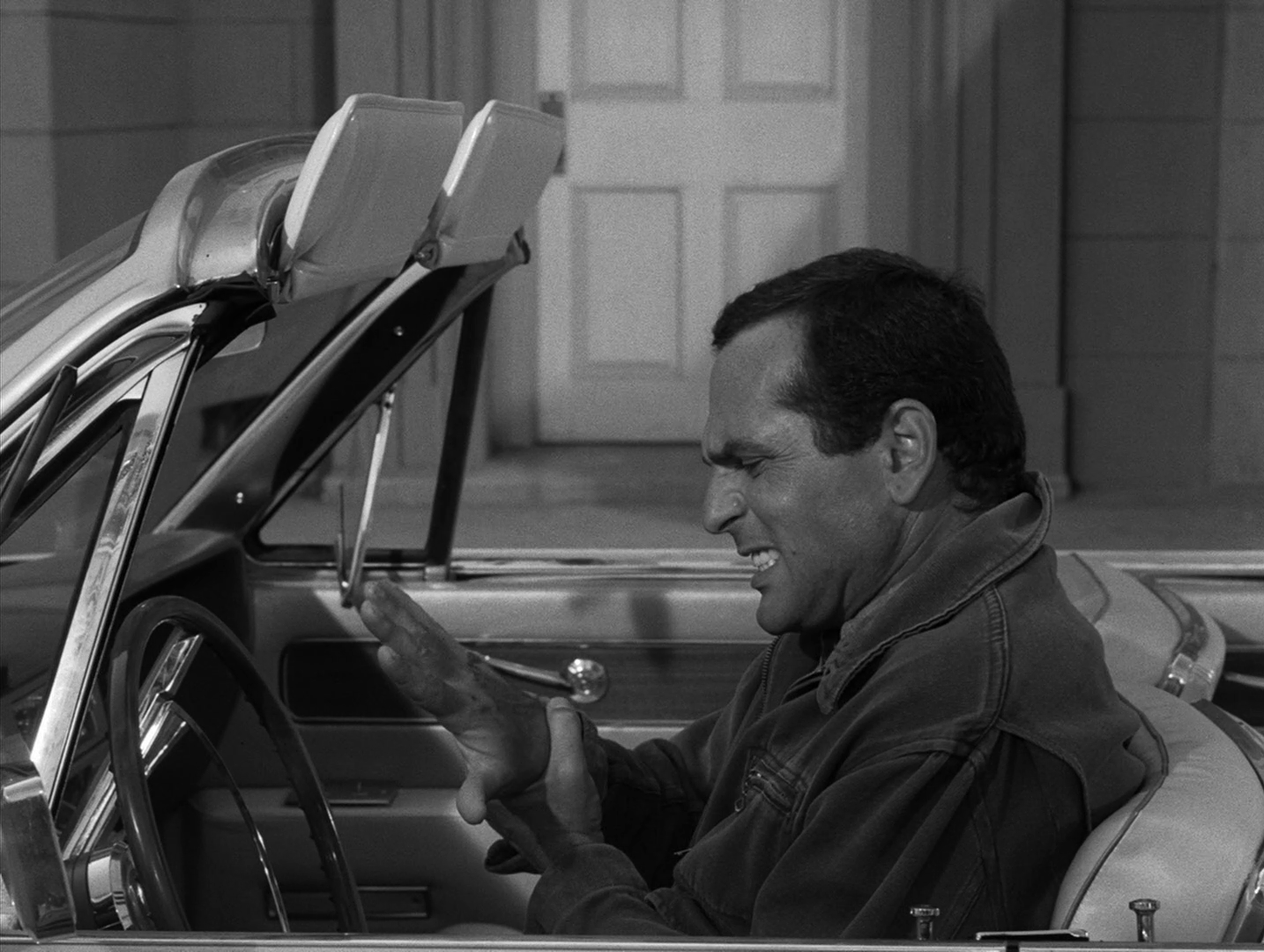
Fifty years ago tonight, a man inexplicably gained the ability to make such impossible trades. “The Self-Improvement of Salvadore Ross” is exactly what it sounds like: the titular Salvadore Ross uses his newfound supernatural bartering talents to better himself. 

Sal is aggressively courting Leah; it’s not a matter of love, it’s a matter of possession. He makes no attempt to hide it, either: “I want her,” he unabashedly tells Leah’s disapproving father. Leah, however, has standards when it comes to choosing a mate, and the crude and directionless Sal doesn’t measure up. Sal angrily punches a wall after she breaks things off with him and ends up in the hospital.

He’s kept overnight for some reason (did a broken bone really require an overnight hospital stay back in the 60’s?), and is roomed with an old man with the flu. They joke about trading maladies and, the next morning, Sal is shocked and delighted to discover that his hand is healed, but he has a cold. The old man objects; his new broken hand will never heal, given his advanced age. No take-backs, Sal decrees as he leaves.


Sal then uses his new talent to systematically improve himself: he sells his youth for a vast fortune, then regains it by buying time from others, a year at a time. Soon he’s young again (but still quite rich) and back on Leah’s scent. She’s still not interested, though, seeing as how he lacks the non-material qualities she prizes most: kindness, selflessness, compassion.


When we next see Sal, he’s a changed man. Leah sees the change and relents; he is the man she wants after all. Her father will have none of it, and pulls a gun on Sal. Sal begs for him to show him mercy and compassion, to which he coldly replies: “Compassion? Don’t you remember? I sold it to you yesterday.” He pulls the trigger.


Written by Jerry McNeely from a short story by Henry Slesar, “The Self-Improvement of Salvadore Ross” is one of the better offerings of the fifth season despite the ridiculously implausible and confusing ending. Leah is convinced that Sal has evolved into a man worthy of her love… in a single day? Sal’s proven himself to be a manipulative bastard in the past; she has no reason whatsoever to think he’s not simply putting on an act. Why does Sal ask Mr. Maitland for compassion when he knows for a fact he no longer possesses it? Does the acquisition of compassion somehow impair his memory? And if Mr. Maitland is the upright saintly type we've been led to believe he is, why would he ever sell his compassion --- his defining, honorable trait --- to anyone, especially a slimeball like Sal? It’s sloppy, expedient and… yes, another example of the dreaded deus ex machina. The end renders everything before it moot.

If there’s one thing I like about the ending, it’s that it serves as a nice bookend for season one’s “The Four Of Us Are Dying,” which also ends with Don Gordon getting shot by an old man. But that ending was organic and jibed with the events that preceded it; I guess we can argue that cosmic justice is indeed served here by Sal getting blown away, but at what cost? A good man (Mr. Maitland) is now a soulless shell of a man (and will almost certainly go to prison for murder), and the innocent Leah just lost the man she loves and her father in one shot (har har). If this is cosmic justice, it’s hugely skewed.

But “The Self-Improvement of Salvadore Ross” is still an entertaining episode, thanks largely to the great cast and the clever story (up till that ending, that is). The concept of buying and selling years is a fascinating one: the 2011 sci-fi film In Time uses this idea as the basis for its parallel-earth society, the citizens of which have built-in bio-clocks that keep them frozen at the age of 25 forever… as long as they continually acquire time, which is their currency.

There's particularly effective bit at the top of act two. The elderly Sal enters an elevator, which is operated by a young man. When he gets off, he's young again... and the bellhop is now an old man, holding a big fat check in his hands.

Rod’s not smoking during his opening narration: he’s holding a pair of sunglasses. I dunno, maybe sponsor American Tobacco was giving away sunglasses in some kind of promotion or something (remember all that Joe Camel and Marlboro Man merchandise?).


THE MUSIC


The episode is stock-scored, mostly with non-TZ cues from the CBS Music Library; however, we do hear a few bits of Fred Steiner’s scores for “King Nine Will Not Return” (“Sand”) and “The Passersby” (“Morning,” which was also used in last week’s “The Long Morrow”).


FAMILIAR FACES

The major players this week should be quite familiar to Twilight Zone fans. First up is Don Gordon (Salvadore Ross), who memorably played one of Arch Hammer’s alternate identities in season one’s “The Four of Us Are Dying.” He also appeared on The Outer Limits twice (“The Invisibles” and “Second Chance”).

*Sigh* Gail Kobe (Leah Maitland) is on hand for her third and final TZ appearance (she made me swoon in season one’s “A World of Difference,” then again in season four’s “In His Image”). Like Don Gordon, she popped up on The Outer Limits twice (“Specimen: Unknown” and “Keeper of the Purple Twilight”).  If you can’t tell, I have something of a crush on her. She passed away last August. Rest in peace, you beautiful thing you.

Mr. Maitland is played by Vaughn Taylor in his fifth and final TZ excursion (he appeared in season one’s “Time Enough at Last,” season three’s “Still Valley” and “I Sing the Body Electric,” and season four’s “The Incredible World of Horace Ford”). He also did two episodes of The Outer Limits (“The Guests” and “Expanding Human”).

The unnamed old man in the hospital is played by J. Pat O'Malley, whom you may remember from “The Chaser” in season one and “The Fugitive” in season three. He’ll also be back later this season for “Mr. Garrity and the Graves.” Interestingly, the unnamed hospital nurse is played by Kathleen O'Malley… his daughter!


“The Self-Improvement of Salvadore Ross” is quite good, better than many season five offerings, and it shines despite its unsatisfying conclusion. If we could just take a page from Sal’s book and trade its ending for a different one….


Next week:
“The Eye of the Beholder,” but without the pig people. It’s better than it sounds.


Friday, January 10, 2014

Episode Spotlight: "The Long Morrow" (1/10/1964)


Season 5, Episode 15 (135 overall)
Originally aired 1/10/1964
Cayuga Production # 2624


Fifty years ago tonight, a May-May romance threatened to become a December-May romance, but instead ended up a May-December romance. Everybody with me?

“The Long Morrow,” written by Rod Serling (apparently channeling O. Henry), introduces us to Commander Douglas Stansfield, an astronaut who has just been handed a life-changing mission: he’s to make a solo trip to a neighboring galaxy, from which he won’t return for forty years. He’ll be frozen in suspended animation for the bulk of the trip, so he’ll hardly age while he’s away. He has a meet-cute with Sandra Horn, a Space Agency employee, and the two immediately fall in love. He can’t back out of the mission, so it’s doomed to be a brief affair.

After Doug blasts off, Sandra submits to the same suspended animation process. 40 years elapse and, when Doug’s ship returns, she emerges fresh and (still) young and ready to start her life with him. However, communication with Doug was lost six months after his departure and, grieving his lost love in the void of space, he forewent the freezing process for the duration of the trip. He’s now an old man and, despite Sandra’s pleas, he bitterly sends her away.


Okay, this is just horrifically cruel. This is an example of a writer that, for some unknown reason, hates his characters and designs the worst possible outcome for them. Honestly Rod, what did Doug Stansfield ever do to you? On the surface, the story appears to be a mutual tragedy, but Sandra actually gets off pretty damned easy, comparatively speaking. She’s still young and vibrant; she can pick up the pieces and move on with her life. Doug, meanwhile, is just plain fucked. He just spent most of his life alone in a space capsule, undoubtedly hanging onto his sanity by the thinnest of threads, and the girl he did it for is now half his age. I imagine he’ll be hanging himself or slitting his wrists after the credits roll. 

But hey, why couldn't Doug have himself frozen for the next forty years, to be revived when Sandra grew older? It wouldn't even have to be forty years; it could just be enough to make it not so creepy (say, twenty-five years). I’ll tell you why: because Serling would've had her marry somebody else, and Doug’s heart would get broken all over again.


Dr. Bixler indicates that suspended animation is a new technique, but evidently it’s available on demand for any employee of the project. Taking that into consideration, don’tcha think it would've occurred to Sandra to freeze herself BEFORE Doug left? In fact, the story might’ve played better if they’d talked about it, but Doug forbade her from doing it in the interest of allowing her to “live her life.” Then she’d stubbornly do it anyway after he lifted off with the intention of surprising him. I guess the end result would've been the same, but it would be a little less arbitrary.

Here’s how I would've written it: I would've had Sandra come to meet Doug upon his return, a sad and lonely old maid who couldn't bear to marry anyone else. The surprise is the same: Doug arrives as an old man, having eschewed the suspended animation. Now it’s a seemingly tragic love story with an unexpected sweet ending, a powerful statement on the lengths man will go to attain true love.


So what else is wrong with this episode? Serling’s dialogue is terrible, just god-awful. In fact, this may be the single worst collection of awkward Serlingisms in the entire series run. Wait, “The Fear” might be worse (we’ll see when we get to it later this season). Seriously, nobody talks like this, and if they do… well, these two might be perfect for one another after all.  

And dammit, we get lots of shots of Doug in his tiny li’l Speedo while he’s on ice, but we get nothing in the way of female eye candy. I would've LOVED to see Mariette Hartley in a similar state of undress...at least Star Trek was kind enough to pick up the slack a few years later.


What’s right about the episode? The prologue is wonderfully eerie, ripe with promise. We open with Doug aboard the space capsule; lying prone in suspended animation in a frosty glass box (we last saw this prop in season two’s “The Rip Van Winkle Caper,” only there it was covered with dust and there were four of ‘em). Doug’s narration (that’s right, Serling shares voiceover duties with the main character; this has only happened a couple of other times in the series) fills us in on a few details, and we then get a very effective flashback scene in which he receives the deep space assignment. Act one closes with more narration from Doug, in which he rhapsodizes about Sandra while in hibernation, accompanied by an interesting shot in which her face is overlaid onto his.


There's a marvelous moody atmosphere throughout the episode, most potent in the scenes in the shadowy hallway (sci-fi noir?). And, despite the unfortunate dialogue foisted on them, both leads are quite good, particularly Mariette Hartley. I do wish Sandra would've put up more of a fight when Doug sends her away at the end, but that’s a script issue.


THE MUSIC

“The Long Morrow” is stock-scored. The “Morning” cue from Fred Steiner’s beautiful score for season three’s “The Passersby” appears three different times, and its elegiac ambiguity underscores Doug and Sandra’s doomed romance quite nicely.


FAMILIAR FACES

Commander Douglas Stansfield (young and old) is brought to life by Robert Lansing in his only TZ gig. He does have another Rod Serling connection on his resume, however:  he appeared on Serling’s short-lived Western series The Loner in 1966 (“The Trial in Paradise”). Genre fans know him best as Gary Seven from Star Trek’s “Assignment Earth” episode in 1968, but he had roles on other sci-fi/fantasy/horror series, including ThrillerOne Step Beyond, and the 1988 revival of Alfred Hitchcock Presents.


The lovely Mariette Hartley is radiant as Sandra Horn in her only TZ appearance. She had a notable role as Zarabeth, the painfully lonely sole inhabitant of a planet’s ice age (pictured earlier in this entry), in Star Trek’s “All Our Yesterdays” in 1969 (so hey, I guess she kinda sorta got a dose of her own medicine). I first took notice of Hartley when she appeared in the “Married” episode of TV’s The Incredible Hulk in 1978, in which her character dies a dramatic death in The Hulk’s arms. I was 8 years old when it first aired, and I remember tearing up (this might’ve been the first time a TV show ever made me cry). Hartley is still quite lovely at 74.


Dr. Bixler is played by George MacReady in his only TZ appearance; he’d cross paths with Rod Serling again, however, in the Night Gallery pilot movie in 1969 (he appeared in the opening segment “The Cemetery”). He also did two tours on The Outer Limits (“The Invisibles” and “Production and Decay of Strange Particles”). 


General Walters is played by Edward Binns, whom we enjoyed previously as Colonel Donlin in season one’s “I Shot An Arrow Into the Air.”


“The Long Morrow” certainly provides the surprising twist that the show is so famous for, but the problem here is that it’s crushingly, painfully meaningless. I’m reminded of O. Henry’s iconic (and ironic) “The Gift of the Magi,” in which an impoverished couple gives up their most beloved possessions for one another (he sells his watch to buy her an expensive comb for her hair, while she sells her hair to buy him a chain for his watch, leaving them both with nothing but one another), but in that mutual sacrifice there was a point, that possessions do not equate wealth. What’s the lesson here? Why are these characters made to suffer so profoundly? Serling’s closing narration blames “the ferocious travesty of fate,” which is an absolute cop out. Sadly, the show will continue losing its moral compass as it fades into oblivion.


Next week: Salvadore Ross's future's so bright, he's gotta wear shades.


Friday, January 3, 2014

Episode Spotlight: "You Drive" (1/03/1964)


Season 5, Episode 14 (134 overall)
Originally aired 1/03/1964
Cayuga Production # 2625


Fifty years ago tonight, Rod Serling’s “You Drive” premiered, roughly one third into the series’ fifth season. The season has thus far been something of a roller coaster, with definite high points (“In Praise of Pip,” “Living Doll”) and, um, efforts leaning in the opposite direction (“A Kind of a Stopwatch,” “Probe 7, Over and Out”). “You Drive” represents an interesting schizophrenic approach, as it features some of both. The scenes that open and close the episode are quite excellent, matching the stunning quality of the show’s first season. The twenty minutes in between, however…. Well, are more on par with season four.


The opening scene finds a distracted Oliver Pope driving home from work in the rain. He errantly hits a newspaper boy on a bicycle and, after stopping long enough to look at the boy’s twisted body, panics and flees the scene. Serling’s clipped, tense opening narration has a sense of propulsive urgency that I haven’t heard since his (atypical) mid-episode narration in season one’s “I Shot an Arrow into the Air.” The accompanying music, lifted from Jerry Goldsmith’s score for season two’s “Nervous Man in a Four Dollar Room,” adds to said urgency. 


The sight of the injured boy, lying in the rain at a disjointed angle, is uncomfortably realistic. And finally, Anthony Edwards’ performance is spot on: he’s an average guy whose attention lapses at a critical moment, which could happen to anyone. It’s easy to condemn his decision to flee, but honestly, who among us wouldn't at least feel tempted to run like hell?


One minor quibble: Serling opening narration describes Pope as a “businessman-turned-killer” immediately after he flees the scene of the accident. It’s a bit of a spoiler, since the kid doesn’t actually die until act two.

As the police attempt to apprehend the driver, Pope’s car begins exhibiting odd behaviors, honking its horn and flashing its headlights seemingly of its own accord. A co-worker of his (whom he dislikes) is inexplicably identified by a witness to the accident, and it seems that Pope might just be off the hook. But that car in the garage has other ideas….


The bulk of the episode is pretty by-the-numbers. As soon as the car starts acting up, it’s all too obvious that things will escalate, and Pope will be ultimately driven (heh heh) to some measure of justice. This isn’t necessarily a criticism; it just feels like a waiting game till the climax arrives. It’s not boring, exactly, but…

Said climax involves Pope avoiding the car altogether and setting out for work on foot. Before his wife’s incredulous eyes, the car pulls out of the garage of its own volition and follows him… and we’re back to the propulsive excitement of the prologue. 


So the obvious question is: what’s powering the car? It could be the ghost of the dead child, except that the car starts acting up before he dies. So maybe it’s an astral projection kinda deal, which graduates to a full-on automotive haunting after he dies?  Nothing in the episode supports this, however, so we’re left with no explanation whatsoever. Bartlett Finchley met a gruesome end at the hands (well, wheels) of his car in season two’s “A Thing About Machines,” but there we had a general uprising of All Things Mechanical to revenge Finchley’s abuse of them, so it was easier to buy. “You Drive” isn’t really a man vs. machine story in that respect.


I suppose it’s possible that we’re seeing Pope’s abject guilt manifesting in a physical way, in the form of his car acting seemingly of its own accord. We've certainly seen guilt do some pretty powerful things on the show already (“King Nine Will Not Return,” “The Arrival,” “The Thirty Fathom Grave”). I was also pondering the possibility of the whole thing being a guilt-fueled hallucination, and that Pope was imagining the car’s antics as his subconscious mind was preparing to make him confess… but then I realized that his wife can also see and hear said antics, so never mind. Speaking of guilt, I’m often guilty of over-analyzing the machinations underlying the magical events that occur in The Twilight Zone, and this week is clearly no exception. The how isn’t nearly as important as the why, and since cosmic justice has once again been served, maybe it’s best not to ask too many questions.


FAMILIAR FACES

Oliver Pope is well-played by Edward Andrews in his second TZ appearance (he was the slimy Government narc Carlin in season one’s “Third from the Sun”). If you grew up in the 80’s like me, you probably know him as Molly Ringwald’s grandfather in Sixteen Candles (the one hosting foreign exchange student Long Duck Dong).


Pope’s office nemesis Pete Radcliff is played by Kevin Hagen, who previously visited The Twilight Zone in season one’s “Elegy” (he played Captain Webber). If you grew up in the 80’ like me, you probably know him as Doc Baker on TV’s long-running Little House on the Prairie.


“You Drive” is directed by John Brahm, his eleventh of a total twelve episodes he’d helm (he’ll be back a bit later in the season with “Queen of the Nile”). He also directed two episodes of The Outer Limits (“The Bellero Shield” and “ZZZZZ”), as well as multiple stints on ThrillerThe Man from U.N.C.L.E. and Alfred Hitchcock Presents.


Ultimately, “You Drive” doesn’t quite live up to the promise of its prologue, but it tries damn hard to redeem itself in the final three minutes. It’s kinda like a sandwich: the filler’s decent, but that bread holding it together is damned tasty. Hmmm, is anybody else hungry?


7 days from now: 
Rocket man, burning out his fuse up here alone..