

Season
5, Episode 32 (152 overall)
Originally
aired 5/08/1964
Cayuga
Production # 2637
Fifty years ago tonight, The Twilight Zone introduced us to a
kindly Old West peddler with a most unusual service to render (and who may be
indirectly responsible for the zombie apocalypse everybody’s so amped up about
these days).

Peddler Jared Garrity rides into Happiness, Arizona and offers to raise the 187 occupants of their cemetery for no charge. He proves his ability to the skeptical local folk by reanimating a dog after an errant wagon runs over it. That very night at midnight sharp, he declares, the town will be reunited with its lost friends and family members.

The truth is that all but one of those
187 people died under violent conditions, and it becomes apparent that the
townspeople were in varying ways complicit in their deaths. They become
increasingly anxious about being confronted by the (literal) skeletons in their
closets and, as midnight grows near, desperately offer Garrity large sums of
money to reverse the process and keep them buried and quiet. He agrees.

Garrity leaves town in the dead of
night and meets up with his partner in crime, just outside the city limits near
the cemetery. The whole thing has been a ruse (his partner faked the dog’s
death), and they move on to the next town significantly richer. Just then the
187 dead do in fact rise up from their graves, eager to return to town to even
some scores.

“Mr. Garrity and the Graves” is a fairly entertaining episode, thanks largely to John Dehner’s wry performance as Garrity. Garrity is younger and more urbane than the peddlers who have passed through The Twilight Zone previously (Henry J. Fate from “Mr. Denton on Doomsday” and Professor Eliot from “No Time Like the Past", both incidentally played by Malcolm Atterbury), and Dehner is a joy to watch as he fleeces the townspeople while somehow appearing to have their best interests at heart.


So what exactly are these reanimated dead folks? They aren’t zombies, since they’re able to speak and recall their lives. They aren’t ghosts, since Zelda Gooberman plans to break her husband’s arm when she sees him (indicating that she, along with the others, have corporeal form). They aren’t even corpses in the traditional sense, since they don’t appear to have decayed at all. And if they indeed climbed up out of the earth, as Garrity indicates, wouldn’t they be covered in dirt?

Interestingly, just a few days before
“Mr. Garrity” aired, ABC’s The Outer
Limits aired “The Forms of Things Unknown,” which concerned a scientist who
can tilt time to bring the dead back to life. Easter 1964 took place on March
29, well over a month before either episode was broadcast, but I suppose it’s
possible that a general air of resurrection was still floating around.

“Mr. Garrity and the Graves” is written
by Rod Serling, based on a story
idea by Mike Korologos (this is his
only credit, so this must’ve been one of those situations where some random
stranger at a party told Serling about an idea for a Twilight Zone, and Serling paid them on the spot for it). As such,
it’s impossible to know who to thank for the positives and who to blame for the
negatives. The positives include a relatively cleaver premise; the negatives
include several holes in said premise. The concept of extorting money to keep
dead people in the ground is a nice reversal on the initial selling point of
reanimating them; however, the fact that the risen dead aren’t decomposed at
all and appear to retain their memories and personalities is troubling (are we
to assume that there’s in fact no afterlife?). The most glaring issue is the
ridiculous amounts of cash the townspeople have on their persons: Garrity
charges the townspeople anywhere from $500.00 to $1,200.00 each for his
services. Adjusted for inflation, those amounts range from $12,820.51 to
$30,769.23 in 2014 dollars. I’m pretty sure there’s never been a time in human history in which folks have walked
around with that kind of cash on them, certainly not in the goddamned desert
near the turn of the century. I can accept a certain level of deus ex machina, but at some point it
just becomes insulting.

"Mr. Garrity” is directed by Ted Post
(season one’s “A World of Difference” and November’s “Probe 7 – Over and Out”);
he’ll also direct “The Fear,” which we’ll get to in a few weeks. Things are
pretty flat for the most part (meaning that the direction is fine but
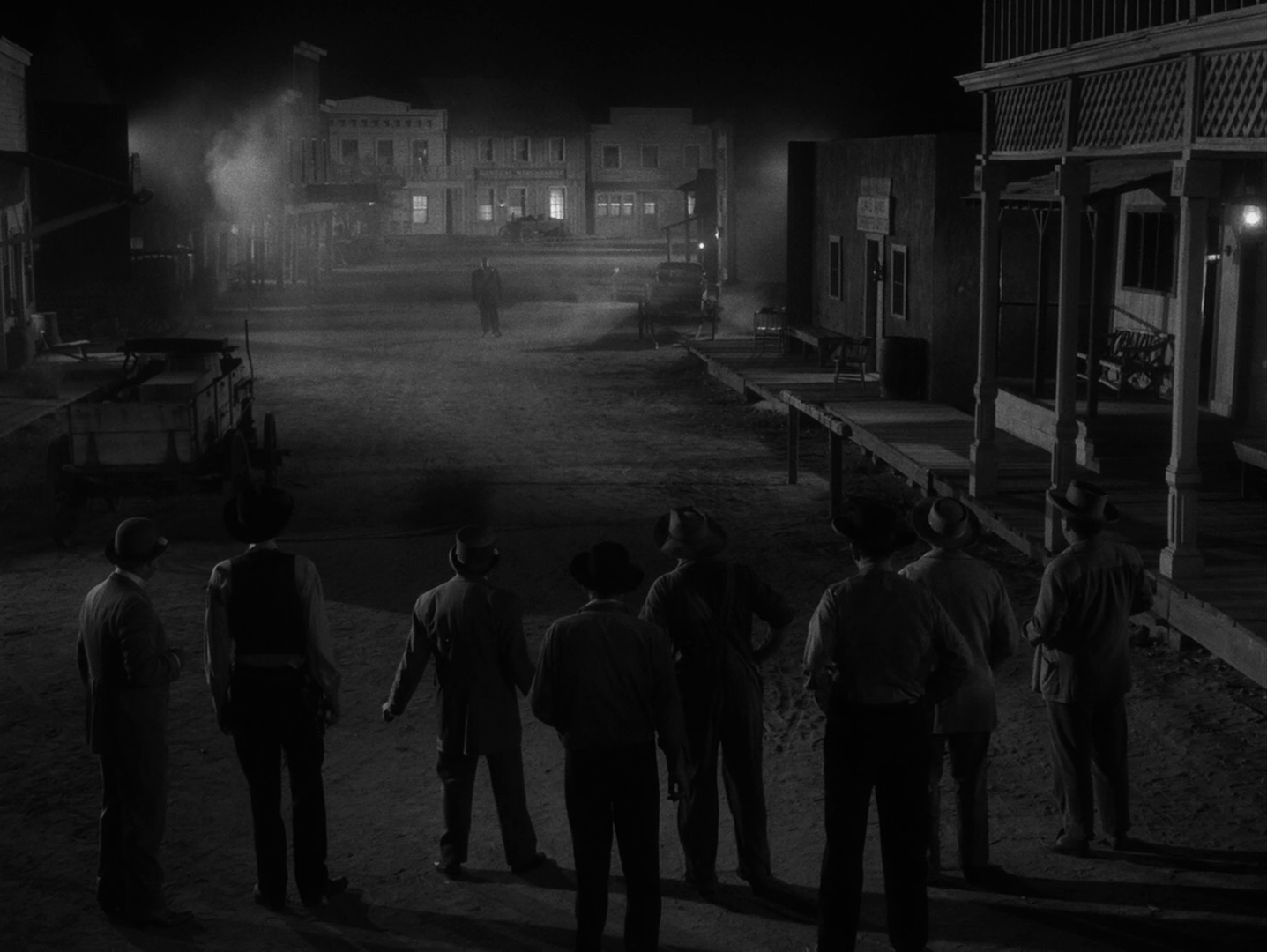
unremarkable), but the sustained long shot of the cemetery just before the dead rise is effectively
eerie.
.
.
The “Happiness, Arizona” sign that opens the episode would soon be repurposed behind the
scenes, modified to reflect the series’ demise.

.
THE MUSIC

“Mr. Garrity and the Graves” features
an original score by Tommy Morgan. His other contributions to the series (“The Last Rites of Jeff Myrtlebank” and “Hocus-Pocus and Frisby,” both from season
three) are pretty harmonica-heavy, but this time around it’s all harmonica and
nothing else. No strings, no percussion, just… harmonica. I suppose it’s
appropriate to the period, but…. well, it’s definitely not my thing. The score
has never been released on the various TZ soundtracks over the years, and it’s not
isolated on the DVD/Blu-ray season five sets, so completist collectors like me
will likely never be able to acquire the recorded score… which, in this case,
doesn’t bother me in the least. I guess I’m not the completist I thought I was.
.
DRAMATIS PERSONAE

John Dehner (Jared Garrity) joins the Three Timers Club this week (he was
the sympathetic Allenby in season one’s “The Lonely” and the skeptic Alan
Richards in season three’s “The Jungle”). Dehner’s only other genre credit is
an episode of Kolchak: The Night Stalker
(“The Knightly Murders”) in 1975.
.png)

J. Pat O'Malley (Gooberman, the town drunk), meanwhile, joins the Four Timers Club (he was in
season one’s “The Chaser,” season three’s “The Fugitive,” and season five’s “The Self-Improvement of Salvadore Ross”). He’s also a four-time veteran of Boris
Karloff’s Thriller (“Hay-Fork and
Bill-Hook,” “Yours Truly, Jack the Ripper,” “The Premature Burial,” and
“Waxworks”); he also logged appearances on Alfred
Hitchcock Presents (“The Dusty Drawer," below) and, like Dehner, Kolchak: The Night Stalker (“The
Zombie”).
+3.JPG)
 Stanley Adams (Jensen, the bartender) looks familiar, it’s because we saw him
in season three’s “Once Upon a Time” as Rollo, the modern day scientist who
steals the time helmet from Buster Keaton. He has another, quite interesting
Serling connection: he played Perelli in the 1962 big-screen adaptation of
Serling’s Requiem for a Heavyweight,
which was originally produced in 1956 on Playhouse
90 (and which made Serling a bona fide star). Adams also appeared on Alfred Hitchcock Presents (“Pen Pal”)
and Boris Karloff’s Thriller (“The
Weird Tailor”); however, genre fans likely recognize him as the notorious
Cyrano Jones, the intergalactic trader responsible for Deep Space Station K7’s
tribble infestation in Star Trek’s
“The Trouble with Tribbles.”
Stanley Adams (Jensen, the bartender) looks familiar, it’s because we saw him
in season three’s “Once Upon a Time” as Rollo, the modern day scientist who
steals the time helmet from Buster Keaton. He has another, quite interesting
Serling connection: he played Perelli in the 1962 big-screen adaptation of
Serling’s Requiem for a Heavyweight,
which was originally produced in 1956 on Playhouse
90 (and which made Serling a bona fide star). Adams also appeared on Alfred Hitchcock Presents (“Pen Pal”)
and Boris Karloff’s Thriller (“The
Weird Tailor”); however, genre fans likely recognize him as the notorious
Cyrano Jones, the intergalactic trader responsible for Deep Space Station K7’s
tribble infestation in Star Trek’s
“The Trouble with Tribbles.”+2.JPG)

The highly-annoying Lapham is played by Percy Helton, whose grating voice was last heard in season four’s
“Mute.” Helton appeared in a whopping seven episodes of Alfred Hitchcock Presents between 1955 and 1961 (I’m not gonna list
them all; you know how to use IMDB if you’re curious); his other genre credits
include gigs on Alcoa Presents One Step Beyond
(“Premonition”) and Thriller (“Rose’s
Last Summer”). He also played Doc Kennedy in one of my all-time favorite film
noirs, 1955’s Kiss Me Deadly; he’s
also the train conductor in 1954’s White
Christmas (which co-stars TZ alum
Dean Jagger), which I faithfully watch every December.
.jpg)
 Sheriff Gilchrist is played by Norman Leavitt in his only Twilight
Zone appearance. His other genre credits include four episodes of Alfred Hitchcock Presents (including "One More Mile To Go," pictured below), three Alfred Hitchcock Hours, and two Thrillers. Leavitt’s final role was that
of a grave digger on the “Ashes to Ashes” episode of Quincy, M.E. in 1978, which is a bit creepy, given this week’s
subject matter.
Sheriff Gilchrist is played by Norman Leavitt in his only Twilight
Zone appearance. His other genre credits include four episodes of Alfred Hitchcock Presents (including "One More Mile To Go," pictured below), three Alfred Hitchcock Hours, and two Thrillers. Leavitt’s final role was that
of a grave digger on the “Ashes to Ashes” episode of Quincy, M.E. in 1978, which is a bit creepy, given this week’s
subject matter.+2.JPG)
Leavitt (left) with TZ alum David Wayne ("Escape Clause").
 John Mitchum (Ace, Garrity’s partner in crime) previously visited The Twilight Zone as the ill-fated Erbie
in season two’s “The Rip Van Winkle Caper” (he’s the one who didn’t survive the
100-year sleep). His other genre credits include four Science Fiction Theaters, a Thriller
(“The Cheaters”), and a Kolchak: The
Night Stalker (“The Energy Eater”). He was Robert
Mitchum’s younger brother, so I guess he was the James Belushi of his generation.
John Mitchum (Ace, Garrity’s partner in crime) previously visited The Twilight Zone as the ill-fated Erbie
in season two’s “The Rip Van Winkle Caper” (he’s the one who didn’t survive the
100-year sleep). His other genre credits include four Science Fiction Theaters, a Thriller
(“The Cheaters”), and a Kolchak: The
Night Stalker (“The Energy Eater”). He was Robert
Mitchum’s younger brother, so I guess he was the James Belushi of his generation..JPG)
“Mr. Garrity and the Graves,” while
not a particular favorite of mine, is an amusing little number with a grisly (yet
still amusing) denouement. John Dehner, playing a sharp scalpel in a room full
of dull shovels, is really the bulk of the attraction here. I guess it’s more or
less a comedy, so I’m willing to forgive the logical problems that crop up,
which I reckon means I’m right comfortable recommendin' it to y'all.
Next week:
Robbie the Robot returns to give us
our very last Forbidden Planet alert.


.png)


.png)


