Thursday, April 7, 2011

TZ Promo: “A Hundred Yards over the Rim” (4/07/1961)


“A Hundred Yards over the Rim” (4/07/1961)
Season Two, Episode 23 (59 overall)
Cayuga Production # 173-3654


His name is Christian Horn. He’s the leader of a ragged group of settlers on their way to a new life in the west. They’re out of water, Horn’s son rages with fever, and spirits are at an all-time low. Horn sets off on foot, rifle in hand, to explore what lies beyond a sand-covered hill nearby (“just over that rim there, about a hundred yards”). The year is 1847. When Horn comes down the other side, however, it’s 1961.


“A Hundred Yards over the Rim,” written by Rod Serling and directed by Buzz Kulik, first aired 50 years ago tonight. Generally regarded as one of the series’ finer offerings, it’s a simple story of a desperate man who, by processes unknown, finds himself in a future that makes almost no sense to him. The present-day folks he encounters are in a similar quandary: who is this guy, covered in sweat and dust and wearing a stovepipe hat in the desert? And why is his dental work so old fashioned….?


Cliff Robertson nails it as Christian Horn. He behaves and moves like a wounded animal, confused and utterly lost, an artifact displaced from everything he knows. He reminds us of Albert Salmi’s Joe Caswell from season one’s “Execution,” but with less menace. It’s a truly great performance, one of the best in the entire series.


The on-location shooting near Olancha, California (roughly 20 miles south of Lone Pine, where “King Nine will Not Return” was shot earlier this season) provides some absolutely breathtaking imagery. Check out the scene in which Horn encounters a highway, something completely alien to him. It’s just him and the road, and an endless desert all around. The sight of Horn, juxtaposed against modern pavement (Route 190, in this case), is one of the series’ indelible iconic images. And that scene in which a police cruiser chases Horn back up the rim (pictured right)? The wide open scenery just plain breathes. You really get an effective (and authentic) visual representation of those “wide open vistas” the old west promised newcomers. The production value achieved by the location shooting elevates an already-good episode to greatness.


The outskirts of Olancha are featured in a 2010 video montage showcasing various locations in and around Death Valley where select TZ episodes were filmed. Created by fellow fan (and fellow TZ music enthusiast) Paul Giammarco, Twilight Zone: Death Valley (linked above) is absolutely wonderful (and would’ve made a great bonus feature on the blu-ray). Incidentally, I scored (pun intended) copies of cue sheets for all 156 TZ episodes from Paul several years back. I thanked him then, and I’m thanking him again here.


A highlight of the episode is Fred Steiner’s exciting musical score. Employing a diverse collection of percussive instruments (including vibraphone, glockenspiel, tympani, and chimes) alongside piano and harp (and, fittingly, harmonica), the music propels the action and creates a tense, otherworldly mood. The harmonica keeps things genre-specific (this is, after all, essentially a western), but the rest of the diverse ensemble provides a nice off-kilter counterbalance.

Steiner in 2007.

Steiner’s first TZ score was “King Nine Will Not Return” earlier this season, and he’ll be back to score season three’s “The Passersby” (which, incidentally, is the best thing about that one; we’ll get to it in October). Steiner composed a total of 7 original scores for the series, but he isn’t typically mentioned alongside luminaries like Bernard Herrmann and Jerry Goldsmith when TZ music is discussed. It’s a shame.


Next week: Season one’s “The Mighty Casey” gets repeated. The week after, another great time travel episode --- also shot near Olancha --- premieres. This one’s about four criminals and a master plan to pull off the ultimate heist…. which goes terribly awry. It’s pure gold, baby.


Thursday, March 31, 2011

TZ Promo: “Long Distance Call” (3/31/1961)


“Long Distance Call” (3/31/1961)
Season Two, Episode 22 (58 overall)
Cayuga Production # 173-3667


Fifty years ago tonight, a little boy’s dear departed grandmother reached out and touched him. No, this isn’t a zombie story (those wouldn’t be in vogue for a few more decades). Rather, Grandma bridged the gap between the real world and the afterlife with a simple phone call.

Brrrrring. Billy, it’s for you!


Charles Beaumont’s “Little Girl Lost” offers us the latest in a long line of The Twilight Zone’s supernatural objects. It’s a toy telephone which, for reasons never explained, can somehow connect the living with the dead. The supernatural aspect is actually pretty subtle… Billy could be imagining/pretending that he’s talking to his grandma. Billy’s mom, shocked into near-catatonia when she hears breathing on the other end of the toy phone, may simply be the victim of her own nerves. Billy’s near-death incident may have been a simple accident, not influenced by grandma’s urging. And the climax, in which Billy’s dad pleads with grandma to release her grip on the boy… well, the end result might just be a coincidence. Either way, the chain of events is undeniably horrific. The death of a loved one is hard on a kid, but sheesh.


Forbidden Planet alert! Well, sorta. Billy is played by Billy Mumy, probably best known as Will Robinson from TV’s Lost In Space, the cast of which included the B-9 Robot, Robby the Robot's fraternal twin (Robby himself appeared on the series once too). This is Mumy’s first of three TZ appearances, but most people don’t remember this one. Next season, he’ll return as little Anthony Fremont, the most powerful kid in the world, in the excellent “It’s a Good Life.” Beyond that, he shows up in season five's "In Praise of Pip," opposite the legendary Jack Klugman. I was hoping to snag Mr. Mumy for a brief Q&A before this entry went to press, but he didn’t return my messages. Ah well, he’s a busy guy, with his folk music career and all. He’s still okay by me.


I scoured Google Images for the toy telephone used in this episode, but I came up empty. I did, however, find this:

Bet you weren’t expecting a Toy Story 3 plug here, were you?

Interestingly, another “chat with the dead by telephone” episode will crop up down the road, in season five’s “Night Call,” which will beat this episode by a mile. However, “Long Distance Call” is decent enough. It’s hampered by the videotape it was shot on (this is the final of season two’s six episodes that were shot on tape to save money), but the script and the performances are of sufficient quality to overcome the technical end of things. It’s not a favorite of mine, but I don’t mind recommending it.


Next week: A desperate man in 1880 walks over a sandy hill and finds himself in 1961. It’s the first of a Twilight Zone time travel double-whammy, and it’s a good one. Do tune in.


Thursday, March 24, 2011

TZ Promo: “The Prime Mover” (3/24/1961)


“The Prime Mover” (3/24/1961)
Season Two, Episode 21 (57 overall)
Cayuga Production # 173-3647


My favorite TV show when I was a kid (around 11 or 12) was The Greatest American Hero, and of that show, one of my favorite episodes involved our hero, average guy Ralph Hinkley, discovering that his alien supersuit imbibed him with (among his other powers) telekinetic abilities. Hilarity, as it usually did, ensued. Several decades earlier, another average guy on TV had similar powers. 50 years ago tonight, we met him for the first time.

No, it’s not Barnaby Jones. Well, it is… but this is Buddy Ebsen in his pre-Barnaby days. Here he’s Jimbo Cobb, a likeable (albeit simple) fellow who co-owns a diner with Ace Larsen, a restless sort who dreams of bigger things. Jimbo’s just fine with things as they are.

A horrific car accident (which is technically brilliant and has to be seen to be believed; it doesn’t look like stock footage, either) requires Jimbo to reveal an amazing talent: he can move things with his mind. Sonuvagun, simple ol’ Jimbo is a telekinetic! Ace’s eyes go wide, and visions of big money in Vegas dance seductively in his head. You can see where this is going.

Written by Charles Beaumont (from a story by George Clayton Johnson; uncredited) and directed by Richard L. Bare, “The Prime Mover” is a pretty enjoyable TZ excursion, thanks mostly to the clever interplay between the leads. Ebsen plays Jimbo as a big dumb lug, but by the end it’s apparent that he’s way brighter than he lets on. As Ace, Dane Clark is snappy and occasionally insensitive, but his affection for Jimbo is evident all the way through. Ebsen and Clark inhabit the roles nicely, and Beaumont provides some great dialogue for them.

TZ babe alert! The Vegas cigarette girl, who Ace “buys” for the evening (it’s not what it sounds like… or is it?), is smokin’ hot (cigarette pun intended), and is played by Jane Burgess. Arooogah!


Next week: Videotape rears its low-res head one final time. We’ll get up close and personal with an enchanted toy telephone and a possessive dead grandmother. Hear that ringing? It's for you.


Tuesday, March 22, 2011

"156" Contest Winner: Lauren McCloskey!


Lauren McCloskey of Greensburg, PA is our contest winner! She was the first to correctly answer yesterday's spontaneous trivia question: Why is 156 a significant Twilight Zone number? The answer is: there were a total of 156 episodes aired during the series' 5-year run. Lauren is receiving a copy of Twilight Zone: The Movie on DVD. Congrats!


The lovely Ms. McCloskey, semi-conscious in Madrid.


Sunday, March 20, 2011

TZ Repeat Report: Déjà View (156th Post, and a Contest!)


Hey! This is my 156th post. To the casual outsider, that number probably seems completely random. However, true fans of The Twilight Zone should know why that number is significant. Hey! Sounds like a perfect excuse for a giveaway. The first person to email me with the reason why 156 is an important Twilight Zone number will get my personal copy of Twilight Zone: The Movie on DVD (it's opened, but in perfect condition). Hit me up at craig.beam@frontier.com and prove your TZ prowess. No Googling! Now, on with the blog...

Back in the 60’s, TV shows typically produced so many episodes per season that they couldn’t repeat them all during the summer before the next season started in the fall. The Twilight Zone was no exception. However, the show’s second season was short by several episodes (29 versus season one’s 36), due primarily to budget clampdowns by CBS. To pad out the season, several s1 episodes were rebroadcast outside the normal summer repeat season. This means s1 repeats were broadcast during the summer after s1, sprinkled throughout s2 and, oddly enough, during the summer after s2 ended. All in all, only 5 season one episodes went unrepeated. Happily, “Mr. Bevis” was one of them. Sadly, the other 4 were great episodes: “The Sixteen-Millimeter Shrine,” “Judgment Night,” “What You Need,” and… a personal favorite, “Long Live Walter Jameson.”

Consequently, not a single s2 episode would be repeated until the summer of 1962 (after s3 had finished its run), and even then a scant 13 episodes --- one third of the total season --- were repeated (a 14th episode shown during the summer of 1962 was “People Are Alike all Over”--- from s1!).

Meanwhile, a whopping 16 s2 episodes weren’t repeated (happily, “Mr. Dingle, the Strong” was among them). But that’s nothing compared to the fate of s3…. NONE of its 37 episodes were ever repeated on network television! The reasons for this are complex, and will be addressed when we finish s3… in June of next year. Patience, grasshopper.

Now, my original plan was to spotlight each episode’s repeat individually, but I found that I often didn’t have anything new to say the second time around (see here). Still, in the interest of completeness, I’d prefer to address them on some level; therefore, I’ve decided to spotlight them in batches. I’ve already covered the repeats up until the end of summer 1961 (collected under the tag “repeat promos” in the list at right), so here now are the repeats that occurred during the course of s2:

12/30/1960 “A Stop at Willoughby” (orig. broadcast 5/06/1960)


02/17/1961 “A Passage for Trumpet” (orig. broadcast 5/20/1960)


03/17/1961 “The After Hours” (orig. broadcast 6/10/1960)


04/14/1961 “The Mighty Casey” (orig. broadcast 6/17/1960)


From here, we won’t see any more repeats until s2 ends and the summer rerun season kicks in on 6/09. At that point, we’ll get 14 weeks of repeats (again, all from s1), followed by the premiere of s3 on 9/15. I might split up the summer 1961 repeats into two batches… I dunno yet.

The plethora of s1 repeats throughout the first three years of the show is actually quite convenient for me. S1 wasn’t available on blu-ray during my 50th anniversary viewings (it was released this last September, just before s2 kicked off), so I was forced to watch each episode on DVD in standard definition. The repeats give me the perfect excuse to watch the episodes again in high definition without deviating from the schedule. It’s almost too perfect. Hmmmm…. Serling and company couldn’t possibly have foreseen my blog project… right? Sounds crazy… but hey, stranger things have happened in The Twilight Zone.


Saturday, March 19, 2011

Special Report: There Is Nothing Wrong With Your Television Set....


I love The Twilight Zone. If this blog is proof of nothing else, let it stand as a digital testament to my undying love for the series. However, my lifelong relationship with TZ is by no means monogamous. I’ve been known to step out, as it were. It’s what you might call an open relationship. In other words, I love other shows too. However, no matter how far I stray, in the end I always come home to the old girl.

Today, I’d like to turn the spotlight away from my immortal beloved for a change and focus on one of my televisual mistresses. Ladies and gentlemen, I give you… The Outer Limits.


The Outer Limits was an hour-long anthology series that aired on ABC for a scant season-and-a-half (1963-1965). While The Twilight Zone typically presented morality plays wrapped in science fiction or fantasy stylings, TOL concerned itself with straight science fiction wrapped in monster movie and/or gothic horror stylings. Both series deviated from their respective formulas numerous times, of course, but while TZ kept a fairly cool, urbane head most of the time, TOL took some pretty deep swerves into absolute batshit oblivion. Episodes like “Don’t Open Till Doomsday” and “The Guests,” drenched in psychosexual angst and disturbing alien imagery, were probably the weirdest things to hit the airwaves up to that point in time. “ZZZZZ,” about a queen bee who takes human form and becomes entangled in an entomologist’s family affairs, is one of the most overtly sexual things I’ve ever seen on television, and not just because of Joanna Frank’s astounding, uh, attributes.


There are a few Outer Limits offerings that I’d rank among the finest things EVER presented on television: “The Architects of Fear,” “The Man Who Was Never Born,” “Corpus Earthling,” “Demon With a Glass Hand” and “The Inheritors” are absolutely brilliant (three of those star Robert Culp, a favorite actor of mine who passed away recently). There are many others beyond those that range from good to really great. Episode-for-episode, I’d say The Outer Limits achieved a much higher quality-to-crap ratio than even my beloved Twilight Zone. Of its 49 episodes, there are probably only 1 or 2 TOL episodes (at most) that I absolutely hate. By contrast, TZ has at least a dozen dismal failures in its 156-episode run. Do the math.


I first discovered The Outer Limits in 1984 through my old friend, Rod Serling’s The Twilight Zone Magazine. They ran a multiple-issue overview of the series, complete with an episode guide, written by David J. Schow. He later expanded his work and published it in book form as The Outer Limits: The Official Companion, which is an absolute must-have for fans of the show. The book has been offered in two distinct editions, and both are way out print (I still have the original, and my friend Bill Huelbig has the second, much more valuable edition). Resourceful internet users may manage to track down a PDF version of the second edition (which I did a few months back).


Sometime in 1985 (I think), a local channel (KPDX-49) started airing The Outer Limits five nights a week in syndication. I couldn’t tape them, as the VCR was already busy recording The Twilight Zone every night over on KPTV-12, so I caught as many of them as I could (“The Sixth Finger” was the first episode I ever saw). Starting in 1987, MGM/UA started releasing individual episodes on VHS, so I started buying them as they were released (three episodes at a time). I never did collect the entire series on tape, but I did pretty well…. about half, if memory serves.


The VHS boxes were just plain gorgeous. In fact, the basic design has continued to pop up over the ensuing years… first in the packaging of the (wonderful) Sideshow Collectibles deluxe action figures, then in the DVD sets from MGM (whose enclosed episode guides feature several of the episode-specific artwork created for the VHS releases). I’ve actually considered re-collecting the tapes with the express purpose of acquiring high-quality scans of all 49 boxes. Yeah, they’re that gorgeous (and I’m that obsessive-compulsive).


Anyway, the entire series was also available on VHS through Columbia House, and select episodes were made available on laserdisc too. And then the entire series was released on DVD (in two sets, one for each season), effectively rendering the earlier VHS and laserdisc offerings obsolete. The DVDs have been re-released at least twice in different packaging, but the actual discs are identical to the original release… which is unfortunate, since the discs are DVD-18s (double-sided) and are prone to failing (my copy of season two glitches up on “Behold, Eck!” and “The Premonition”). A blu-ray release would be MOST welcome, but I doubt it’ll happen any time soon.


The Outer Limits will turn 50 in September 2013. I was seriously considering starting a blog similar to this one, in which I’d celebrate each episode on the 50th anniversary of its original broadcast… until I became aware of the following:


It’s not an anniversary project like mine, but it’s a similar concept…. in a compressed time frame. Peter Enfantino and John Scoleri (co-editors of The Scream Factory: The Magazine of Horrors Past, Present and Future) are watching an episode every day and publishing their thoughts in a conversational format. Peppered between the daily episode reviews are spotlights and essays by such luminaries as Gary Gerani (author of Fantastic Television and frequent commentator on The Twilight Zone blu-rays) and David J. Schow, author of the aforementioned The Outer Limits: The Official Companion (large chunks of which are being published on the blog in the form of scanned pages… right-click-save, baby!). It’s a truly great blog, and reading it every day these past few months has been a real treat. One truly inspired touch --- they’ve embedded Hulu links for all 49 episodes, so you’re one click away from watching every single episode. I imagine the links will eventually expire, but for now they work.*

Unfortunately, I’m plugging WACT right at the end: as I type these words, they’ve finished reviewing the series and have just posted what appear to be their final entries. Fortunately, internet content doesn’t go out of print, so the blog should be around for a long, long time (just like this blog… I hope…).


So anyway, I’m torn. I was really excited about the prospect of doing an Outer Limits blog, but will I really cover any ground not already traversed? By TOL experts, no less?

I dunno. I’ve just become aware that there are multiple other Twilight Zone blogs out there, chronicling the series an episode at a time just like me, so maybe there’s room. The internet is pretty big, after all.


* Side rant: I can watch The Outer Limits for free on Hulu’s website, but the show ISN’T available through Hulu Plus (which I’m a paying member of)? What the hell?


Thursday, March 10, 2011

TZ Promo: “Static” (3/10/1961)


“Static” (3/10/1961)
Season Two, Episode 20 (#56 overall)
Cayuga Production # 173-3665


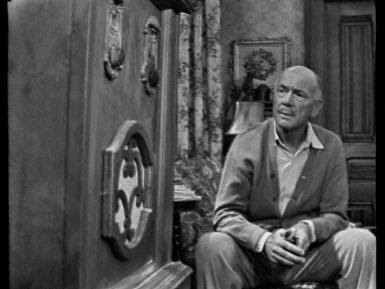
50 years ago tonight, Charles Beaumont brought us a charming tale of nostalgia which, by the end, magically transforms into a tale of unrequited love and second chances.


In "Static," Ed Lindsey is an old man, wiling away his last days in an old folks’ home (today we’d call it an assisted living facility). The other inmates (oops, residents) pass the time watching mindless TV shows, but he’ll have none of it. He crankily drags his big old radio out of the basement and holes up in his room, listening to the glorious programs of old. Lucky some local station broadcasts those old shows… right?


You already know what’s coming, don’t you? There’s no station broadcasting the old shows. The radio, through unspecified means, is picking up radio signals from the past. That’s the first of two supernatural elements in this episode. Discussing the second supernatural piece would require me to spoil the ending, which I’d rather not do. I will say that the episode gradually reveals itself to be a rather sweet love story, and leave it at that.


Leading the cast is the wonderful Dean Jagger, who (to me) will always be the gruff-but-loveable Major General Thomas F. Waverly in the Bing Crosby-Danny Kaye classic White Christmas. It’s required viewing in my house around the holidays, and I choke up every time. My most recent viewing was especially great, because I got to experience the film in high definition (on blu-ray) for the first time. It looked spectacular.

Blu-ray capture shamelessly stolen from... well, it's pretty obvious.

“Static” is one of season two’s six videotaped episodes. As such, it looks crummy. High definition does nothing for it. Too bad. The story is good, though, and the performances are great. It’ll never be counted among the series’ high points, but it rises above its technical handicaps well enough. It’s certainly worth a look. I haven’t seen it in many, many years, so I’m looking forward to tonight’s 50th anniversary viewing.


Next week: Repeat city, baby (it’s season one’s “The After Hours,” which deserves multiple viewings). Two weeks from tonight, we’ll take a road trip to Vegas with two small town guys, one of whom happens to be telekinetic. Roll the dice and check it out.