I'm a couple of years late, but I've decided to establish a presence on Twitter. So if you're Tweet-enabled, feel free to follow me @twizoneblog.
Wednesday, June 11, 2014
Tuesday, June 10, 2014
55th Anniversary DVD Collection announced...
Looks like Image Entertainment is releasing yet another DVD compilation on July 1st (*yawn*). I already own the entire series on both DVD and Blu-ray, and if I didn't, I could watch it on Hulu (all five seasons) or Netflix (everything except season four as of this writing), so this kind of announcement doesn't excite me in the least. The only reason I'm mentioning it is because, as far as I know, it's the first item to commemorate the series' upcoming 55th anniversary, which falls on October 2nd.
Having said that, it does contain a pretty great selection of episodes. The 2-disc set features the following:
I have no argument with the selection: all 17 episodes are top notch (well, I'm not exactly fond of "Time Enough at Last," but I can't deny its iconic status). There are of course a few I'd swap out (I'd probably trade "The Masks" for "Third from the Sun," for example), but this is a really solid compilation. I guess it's a great (and inexpensive; Amazon's pre-order price is $18.99) way to introduce new viewers to the series. The fact that it's a DVD-only compilation is a bit troubling, however. There's simply no excuse in this day and age to restrict content ---- particularly content that has already been remastered in high definition --- to lowly standard-def. Given the number of times Image has milked the Twilight Zone cow, this is more than a bit disappointing.
Still haven't upgraded? C'mon.
Monday, June 2, 2014
Merch Spotlight: Nightmare at 20,000 Feet diorama (Bif Bang Pow!)
I received Bif Bang Pow!’s Nightmare at 20,000 Feet diorama as a birthday gift from my good
buddy Bill Huelbig about six months ago. I took pictures of it for my intended
spotlight… which never quite happened. I have no excuse for this item slipping
through the proverbial cracks, other than the fact that writing two blogs for eight months straight has
been a bit overwhelming. I’ll attempt to rectify this oversight now.
When the first
“Classic Moments” diorama (a San Diego Comic Con exclusive based on “The Invaders”) was
announced, one of my initial reservations concerned the size: the promotional
pictures made it seem big enough to be a big unwieldy for my purposes (never
mind that the damned dimensions were readily available: 6.5” deep x 5.0” wide x
3.5” tall). I also wasn’t a fan of the sculpt (I think eliminating the Agnes
Moorehead character entirely and just featuring the Invader and his flying
saucer would’ve been way better). Another reservation was the price: $24.99
plus shipping, which seemed somehow unreasonable (however, I had no context to
justify this conclusion). Further, I had
grown a bit disenchanted with BBP’s offerings in general, especially since
their action figure line had essentially screeched to a halt (see here for the
sad tale). When the second diorama (based on “Nightmare at 20,000 Feet”) was
announced, I found myself quite underwhelmed, and decided at that point to
avoid the dioramas completely.
I did
experience a bit of regret when the third diorama was announced (from “Eye of the Beholder”), which looked really impressive. But by then the “Invaders”
diorama had sold out, and finances prohibited me from paying aftermarket prices
(also, the completist in me couldn’t bear to buy some but not all of them), so
I stuck to my guns and didn’t bite.
And then---
good ol’ Bill sent me the “Nightmare at 20,000 Feet” diorama for my birthday,
and all bets were abruptly off.
First off, the
box is approximately the same size as those that house BBP’s TZ bobble heads,
but the actual item itself is much smaller (6.5” wide x 4.5” long x 2.5” tall; again,
having never bothered to check the specs, I was expecting it to be quite a bit bigger).
I found the compactness quite appealing, and my original (unfounded) unwieldiness
argument was immediately shattered. Plus---- well, the damned thing ended up
being quite cool in general, so my original underwhelmed reaction was
supplanted as well.
Have a look, kids.
If I have a
complaint, it’s the fact that the Gremlin is painted the same gray as the
plane, which makes him (it?) really hard to see. Just a few brushstrokes of a darker
gray would’ve made a big difference (I’m certainly not expecting much detail at
this scale). Otherwise---- a really solid piece. After my initial blasé
reaction, I’m quite happy to wholeheartedly recommend it. Thanks Bill!
If you want your own (and why wouldn't you?), it's still available from Entertainment Earth. $18.99 plus shipping and it's yours.
So now the
inevitable question arises: what about those other two dioramas? The “Eye of the Beholder” diorama (which is still available for $29.99 plus shipping; I'm not sure why the price point is so much higher) is
definitely something I want to pick up at some point. It appears that perhaps
the line will stop at three (it’s been over a year, and a fourth diorama still
hasn’t been announced), so I suppose I can swallow the aftermarket price of the
“Invaders” diorama (I’ve still got some issues with the sculpting but, given the
diminutive scale, it may be much less problematic) for completion’s sake.
Thursday, May 29, 2014
Episode Spotlight: "The Fear" (5/29/1964)
Season
5, Episode 155
Originally
aired 5/29/1964
Cayuga
Production # 2633
On
March 25, 1964, a sad bit of Twilight
Zone history occurred when shooting wrapped on Cayuga’s final production.
It was no secret at that point that the series had been cancelled (CBS had
announced its fall schedule in January), so the crew certainly knew that their
work in the fifth dimension was coming to an end. I’d like to believe that Rod
Serling was there with them on the set to hear that final “Cut!” uttered, and
that in that moment he felt a rush of pride for his contribution to the
landscape of imaginative television. However, I think it’s far more likely that
he was nowhere near that set, and that he was too worn out to give much of a
damn. As fatigued as the series often felt as it wound down, Serling’s own
fatigue was magnified several times over.
That
final production, Serling’s “The Fear,” premiered on CBS a scant two months
later, exactly fifty years ago tonight.
Charlotte
Scott, a big city fashion editor who is on an extended sabbatical following a
nervous breakdown, is staying in a luxurious cabin near an unspecified mountain
village. State trooper Franklin visits her to follow up on a report of some
strange lights in the sky in the area.
The
two are beset by mysterious phenomena: bright lights appear and disappear
outside the house, high branches in the surrounding trees are broken, and all
communication with the outside world (his police radio and her telephone) is
cut off. His squad car rolls on its own
(despite the emergency brake being engaged) and flips onto its side.
Soon after, Franklin discovers that his car has been flipped back over…. and
a set of oversized fingerprints have been left on it. The next morning, the pair discovers
an enormous footprint in a nearby clearing and, overcome with terror, Ms. Scott
runs away screaming. She quickly comes face to face with the apparent source of
the strange happenings: a gigantic humanoid creature whose entire head is a
single eyeball.
Franklin
fires several rounds into the creature, which promptly deflates. It’s a
balloon! The pair then spies a small flying saucer nearby, inside which tiny
aliens are reporting to their superiors that their plan to frighten the giant
Earthlings has failed. The ship takes off with its proverbial tail between its
legs.
“The
Fear” is written by Rod Serling, his
92nd (!) and final contribution to the legendary series that he unleashed upon
the world. I’d love to plumb the depths of his teleplay and analyze meanings
both surface and hidden, but the sad fact is… well, there aren’t really any
such depths or meanings to speak of. “The Fear” centers on a single theme,
revealed right up front in the episode’s title: fear. The episode’s about being
afraid in the face of the unknown… and that’s it. Serling tackled many
sociopolitical themes and their impact on the human condition throughout the series, and
the fact that his final Twilight Zone
makes no meaningful comment on anything is more than a bit deflating (ha! See
what I did there?) He misquotes FDR’s famous “the only thing we have to fear is
fear itself” in his closing narration and, if that’s the point he’s trying to
make, I would argue that it’s not appropriate to the story. I think it’s
entirely appropriate to be afraid if there’s a giant alien coming after
you, whether or not it turns out to be a hoax later.
In
the director’s chair this week is Ted
Post, who also helmed “Probe 7, Over and Out,” and “Mr. Garrity and the Graves” earlier this season and, way back in season one, “A World of Difference” (a favorite of mine). His work here is more or less workmanlike,
but there are a few nice touches (Franklin’s flashlight-armed searches outside
are effectively spooky, and hey, you’ve gotta love those huge fingerprints on
his car!). I do have an issue with the enormous footprint our protagonists
find, however: wouldn’t there be several of them? The fact that there seems to
be only one should have been a tipoff that things might not be as they appear.
And how the hell does Franklin’s car flip onto its side? Even if it struck
something as it was rolling, it wasn’t moving any more than five miles per
hour. Those enormous fingerprints don’t appear until after the car is returned to its upright position, so we can’t even
blame the aliens for this one. And Franklin’s estimation that the giant is "500
feet high" turns out to be a hilarious miscalculation, as we see when our heroes come face to face with it.
As
Franklin and Ms. Scott work through the mystery of the giant alien, the episode
feels like a companion piece of sorts for “Stopover in a Quiet Town” (how
awesome would it have been to end things with the giant alien girl looming over
Franklin and Charlotte, the sky booming with her mischievous giggling? It
wouldn’t have made much sense, but I think I would’ve preferred it to the
actual denouement). I guess we could also draw parallels to season three’s “The Little People” and, for that matter, “The Invaders.”
When I reviewed "The Brain Center at Whipple's" two weeks ago, I lamented the fact that the appearance of Robby the Robot signaled the final Forbidden Planet connection we'd see in the series. I love being proven wrong when it comes to stuff like this: while the tiny aliens' flying saucer isn't our beloved United Planets C-57D Space Cruiser, the stock shot (from "Death Ship") of the ship beating a hasty retreat most certainly is. So there you go,kids: one more Forbidden Planet alert for the road.
“There
are more things in heaven and earth, Horatio, than are dreamt of in your
philosophy,” says Franklin to Ms. Scott early in the episode. If this quote
from Shakespeare’s Hamlet seems a bit familiar, it’s because Richard Matheson also used it in season one’s “The Last Flight.”
A
couple of complaints: first, it seems contrary to Serling’s usual sympathetic
humanist ethic to have Franklin start shooting at the giant alien without even
attempting to communicate with it, particularly since the alien has never
exhibited any overt intent to bring harm or destruction. Hey Rod, remember “The Gift”? Second,
“The Fear” is probably the single most over-the-top example of Serling’s
notorious “purple prose” tendencies supplanting natural, realistic dialogue.
Zicree says it best in his Twilight Zone
Companion: “(M)uch of the dialogue sounds like two Rod Serlings talking to each
other.”
When
I reviewed the Outer Limits episode
“The Borderland” back in December, I described Mark Richman’s performance as a
“pretty impressive Rod Serling impression.” Here’s a short clip to illustrate:
Pretty uncanny, huh? Now,
Richman doesn’t act (much) like Serling in “The Fear,” but he definitely resembles him.
Bif Bang Pow! named their action figure of the big guy Cyclops, which is probably an appropriate name for it (it certainly sounds more ominous than “Alien Balloon”). I don’t have it, so I can’t comment on its merits (I stopped collecting Bif Bang Pow!’s TZ stuff about a year or so ago, which I probably should’ve mentioned before now; long story short: too many quality control problems on their end, plus the majority of their offerings just don’t interest me; I’ll try to elaborate in a separate post soon).
.
THE MUSIC
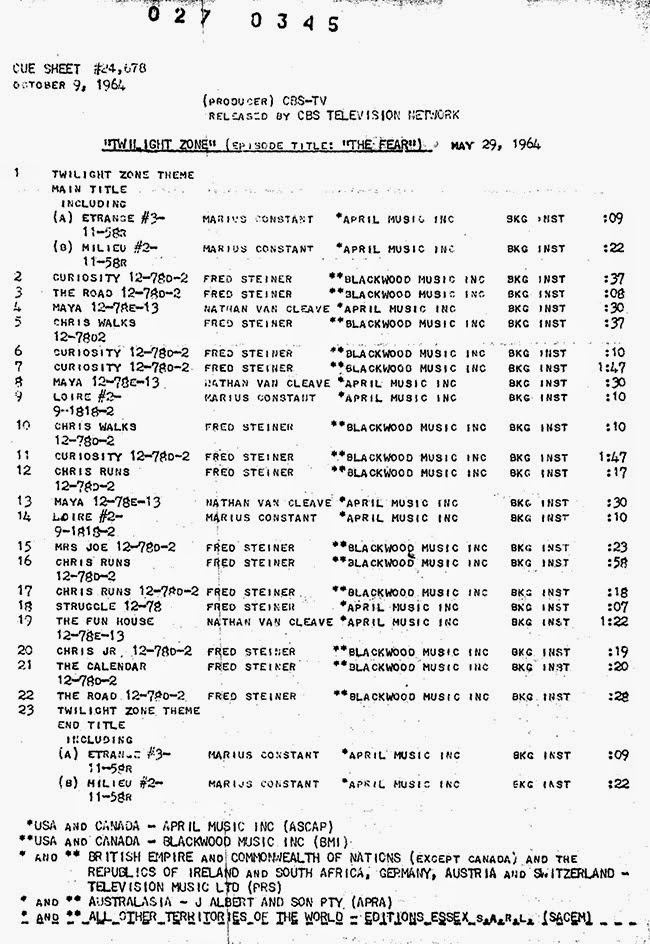
“The
Fear” is stock-scored, meaning that the underscore is a patchwork of
pre-existing recordings from the CBS Music Library, comprised mostly of Fred Steiner cues (from “King Nine Will Not Return” and “A Hundred Yards over the Rim,” both from season two). We also
hear “Maya” and “The Fun House” from Nathan
Van Cleave’s score for season one’s “Perchance to Dream.” Hearing music
from the show’s earlier days this close to the end is a welcome touch indeed
(though I doubt that was the intent), and I’m happy to report that the various
cues mesh pretty well together, despite originating from three different
scores. While “The Fear” doesn’t feature an isolated music track on the DVD and
Blu-ray releases of the series, all three of those earlier scores have been
released multiple times over the years, on both vinyl and CD, from both Varese
Sarabande and Silva Screen Records. The Definitive DVD and Blu-ray releases of
the first and second seasons also include isolated music tracks for all three
episodes, so if one wanted to piece together a soundtrack for “The Fear,” the
resources are easily obtained (except for that short little Marius Constant
bit, dammit).
.
DRAMATIS PERSONAE
Trooper Robert Franklin is played by Mark Richman in
his only Twilight Zone appearance.
Richman has extensive genre experience, including roles on The Outer Limits (“The Borderland” and “The Probe”),
Alfred Hitchcock Presents (“Man with
a Problem” and “The Cure”), The Invaders
(“The Leeches” and “Inquisition”), The
Incredible Hulk (“Triangle) and, a bit more recently, Star Trek: The Next Generation (“The Neutral Zone”).
Richman with TZ alum Susan Oliver.
Charlotte Scott is
played by the beautiful Hazel Court
in her only Twilight Zone appearance.
Genre fans can spot her in four episodes of Alfred Hitchcock
Presents (“The Crocodile
Case,” “The Avon Emeralds,” “Arthur,” and “The Pearl Necklace”) and one episode
of Boris Karloff’s Thriller (“The
Terror in Teakwood”). On the big screen, Court can be seen in 1957’s The Curse of Frankenstein from Hammer
Films, not to mention a trio of Roger Corman adaptations of Edgar Allen Poe
stories (1962’s The Premature Burial,
1963’s The Raven, and 1964’s The Masque of the Red Death). Did I
mention that she’s beautiful? She’s definitely a TZ Babe, make no mistake. *Sigh*
The
part of the giant Cyclops “alien” is played by a BIG GODDAMNED BALLOON which,
to my knowledge, never worked in television again (though it would’ve been
positively smashing in the Macy’s Thanksgiving Day Parade, right?).
“The
Fear” was the final Twilight Zone episode
to be filmed (“The Bewitchin’ Pool,” the final episode aired, was shot earlier
but took longer to complete in post-production; more on this when we get to it), and it definitely feels like
the show is running on fumes as it lurches toward the finish line. It’s not
exactly terrible, but it’s nowhere near good: like the aliens’ giant balloon,
it’s ultimately a bit flat.
Next:
There’s
only one new episode left of the entire series… but you’re gonna have to wait
three
weeks for it. Talk
about cancelus interruptus….
Thursday, May 22, 2014
Episode Spotlight: "Come Wander with Me" (5/22/1964)
Season 5, Episode 34 (154 overall)
Originally aired 5/22/1964
Cayuga Production # 2641
He
said: Come wander with me, love
Come
wander with me
Away
from this sad world
Come
wander with me
He
came from the sunset
He
came from the sea
He
came from my sorrow
And
can love only me
Oh
where is the wanderer
Who
wandered this way?
He’s
passed on his wandering
And
will never go away
He
sang of a sweet love
Of
dreams that would be
But
I was sworn to another
And
could never be free
Singer Floyd Burney, the Rock-A-Billy Kid,
arrives in a remote backwoods town in search of a usable folk song. The
proprietor of the music store (a barn full of musical instruments, actually)
gives him the cold shoulder, but he hears the perfect melody emanating from
somewhere in the neighboring woods. Guitar and tape recorder in hand, he sets
out to track it down, taking no notice of the black-clad woman watching him... not to mention the nearby headstone with his name on it.After a fruitless search of unknown duration, he sits down and tries sounding out the melody. Just then the hummer of the elusive song appears, a young woman named Mary Rachel. She refuses to give her song to him, however, stating that it “belongs to someone else” (that “someone else” is Billy Rayford, her fiancĂ©). Burney turns on the charm and, before you can say “redneck seduction,” she’s happily singing the song into his tape recorder. Act one ends with Mary Rachel in Burney’s arms with his tongue planted firmly down her throat.
Act two opens with the pair listening
to the recorded song, Burney enjoying what is presumably a post-coital smoke. He
promises to take Mary Rachel to the big city, where he’ll buy her sparkling jewels and
unicorns and whatever the fuck else, and she laps it up like the Appalachian
simpleton that she is. Just then Billy Rayford arrives, shotgun in hand, poised
to take out the competition. Burney dispatches him with a rock to
the head, at which point his tape recorder kicks on… but the song has now
changed, its lyrics reflecting the murder.
You killed Billy Rayford
Bespoke unto me
Struck him down in his anger
'Neath an old willow tree
By the lake where our love dwelled
'Neath an old willow tree
You killed Billy Rayford
'Neath an old willow tree

Mary Rachel begs him not to run “this time,” that if he lets her hide him “things might be different.” Burney assumes she’s nuts and flees from the wrath of Rayford’s vengeance-minded kin. When he looks back at her, she's now inexplicably dressed in black mourning garb.
They sought out their brother
And found him alone
The wept by the lakeside
For a boy hardly grown
They wept by the lakeside
And vowed he must die
The wandering stranger---

He makes his way back at the music store, where the proprietor refuses to help him. He clocks him in the head, doubling his body count. He then tries to hide, but the instruments come to life in an accusatory cacophony, leading the Rayford posse straight to him. A gunshot sounds, and we close on a shot of that mysterious headstone….
“Come Wander with Me” was written by Anthony Wilson, who also wrote the
pilot episode of my newest sci-fi TV obsession The Invaders (“Beachhead”)… which I will most likely be blogging
about when the series turns 50 in 2017 (so if you were wondering if I’d be
doing any more of these Silver Anniversary blogs, there’s your answer). Wilson
has another (very approximate) Rod Serling connection: he developed the TV spin-off of 1968’s Planet of the Apes,
which Serling had a hand in adapting from Pierre Boulle’s novel. Hey, I said it
was approximate, didn’t I?
In the director’s chair is Richard Donner for his sixth and final Twilight Zone go-round. “Come Wander
with Me," which turns 50 tonight, has something of a proto-David Lynch vibe about it: impressive visual
flair with tons of atmosphere, heightened (almost to the point of artifice)
acting, and a twisted, near-incomprehensible plot. The episode would sit
comfortably next to films like Mulholland
Drive and Wild at Heart. I’m a
Lynch fan, so it delights me to draw this comparison.
In any case, I cannot deny that he is
quite dickish, particularly when he chucks a rock at an innocent crow for no
reason whatsoever (where’s PETA when you need ‘em?). Oh yeah, and he kills two
guys, which doesn’t really help his case (in all fairness, Billy Joe Jim Bob
Rayford was about to blow him away, so we can call that one self-defense; the
music store guy totally didn’t deserve to die, however). His worst offense of
all may be his relentless self-branding: he wears a shirt with his initials on
it, plays a guitar with his name on it, and drives a car with --- you guessed
it, his name on it. Since he states his own name frequently (“You’re bespoke,
I’m Floyd Burney, so what?”), none of this is necessary.
This is the point at which I'd usually dissect the supernatural force(s) at work and poke holes in it/them, but in this case the dreamlike atmosphere more or less defies such analysis. Burney is either trapped in a time loop or, more likely, is eternally reliving his transgressions (like Karl Lanser in season one's "Judgment Night" or, more recently, the E-89 crew in season four's "Death Ship"). I also wonder if the song itself is cursed somehow...? It doesn't matter. This is a dream, or a nightmare, or some half-conscious point in between.
.
THE MUSIC
“Come Wander with Me” features an original
score by Jeff Alexander (who also
scored season two’s “The Trouble with Templeton”), which includes an intriguing
original song, (music by Alexander, lyrics by Anthony Wilson), verses of which
appear throughout the episode. The song was later featured in the notorious
2003 film The Brown Bunny (notorious
because its, um, climatic oral sex scene was not simulated; yes, I’ve seen it, and it’s clearly the real, um,
thing); before that, Alexander himself integrated an instrumental version of
the song into his score for the 1968 western Day of the Evil Gun. I’ve pieced
together the various sections into a semi-cohesive song for your listening
pleasure (you’ll notice a drop in quality in the fourth and final verse, since
it was heard in the episode as a tinny tape recording; I also didn't include the apocryphal story-specific verses)….
The underscore, fragmented song pieces
and all, can be enjoyed (without intrusive dialogue and sound effects) thanks
to the isolated music track present on both DVD iterations and the more recent
Blu-ray release of season five.
Dutch singer Anneke van Giersbergen covered the song in 2007 under the moniker Agua de Annique. It's every bit as lovely and haunting as the original recording. Enjoy!
.
DRAMATIS PERSONAE
Floyd Burney is played by Gary
Crosby (yes, Bing’s son) in his only Twilight
Zone appearance. Crosby’s other genre credits include The Bionic Woman (“Bionic Beauty”), Wonder Woman (“Light-fingered Lady”), and Project U.F.O. (“Sighting 4003: The Fremont Incident” and “Sighting
4022: The Camouflage Incident”); unfortunately I was unable to procure any usable photos from any of them, so instead I’ll include Crosby’s 1951 Life Magazine cover. That’s right, kids: the
Rock-A-Billy Kid made the fucking cover.
Note "The Midnight Sun" there in the upper left corner. It's clearly not a reference to the Twilight Zone episode of the same name (which would air ten years later), but it's a cool coincidence nonetheless.
The role of Mary Rachel was Bonnie
Beecher’s first professional acting gig. Her career was short-lived (1964-68)
but, in that slight span of time, she managed to land roles on Star Trek (“Spectre of the Gun”), The Invaders (“Beachhead”) and The Fugitive (two, actually: “Ill Wind”
and “Ten Thousand Pieces of Silver”). She has the pleasure (maybe, I dunno) of
being married to hippie activist Hugh Romney, better known as Wavy Gravy.
The zombie-like proprietor
of the music store is played by Hank
Patterson, who has crossed over into The Twilight Zone twice before (season
three’s “Kick the Can” and, more recently, “Ring-a-Ding Girl,” in which he was
the cranky high school superintendent who wasn’t having any of Bunny Blake’s consarned nonsense). Patterson has no other genre experience to speak of; most fans of
classic TV probably remember him as Fred Ziffel on both Petticoat Junction (1963-66) and Green Acres (1965-71).
“Come Wander with Me” is marvelously
schizophrenic: on one hand it’s a disjointed and jarring circle with no
resolution and a brash loudmouth at its center; on the other it’s an ethereal
mystery operating on the languid logic of dreams. There’s nothing else in the series quite like
it; given the fifth season’s frequently derivative nature, it’s both welcome and
refreshing. I love it.
Next
week:
With only two episodes left to air,
Rod Serling offers up his
very last Twilight Zone teleplay. I wish to Christ it was a good one... but
alas.
Subscribe to:
Posts (Atom)


.png)


.jpg)


