Showing posts with label George Clayton Johnson. Show all posts

Tuesday, December 20, 2016

1x11 "Loose Changelings"


Shapeshifters of the world unite! This week Craig takes on the Twilight Zone classic “The Four of Us Are Dying” (and the George Clayton Johnson short story that inspired it) as well as the not-quite-so classic “The Self-Improvement of Salvadore Ross” in a jazz-fueled free fall into the neon-splashed netherworld of film noir. Along the way he enjoys an enlightening chat with Mr. Stephen Pickard, the man largely responsible for the HD-sourced transfers (and the bumper crop of isolated music tracks!) commissioned for the glorious Definitive Edition DVD sets… which makes him a true hero in our eyes.

Opening theme: “Neither Here Nor There” (Revision #2) by Twin Loops

Closing music: “The Four of Us Are Dying” by Nine Inch Nails (from the album The Slip, copyright 2008 by the Null Corporation)

The Twilight Zone is a trademark of CBS, Inc.

Between Light and a Shadow: A Twilight Zone Podcast is a nonprofit podcast. Music clips and dialogue excerpts used herein are the property of their respective copyright owners; we claim no ownership of these materials. Their use is strictly for illustrative purposes and should be considered Fair Use as stated in the Copyright Act of 1976, 17 U.S.C. section 107. 

Friday, December 20, 2013

Episode Spotlight: "Ninety Years Without Slumbering" (12/20/1963)


Season 5, Episode 12 (132 overall)
Originally aired 12/20/1963
Cayuga Production # 2615


My grandfather's clock was too large for the shelf
So it stood ninety years on the floor
It was taller by half than the old man himself
Though it weighed not a pennyweight more
It was bought on the morn of the day that he was born
And was always his treasure and pride
But it stopped short, never to go again
When the old man died
Ninety years without slumbering
His life seconds numbering
It stopped short, never to go again
When the old man died

“My Grandfather’s Clock”
(Henry Clay Work; abbreviated)


76 year-old Sam Forstmann lives with his pregnant granddaughter Marnie and her husband Doug. He shares his room with a grandfather clock, which he’s owned all his life and obsessively maintains. It’s his steadfast belief that, should the clock stop ticking, he will die. Marnie is increasingly worried about him so, to placate her, he agrees to sell the clock to a neighbor (on the condition that he be allowed to continue maintaining it).


The new owners of the clock take an unexpected trip and, without Sam’s daily upkeep, the clock begins to slow down. Sam’s attempts to break into the house are stopped by police intervention. Dejected, he returns home and goes to bed, certain that he will die that night.


The clock stops. Sam’s spirit appears to separate from his body, and the two engage in a lively debate about the merits of his long-held belief that the clock is intrinsic to his existence. Sam essentially talks himself out of this belief and, the next morning, surprises Marnie with his new outlook on life.


Wait, what?

Yeah, you heard me. We just spent twenty-five minutes feeling sorry for this old man because of his clock obsession, which is really just a fear of dying, which we can certainly all understand and sympathize with, and then ---- at the crucial moment ---- he simply changes his mind. Sucker punch!


I get where the title of the episode comes from, but it’s confusing because Sam is 76, not 90. They could’ve made him 90, but then they’d lose the “Spirit of ‘76” joke that pops up in Sam’s conversation with his own spirit (which seems kinda dumb anyway; it wouldn't have been a big loss). We last saw Ed Wynn five years ago (in season one’s “One for the Angels”), and he seems to have aged quite a bit. I’d buy him as 90.


The rooms in Doug and Marnie's place seem abnormally large. Look at the size of Sam's bedroom!


The teleplay was written by Richard de Roy, adapted from “Tick of Time,” a teleplay by George Clayton Johnson. Johnson was unhappy with de Roy’s changes and chose to be credited under his pseudonym Johnson Smith. I'm not sure which of them to thank, but the script features one of my favorite lines in the whole series. It’s in Serling’s closing narration, and was featured prominently in Arlen Schumer’s Visions from The Twilight Zone.


THE MUSIC

“Ninety Years without Slumbering” features an original score by Bernard Herrmann, his seventh and final for the series.  His work here interpolates the melody from “My Grandfather’s Clock,” an old British standard written in 1876 by Henry Clay Work (which has been recorded by several acts over the decades, most notably Johnny Cash in 1959 and, more recently, R&B’s Boyz II Men in 2004; never thought you’d see a Boyz II Men reference here, didja?). As such, the melodic score sounds nothing like his typical TZ output (which consist largely of dramatic and moody, often ethereal cues).  An exception is the music underlying the scene in which Sam is confronted by his own spirit (titled, simply, “Ninety Years without Slumbering XI”; this particular score uses only numbers as cue titles): vibraphone and harp dance atop and around brooding bass clarinet chords, evoking Herrmann’s earlier work in “The Lonely” and “Eye of the Beholder” (as well as his “Outer Space Suite,” a CBS Music Library work used in many TZ episodes). The original Herrmann recordings have never been officially released; however, they can be obtained via the isolated music tracks present on both the DVD and blu-ray sets of season five (from Image Entertainment).


Additionally, Joel McNeely recorded all seven of Herrmann’s TZ scores (along with his various title themes) in 1999 for a 2-CD set released by Varese Sarabande Records (discussed recently when we covered “Living Doll”). I do have some reservations about McNeely’s interpretations but, given the relative simplicity of “Ninety Years without Slumbering,” his take on it sounds fine (though, purist that I am, I’ll never place it above Herrmann’s original recording).


FAMILIAR FACES

Ed Wynn (Sam Forstmann) first crossed paths with Rod Serling in 1956’s “Requiem for a Heavyweight” on Playhouse 90, and then again in the aforementioned “One for the Angels” in 1959. It should be noted that he’s the father of Keenan Wynn, who starred in season one’s “A World of His Own” and co-starred with his dad in the aforementioned “Requiem for a Heavyweight.”


From left: Keenan Wynn, Jack Palance, Ed Wynn

Mamie Kirk, Sam’s pregnant granddaughter, is played with familial sweetness by Carolyn Kearney, who also appeared in the TZ proto-pilot “The Time Element” on Westinghouse Desilu Playhouse in 1958 (as the newlywed Mrs. Janoski). I called her a TZ babe then, but I feel less inclined to lust after her here (probably because her character is quite pregnant and, believe it or not, I’m not a total cad).


Fortunately, my lust needs are covered here by Carol Byron, playing the tasty dish next door (also named Carol). She’s kinda adorable, which assists me in looking past her overeager housewife-in-a-commercial acting (just listen to her exclaim “George doesn’t think I’m a bargain hunter; wait’ll he hears about this!”).


William Sargent (the psychiatrist, Dr. Mel Avery) previously passed through The Twilight Zone as the Project Manager in season four’s “The Parallel.” He also appeared on a variety of other genre TV series, including Alfred Hitchcock Presents, Star Trek, and The Invaders.


Dick Wilson (Mover #1) appeared in season one’s “Escape Clause” as an exasperated insurance adjuster, but I’m sure he’s much better remembered for his role (as opposed to roll, har har) as Mr. Whipple in 25 years’ worth of Charmin commercials. Mover # 2, meanwhile, is played by stuntman Chuck Hicks, last seen as The Maynard Flash in “Steel” a couple of months back. He has another (very tenuous) Serling connection: he played a boxer in a 1963 episode of The Many Loves of Dobie Gillis titled, punnily enough, “Requiem for an Underweight Heavyweight.”


I wrote and directed a teleplay back in 1995 or so called “Nothing to Fear,” in which a time-obsessed man uses a pocket watch to keep himself organized and alert in an attempt to stave off a murderous creature whom he believes will strike if he lets down his guard. The resultant half-hour film (shot on 8mm video), which starred a couple of friends (Donovan Littlejohn and Jason Ulven; ‘sup fellas?), went on to repeated airings on the Tualatin Valley Public Access channel here in Portland (which was probably happy to air something other than local Freedom of Speech champion Jim Spagg’s naked rantings and ravings; if you've never heard of Jim Spagg, Google him for some, um, eye-opening fun). 


In retrospect, “Nothing to Fear” was a half-baked idea to begin with, and the creature’s existence was never really adequately explained, but I suppose worse things have shown up on TV (about half of Tales from the Darkside’s four-year run, for example). Oh, in addition to writing and directing the piece, I shot it, edited it, composed and performed its electronic music score, and appeared in a cameo role. Sextuple threat!

Damn, I had a lot of hair back then.


The acting is uniformly good in “Ninety Years without Slumbering,” but unfortunately the strong thespianism on display is largely wasted on a disappointing, pedestrian script. The fascinating concept of time obsession is merely name-dropped instead of being examined and explored. Throw in the implausible last-minute reversal to create a happy ending and you end up with precious time wasted.


Next week: Ring-a-ding-a-ling-a-ding-dong!


Thursday, February 9, 2012

TZ Promo: “Kick the Can” (2/09/1962)


Season 3, Episode 21 (#86 overall)
Cayuga Production # 4821


“You can’t stop kids from playing kick-the-can. It’s like statues, and hide-and-seek. It’s in their blood! It’s a special summer ritual. Did you ever stop to think of it? All kids play those games, and the minute they stop--- they begin to grow old. It’s almost as though playing kick-the-can keeps them young. Did you ever notice that?”

That’s Charles Whitley, who’s just figured out the secret of youth. Ben Conroy, his lifelong friend and fellow resident at Sunnyvale Rest, steadfastly and stubbornly disagrees. 50 years ago tonight, one of them was proven right.

“Kick the Can” is George Clayton Johnson’s fourth and final* Twilight Zone script, and it’s easily his best (if only the other writers could’ve gone out with a similar bang). This is one of those episodes where everything, from Johnson’s script on up, works beautifully. There is a palpable air of sentimentality, but it never becomes cloying or maudlin. The scene in which the nursing home residents, led by Whitley, endeavor to sneak out for a nighttime game of kick-the-can is a sheer delight. There's a simple sweetness that's irresistible.


Ernest Truex is wonderful as Whitley. You can’t help but sympathize with him right off the bat. The opening scene, in which he says his goodbyes to his fellow residents, fully believing that his son is about to pick him up and take him home, is staged masterfully (we only hear snatches of dialogue between father and son; most of the scene consists of the other residents on the front porch, leering expectantly, figuring out that things aren’t going according to Whitley’s hopes). When Whitley’s son drives away without him, and he sits down beneath a nearby tree, near tears, our hearts break for him (which is pretty amazing, given we’ve only known this guy for three minutes). Truex’s face is marvelously expressive, conveying disappointment and heartbreak. From there, his growing elation at figuring out the secret of youth (playing the titular game of kick-the-can) is just plain fun to watch.


Truex was last seen in season one’s “What You Need,” playing a peddler with a supernatural knack for providing exactly what people need at the exact time they need it. He was fine there, but here he truly shines. It’s a shame The Twilight Zone didn’t utilize his talents more.


Equally great is Russell Collins as Conroy. Bitter and tired, he has no patience for Whitley’s sudden flights of fancy and reacts brusquely and without sympathy. The scene in which he discusses Whitley with Sunnyvale’s superintendent, however, belies a convincing concern for his friend, which adds a nice dimension to the otherwise gruff character. And just watch his turnaround at the end of the episode…. It’s just damned heartbreaking.


Burt Mustin has a minor role as another of the Sunnyvale residents (we last saw him in season two’s “Night of the Meek,” where he received a new pipe and smoking jacket from Henry Corwin, aka Santa Claus).


Whitley’s son is played by Ernest Truex’s real-life son Barry. A nice touch (even though the poor guy didn't get screen credit!).

The child playing the transformed Whitley is similarly uncredited, but he reminds me of Hermie Brandt (Jerry Davis) from season 4’s “The Incredible World of Horace Ford.” Compare these two shots:


I dunno, maybe it's the messed-up teeth. Or maybe it's the lamp globes. Are they the same kid? The answer lies somewhere... in The Twilight Zone.


“Kick the Can” was one of four episodes remade in 1983’s Twilight Zone: The Movie. It plays out more or less like the original, except it ends with most of the residents ultimately rejecting the opportunity to be young again. This version lays on the sugar and sentiment pretty thick, but the cast is great (Scatman Crothers in particular). Steven Spielberg himself directed this segment of the film, and it fits squarely in with his other 80’s work (E.T., TV’s Amazing Stories, etc). Not terrible by any means, but the original beats it hands down.


“Kick the Can” is stock-scored. While it’s too bad Cayuga didn’t deem the episode worthy of its own score, at least they were smart enough to pull stock cues from season one’s “Walking Distance” by Bernard Herrmann. Wistful and yearning, the music fits in perfectly here.


Next week: Barry Morse! A player piano with supernatural properties! It can’t lose… right? Well…..


* Of course Johnson's contribution to the series extends beyond four teleplays. Three other TZ scripts were based on his ideas or unpublished short stories, and he did submit a fifth teleplay for season 5 called "Tick of Time," based on his own unpublished short story "The Grandfather Clock." It ended up heavily revised by another writer, to the extent that a chagrined Johnson requested that he be credited under a pseudonym. Therefore, "Kick the Can" is Johnson's final contribution in which he is properly credited as the sole writer. We'll delve into this more when we get to that particular episode (which, by the way, was aired as "Ninety Years Without Slumbering") next December.


Thursday, January 5, 2012

TZ Promo: “Nothing in the Dark” (1/05/1962)


Season 3, Episode 16 (#81 overall)
Cayuga Production # 173-3662


Her name is Wanda Dunn. She’s an old woman who lives alone in a shabby tenement, afraid to go outside. She’s convinced that Death himself is out there, just waiting to come in and claim her.

The thing is…. well, she’s right.


“Nothing in the Dark” is a moving study of humanity’s fear of its own mortality, and Gladys Cooper’s portrayal of the frightened old woman is one of the greatest performances ever captured on The Twilight Zone. Cooper will (happily) return for appearances in season four’s “Passage on the Lady Anne” and season five’s “Night Call.” She’s fine in both, but “Nothing in the Dark” is where she truly shines.


Unfortunately, young Robert Redford... well, sucks as the wounded cop who finally convinces her to open the door and help him. Oh, sure, he’s pretty to look at, but he couldn’t act his way out of a paper bag at this early point in his career (I’m not entirely convinced that he ever became that great of an actor, truth be told). As great as “Nothing in the Dark” is, Redford’s embarrassingly bad performance is a serious blemish. I imagine this is why the episode doesn’t appear in my Top 20 Favorites list (it did make my Top 40 list two years ago, however).


O, DEATH!

This is Death’s third (and final... I think) appearance in the series. We’ve encountered him twice before, in “One for the Angels” and “The Hitch-hiker” (both from season one) and, once again, he proves less frightening when his quarry stops struggling and acquiesces, a pleasant alternative to the skull-and-scythe depiction we’ve all seen countless times. Here’s hoping the real Death is a nice guy...

Another connection to “The Hitch-hiker” can be found in the stock music used in the episode. During Death’s surprise (well, not really) reveal near the end, the underscore features cues from Bernard Herrmann’s music for the radio production of “The Hitch-hiker” (which was subsequently used in the TZ adaptation). A nice touch for attentive ears.

Lamont Johnson directs a George Clayton Johnson script (no relation, as far as I know). We just saw Johnson’s directorial chops two weeks ago in “Five Characters in Search of an Exit” but, interestingly enough, he directed “Nothing in the Dark” earlier. Like, way earlier. The production number (173-3662) indicates that this episode was actually produced during the show’s second season, but held back until the third (the same is true of “The Grave,” which we looked at back in October). The opening shot of act one does not feature the usual season three title cards (episode title, writer, director)… we simply open on a shot of Wanda slowly unlocking and opening her front door. The title shot above is from the episode’s end credits (the only place the episode title was ever seen during season two).

In his The Twilight Zone: Unlocking the Door to a Television Classic (which you need on your shelf; seriously, go NOW and get a copy), Martin Grams Jr. reports that “Nothing in the Dark” was originally scheduled to close the second season, but was replaced by “The Obsolete Man” and held back until midway through season three. This strikes me as odd…. If the episode was ready to go in mid-June, why was it held in limbo for six months? Was Serling and Company as dismayed by Redford's performance as me? In any case, as much as I love “The Obsolete Man,” I think “Nothing in the Dark,” with its elegiac and meditative qualities, would have been more effective as a season finale. But hey, what do I know?

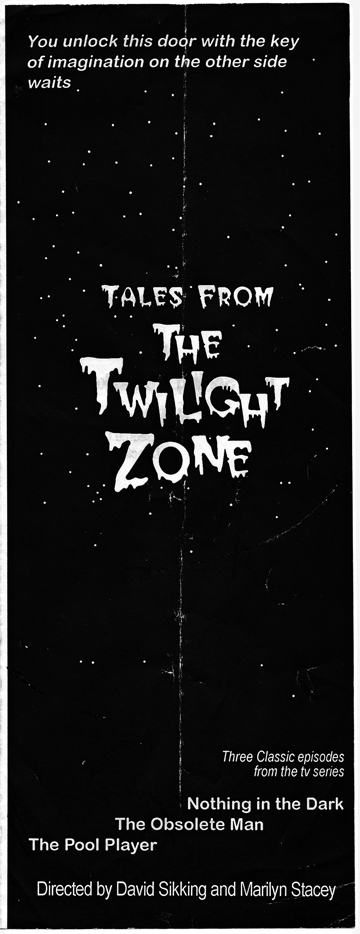
In 1992, a local theater company called Hellfire Productions presented Tales from The Twilight Zone, which included stage adaptations of three TZ episodes: “The Obsolete Man,” “A Game of Pool,” and yes, “Nothing in the Dark.” It’s been almost 20 years, and my memory ain’t what it used to be, but I recall being quite impressed with their efforts.


"Am I really so bad?" Um... yeah, Bobby, you kinda are.

“Nothing in the Dark” is ultimately an exercise in frustration for me. It possesses all the elements of a truly great episode, but Redford’s awkward mannequin routine hurts it enough to cripple its chances at true legend status. As it stands, it’s a Mona Lisa with a crayon mustache. Too bad.


Next week: The world gets nuked yet again… or does it?


Thursday, October 13, 2011

TZ Promo: "A Game of Pool" (10/13/1961)


Season 3, Episode 5 (#70 overall)
Cayuga Production #4815


50 years ago tonight, a little David took on a big Goliath. The weapon of choice wasn’t a slingshot, however. It was a pool cue.


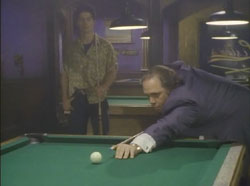
“A Game of Pool,” written by George Clayton Johnson and directed by Buzz Kulik, tells the tale of a skilled but relatively unknown pool player named Jesse Cardiff, who longs to be the best at the game. He’s streetwise and cocky, a bit full of himself, hungry for fame and glory. Late one night, alone in a pool hall, he loudly challenges deceased pool great Fats Brown to a game. Jesse’s just shooting off his mouth, of course, and you can’t really challenge the dead… but this is The Twilight Zone. Fats Brown materializes before his eyes, and the game is on.


The game itself is a tense, well-staged roller coaster, infused with great character moments (Jesse describes all the life pleasures he’s eschewed in order to focus on the game; Fats, meanwhile, names off all the life pleasures he valued over the game; it’s a nice juxtaposition of priorities). When Jesse takes that final life-or-death shot, it’s one of those wonderful edge-of-your-seat moments. You like Jesse, and you want him to win despite his obvious hubris issue, but since it’s The Twilight Zone, a happy ending isn’t always guaranteed (I’m looking at you, “Time Enough at Last”) . Further, happy endings aren’t always what they’re cracked up to be (that’s you, “A Nice Place to Visit”). There, that’s as close to a spoiler as you’re gonna get outta me this week.


It’s no surprise that Klugman shines here; in his youth, he excelled in this type of “downtrodden-but-scrappy” role. What IS a surprise is the nice-guy-tinged-with-menace performance turned in by Jonathan Winters as Fats Brown (yes, THAT Jonathan Winters, the guy who played the giant baby on TV’s Mork & Mindy). You might expect some goofy cheese, but this Winters portrait is the real deal: terse and serious, not to mention downright scary when he first appears. The two actors play off one another beautifully. This is a perfect episode, perfectly executed, and it’s right at home in my top ten favorites list.


REMAKES, REMAKES, REMAKES!

“A Game of Pool” was remade during the 80’s Twilight Zone revival series on CBS. This time, Johnson’s original ending was used, in which the outcome is reversed from what we see in the original episode. The remake features Esai Morales and Maury Chaykin in the Klugman and Winters roles, and is actually fairly effective (as far as remakes go).


Curiously, Johnson himself directed his own production a couple of years ago, also utilizing his original ending (I saw it here, but I'm not sure the link still works). I hate to say it, but it’s a wasted effort. Here are my thoughts, originally posted over at The Twilight Zone CafĂ© on 10/27/2009:

“I watched it today. Unfortunately, it doesn't touch the original (for that matter, the 80s remake is superior too) IMHO. I didn't care much for the actor playing Jesse (he seems a bit old for the part, and he tends to rush through critical sections of dialogue early on), but the actor playing Fats (well, Duke here) is suitably ominous. I can't decide if I like the underscore or not... it seems too modern for the material. And the pool sound effects don't mesh well with the soundtrack. I think my single biggest complaint, though, is the complete lack of actual pool footage! Film is a VISUAL medium. We need to see the damned balls, especially when a specific shot is referenced in the dialogue. All in all, it just seems unnecessary to me. Between the original and 80's versions, both endings are covered. What's the point?”

So... there ya go. Don't let my low opinion stop you from checking it out.


“A Game of Pool” was also performed live right here in Portland back in 1995 (retitled “The Pool Player” for some unknown reason) as part of Tales from The Twilight Zone, a stage adaption of three episodes. As I recall, the players simply described the shots as they took them, which I guess worked well enough (I don’t remember if they used sound effects or not). If I found myself mounting a stage production of this particular episode (hey, never say never), I’d have my actors fake the shots and employ a simple laptop/projector setup (we use ‘em here at work for training purposes) to display pre-filmed footage of each shot. I guess that would make it a multimedia show of sorts. Cool.


Next week: Columbo + Castro = Crappy episode. Ugh.