Monday, February 27, 2012

Kanamit Week Cancelled...


I mentioned a couple of months back that we’d be having a weeklong celebration of that towering alien rascal The Kanamit in March (to coincide with the 50th anniversary of the premiere of “To Serve Man”). However, I regret to report that, due to circumstances beyond my control, Kanamit Week has been cancelled.


What circumstances, you ask? Life, man, just… life. Too much going on, and very little time to pour into this blog outside of the usual weekly episode promos. I had planned to spotlight my Sideshow Collectibles 14" Deluxe Kanamit action figure, which I acquired about a year ago, but it’s deep in storage someplace. Plus, Bif Bang Pow!’s coveted “To Serve Man” notebook (not to mention their Kanamit lunchbox) won’t be available for another month or two. I even had grand plans to make a 3-dimensional Kanamit head cake, but I don’t have the time or money to pull something like that off right now. Suffice it to say, the timing is sadly all wrong for Kanamit Week.


My spotlight of “To Serve Man” will be posted as planned this Friday, with the usual high-definition screen captures. Why Friday instead of the usual Thursday, you ask? Well, since this is leap year, the actual 50th anniversary of “To Serve Man” (3/02) falls on Friday. Staying true to the actual anniversary dates requires a shift to Fridays from now through the end of the summer rerun season (until season four kicks off in January, when we’ll be back on Thursdays again).


Thursday, February 23, 2012

TZ Promo: “The Last Rites of Jeff Myrtlebank” (2/23/1962)


Season 3, Episode 23 (#88 overall)
Cayuga Production # 4811


50 years ago tonight, a dead man sprang back to life… right in the middle of his own funeral. Oh, snap!


Season three found The Twilight Zone visiting the south multiple times (with varying results), and “The Last Rites of Jeff Myrtlebank” is arguably the single most successful sojourn. The episode adeptly mixes countrified humor with a profound supernatural mystery and emerges with a winning concoction. The episode is a joy, through and through.


The town doctor attributes Jeff’s miraculous revival to a condition he calls ipso suspendo animation. Others think perhaps an evil spirit has taken possession of Jeff’s body, and pretty soon the men form a posse to force Jeff to leave town. The ensuing showdown plays out beautifully, and it’s only at the very end of the episode do we find out the truth.


Leading the cast is James Best in the second of three TZ roles (all of them good old country boy types; he’d go on to a career-defining role on TV’s The Dukes of Hazzard playing bumbling Sheriff Roscoe P. Coltrane). Best is marvelous as the recently-deceased (and suddenly quite ambulatory) Jeff, but really the entire cast is spot-on. Sherry Jackson (as Jeff’s fickle girlfriend Comfort) is sure as hell easy on the eyes, and most definitely qualifies as a bona fide TZ babe.


As I’ve reported previously, I used to archive episodes when I was a kid by placing my little portable tape recorder directly in front of the TV speaker (that’s audio tape, folks; VCRs weren’t common items yet). In my original tape of this episode, at the 4:51 mark when Jeff says “Well I’ll be double-dogged,” our family dog Benji could be clearly heard barking, as if on cue. Sadly, both my audio tapes (not to mention Benji himself!) are long lost to time.


“The Last Rites of Jeff Myrtlebank” is one of The Twilight Zone’s better comedies, which means Rod Serling most certainly did NOT write it. We have Montgomery Pittman to thank for this one (he wrote and directed it, as he did with his previous “Two” and “The Grave”). Pittman’s contribution to the series may have been relatively small, but he was batting a thousand all the way. Pittman, who undoubtedly had a bright career in front of him, died of cancer in June of 1962, just four months after “The Last Rites of Jeff Myrtlebank” premiered.


Next week, “To Serve Man” asks the age-old question: if you lead a Kanamit to humans, can you make him eat?


Thursday, February 16, 2012

TZ Promo: “A Piano in the House” (2/16/1962)


Season 3, Episode 22 (#87 overall)
Cayuga Production # 4825


“Of course, I’ve always believed that we have two faces: one that we wear, and the other we keep hidden. The problem has always been to find some method to make people reveal their hidden faces. I suppose it helps if you know what particular hidden face you’re looking for.”

That’s Fitzgerald Fortune, theater critic and asshole extraordinaire. He’s just given his wife a most unusual birthday gift: a player piano. And since this is The Twilight Zone, well... it’s no ordinary player piano.

The titular object in Earl Hamner, Jr.’s “A Piano in the House,” when played, causes people to reveal the side of themselves that they normally keep hidden. It’s a marvelous catalyst for unfettered honesty that has unfortunately found its way into the hands of an absolute sadist: upon discovering the piano’s power, Fortune immediately sets out to use it as a tool to humiliate everyone around him.


Fortune is well-played by Barry Morse in his sole TZ appearance. Several shots find him looking almost satanic… whether it’s his performance or the (fake?) beard he’s wearing is up for debate. Morse is best-known for his four-year stint as Lt. Philip Gerard on TV’s The Fugitive (another favorite classic series of mine).


The sight of Cyril Delevanti (who appeared in “A Penny for Your Thoughts” and “The Silence,” both from season two, and who will return in season four’s “Passage on the Lady Anne”) whooping it up with near-delirious joy under the piano’s spell is worth the price of admission alone. The best performance, however, comes with Muriel Landers’ portrayal of the Rubenesque Marge Moore, who frequently jokes about her own weight as an obvious self-defense mechanism. The piano brings out a delicate, beautiful side of her that is touching and poignant. Just watch the devastation that overtakes her face when the music stops and she comes to her senses.


Special mention must be made of the spectacular curio shop in which Fortune discovers the player piano. It’s filled with some of weirdest, coolest stuff ever assembled. Seriously, if I walked into a place like this, I’d go bust buying almost everything in sight. Just look!


All in all, “A Piano in the House” is decent. The story may be a bit weak, but the performances are uniformly great.


Next week: Country boy dies, then wakes up during his own funeral. And dad gum it, he’s mighty hungry!

Thursday, February 9, 2012

TZ Promo: “Kick the Can” (2/09/1962)


Season 3, Episode 21 (#86 overall)
Cayuga Production # 4821


“You can’t stop kids from playing kick-the-can. It’s like statues, and hide-and-seek. It’s in their blood! It’s a special summer ritual. Did you ever stop to think of it? All kids play those games, and the minute they stop--- they begin to grow old. It’s almost as though playing kick-the-can keeps them young. Did you ever notice that?”

That’s Charles Whitley, who’s just figured out the secret of youth. Ben Conroy, his lifelong friend and fellow resident at Sunnyvale Rest, steadfastly and stubbornly disagrees. 50 years ago tonight, one of them was proven right.

“Kick the Can” is George Clayton Johnson’s fourth and final* Twilight Zone script, and it’s easily his best (if only the other writers could’ve gone out with a similar bang). This is one of those episodes where everything, from Johnson’s script on up, works beautifully. There is a palpable air of sentimentality, but it never becomes cloying or maudlin. The scene in which the nursing home residents, led by Whitley, endeavor to sneak out for a nighttime game of kick-the-can is a sheer delight. There's a simple sweetness that's irresistible.


Ernest Truex is wonderful as Whitley. You can’t help but sympathize with him right off the bat. The opening scene, in which he says his goodbyes to his fellow residents, fully believing that his son is about to pick him up and take him home, is staged masterfully (we only hear snatches of dialogue between father and son; most of the scene consists of the other residents on the front porch, leering expectantly, figuring out that things aren’t going according to Whitley’s hopes). When Whitley’s son drives away without him, and he sits down beneath a nearby tree, near tears, our hearts break for him (which is pretty amazing, given we’ve only known this guy for three minutes). Truex’s face is marvelously expressive, conveying disappointment and heartbreak. From there, his growing elation at figuring out the secret of youth (playing the titular game of kick-the-can) is just plain fun to watch.


Truex was last seen in season one’s “What You Need,” playing a peddler with a supernatural knack for providing exactly what people need at the exact time they need it. He was fine there, but here he truly shines. It’s a shame The Twilight Zone didn’t utilize his talents more.


Equally great is Russell Collins as Conroy. Bitter and tired, he has no patience for Whitley’s sudden flights of fancy and reacts brusquely and without sympathy. The scene in which he discusses Whitley with Sunnyvale’s superintendent, however, belies a convincing concern for his friend, which adds a nice dimension to the otherwise gruff character. And just watch his turnaround at the end of the episode…. It’s just damned heartbreaking.


Burt Mustin has a minor role as another of the Sunnyvale residents (we last saw him in season two’s “Night of the Meek,” where he received a new pipe and smoking jacket from Henry Corwin, aka Santa Claus).


Whitley’s son is played by Ernest Truex’s real-life son Barry. A nice touch (even though the poor guy didn't get screen credit!).

The child playing the transformed Whitley is similarly uncredited, but he reminds me of Hermie Brandt (Jerry Davis) from season 4’s “The Incredible World of Horace Ford.” Compare these two shots:


I dunno, maybe it's the messed-up teeth. Or maybe it's the lamp globes. Are they the same kid? The answer lies somewhere... in The Twilight Zone.


“Kick the Can” was one of four episodes remade in 1983’s Twilight Zone: The Movie. It plays out more or less like the original, except it ends with most of the residents ultimately rejecting the opportunity to be young again. This version lays on the sugar and sentiment pretty thick, but the cast is great (Scatman Crothers in particular). Steven Spielberg himself directed this segment of the film, and it fits squarely in with his other 80’s work (E.T., TV’s Amazing Stories, etc). Not terrible by any means, but the original beats it hands down.


“Kick the Can” is stock-scored. While it’s too bad Cayuga didn’t deem the episode worthy of its own score, at least they were smart enough to pull stock cues from season one’s “Walking Distance” by Bernard Herrmann. Wistful and yearning, the music fits in perfectly here.


Next week: Barry Morse! A player piano with supernatural properties! It can’t lose… right? Well…..


* Of course Johnson's contribution to the series extends beyond four teleplays. Three other TZ scripts were based on his ideas or unpublished short stories, and he did submit a fifth teleplay for season 5 called "Tick of Time," based on his own unpublished short story "The Grandfather Clock." It ended up heavily revised by another writer, to the extent that a chagrined Johnson requested that he be credited under a pseudonym. Therefore, "Kick the Can" is Johnson's final contribution in which he is properly credited as the sole writer. We'll delve into this more when we get to that particular episode (which, by the way, was aired as "Ninety Years Without Slumbering") next December.


Thursday, February 2, 2012

TZ Promo: “Showdown with Rance McGrew” (2/02/1962)


Season 3, Episode 20 (#85 overall)
Cayuga Production # 4812

50 years ago tonight, The Twilight Zone continued its descent into mediocrity with yet another attempt by Rod Serling to be funny. Yawn.


“Showdown with Rance McGrew” is an approximate inverse of season one’s “A World of Difference”: there, a man discovers that the self he knows is merely a movie character, and he’s the actor playing him; here, McGrew is the actor whose TV set surroundings become real, and he is forced to inhabit his role (and all that that implies). It’s unfortunate that the resultant episode is so lame, because it’s a pretty good concept. In going the comedic route, Serling sabotages yet another intriguing idea. The whole thing is just limp. See if you’re not checking your watch after about five minutes. Treated as straight drama, this could’ve been good, maybe even great.


Larry Blyden stars as the unfortunately-named (and unfortunate in general) Rance McGrew, arrogant TV western star who comes face to face with Jesse James, who doesn’t appreciate how he (and his fellow western outlaw legends) is being depicted. We last saw Blyden in season one’s “A Nice Place to Visit,” which is admittedly second-tier Zone, but is light years ahead of this week’s offering. “Showdown with Rance McGrew” is just another example that the show has slipped quite dramatically from those wonderful early days. But you know what? It’s not awful enough to make me angry. It’s just… well, damn it, I just don’t care. Your mileage may vary, but the episode just feels like a giant waste of time to me.


“Showdown with Rance McGrew” is one of six season three episodes adapted into short story form by Rod Serling, which were collected as New Stories from The Twilight Zone in 1962 (the third and final in a series of such collections). Since I bought all three books shortly after discovering the show, I actually read the story long before I ever saw the episode. I thought maybe I’d revisit the story as part of my 50th anniversary… um, celebration sounds wrong… acknowledgment of this episode’s premiere, but I didn’t bother. Again, I’m having a hard time caring here. In all fairness, this isn’t another “Mr. Bevis” or “Mr. Dingle, the Strong” fiasco. It’s just… blah.


1999's Galaxy Quest uses the same core concept: the aging cast of a Star Trek-like TV series find themselves battling space monsters for real. It's both a great development of the concept and a wry parody of Trek. Definitely worth seeking out.

One nice touch: the stock-scoring used is made up of cues by Fred Steiner from his work on Gunsmoke. A nice touch. I wonder if anybody who tuned in late in 1962 was confused.


Oh, and the sight of McGrew’s convertible cruising down the center of the old western town is cute. And the horse braying at him when he shows up…. yeah, that’s cute too. And I recall Arch Johnson was pretty good as Jesse James… so I guess perhaps it’s not a total loss. You know, I write these promos before I watch each episode, so I operate largely from memory. Trouble is, I haven’t seen some of these episodes in a long time (20+ years, in some cases), and my memory ain’t what it used to be. So who knows? Maybe I’ll have a different view of it when I watch it tonight. Remember, that happened for “The Passersby”…..


Next week: the old get younger and Bernard Herrmann’s “Walking Distance” score gets some replay value.


And hey, next time your stash is running low, pick up a pack of Chesterfields. Try 'em, they satisfy.


Thursday, January 26, 2012

TZ Promo: “The Hunt” (1/26/1962)


Season 3, Episode 19 (#84 overall)
Cayuga Production # 4810


50 years ago tonight, a kindly hillbilly took his dog out hunting… and never returned.

“The Hunt” is writer Earl Hamner Jr.’s first Twilight Zone script (he would ultimately write eight episodes), but he’s best known as the creator of TV’s The Waltons. In fact, “The Hunt” exists squarely in that Waltons universe… hillbillies, hicks, log cabins, 'coon huntin'... the whole nine acres. Not exactly my jug o' moonshine, but whatever. It’s a downright homey tale of one man’s transition from life to death, infused with gentle humor and backwoods charm (you’ve gotta love those literal “gateways” to heaven and hell). It’ll never make my favorites list in a million years, but there’s really nothing to complain about here: “The Hunt” is a cute excursion into Hicksville.


Gangly ol’ hayseed Arthur Hunnicut stars as Hyder Simpson, and the play-actin’ he does is jus’ tolerable. He’d go on to play a farmer-turned-catatonic-zombie in the “Cry of Silence” episode of TV's The Outer Limits two years later, but his biggest claim to fame is probably his portrayal of Uncle Jesse in 1975’s Moonrunners, which spawned TV’s The Dukes of Hazzard. Oh, and speaking of The Outer Limits… well, stay tuned.


Jeanette Nolan, meanwhile, is plum delightful as Simpson’s wife Rachel, but she’ll achieve greatness as the (literally) bewitching Granny Hart in season four’s wonderful “Jess-Belle.”


“The Hunt” features an original musical score by Robert Drasnin, whom we discussed a few months back. The score predictably utilizes guitar and harmonica (what, no Jew's harp?), and... well, it's a long way from his wonderful exotica output, that's for sure. The score has never been included in the myriad Twilight Zone soundtracks that have been released over the years, but it’s available as an isolated audio track on Image Entertainment’s blu-ray edition of season three.


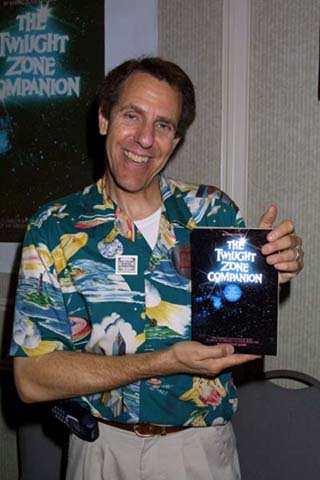
In his Twilight Zone Companion, Marc Scott Zicree calls “The Hunt” “naive, badly directed, (and) only tolerably acted.” Sheesh, what a grouch.

Extra cheese, please.

Funny Zicree story… when I was about 13, I’d just discovered The Twilight Zone and I was well on my way to wearing out my first copy of Zicree’s book. I had a question about something he’d written (I don’t recall the specifics at this late date), so I called information and got his (apparently published) Hollywood number. I dialed the number and, upon hearing Zicree himself answer, lost my nerve and promptly hung up. So hey Marc, if you remember getting what seemed like a crank call 29 years ago... well, it was me. But you know what? I’m not sorry.


Directly after the end credits but before the network ownership stamp (or whatever the hell it is), CBS usually aired a quick (we're talking 5 seconds or so) promo for other CBS series (Gunsmoke, Make Room for Daddy, etc), but every now and then they’d show a public service ad (The Red Cross, etc). After “The Hunt,” viewers were treated to a suggestion by the Ad Council that they attend church and “worship together.” Was this strategically placed to match up with this particular episode’s fundamentalist vibe? We may never know for sure. Say your prayers just in case, kiddies.


Next week: Western + comedy = aw shit, Rod’s trying to be funny again.


Thursday, January 19, 2012

TZ Promo: “Dead Man’s Shoes” (1/19/1962)


Season 3, Episode 18 (#83 overall)
Cayuga Production # 4824


50 years ago tonight, a murdered gangster attempted to get his revenge the tried and true, old-fashioned way: by transferring his soul into a pair of shoes and taking possession of whoever wears them.

Wait, what?


“Dead Man’s Shoes,” written by Charles Beaumont (or maybe it was Ocee Ritch; accounts differ) and directed by Montgomery Pittman, opens with a body being dumped in an alley. The body belongs to a slick cat named Dane, who got himself iced when his business partner decided to go solo. Nate Bledsoe, a local hobo, stumbles across the body while foraging for second-hand food. He finds two things of interest on the body: an apartment key and a pair of rather unique shoes. He pockets the key and slips on the shoes, at which point he is abruptly taken over by Dane’s vengeful spirit… and the fun, as they say, begins.


“Dead Man’s Shoes” exists squarely in the world of film noir, much to my delight. All the hallmarks are there: the city at night, a mob killing, a beautiful moll with a gun in her hand, tough talking goons, a mob-controlled nightclub… it’s all there, baby. A beautiful moment comes when Bledsoe, under Dane’s control, ditches his hobo brethren and walks slowly down the night street. For a brief moment, it feels like season one again. All we need is a distant trumpet and floating neon signs and we’d be right back in “The Four of Us Are Dying”… which, incidentally, this episode strongly evokes, the Virgil Sterig sequence in particular (in which a murdered gangster apparently returns from the dead to get revenge).


Pittman’s direction is adequate but not spectacular. I’m a huge noir fan, so in an episode like this, I wanna see skewed angles and chiaroscuro lighting… but overall things here look pretty flat (except the moment described above). And damn it, I want some menace! Dagget never really comes across as a truly bad guy (I would’ve loved to see Richard Conte in the role; he was great as the heavy in the noir classic The Big Combo), and his sidekick is more crabby teenager than formidable henchman. The climax at the nightclub never achieves much of a confrontational vibe, and it's over much too quickly (I guess this is more a script issue than a directorial misstep).


Warren Stevens (who is still kicking at 92!) is good in the lead: he’s tentative and nervous as Bledsoe and, alternately, disarmingly dangerous as Dane, and his transitions from one to the other are subtle but effective. And hey, Forbidden Planet alert! Stevens played Lt. ‘Doc’ Ostrow, M.D., in that wonderful sci-fi classic.

Stevens, with Leslie Nielsen.

Genre fans will also remember Stevens' appearance in the (unintentionally) hilarious "Keeper of the Purple Twilight" episode of TV's The Outer Limits. And speaking of The Outer Limits.... well, stay tuned.


Meanwhile, Joan Marshall’s Wilma (there’s no way to tell, but I’m betting/hoping she’s got red hair) is a tasty morsel, an easy addition to the pantheon of TZ babes. That resigned sigh she emits as she crumbles beneath Bledsoe/Dane’s kiss is damn hot.


HOMOEROTIC HILARITY

During the episode’s prologue, as Bledsoe is pilfering Dane’s corpse, he slips his hand inside Dane’s back pocket, presumably looking for a wallet. This is an innocent act, purely out of necessity. However, he follows with what amounts to a gratuitous act of grab-ass (I won’t even touch the necrophilia ramifications therein). You’ll miss it if you blink, but thanks to the wonders of technology, the moment can be isolated and studied in high definition.


Yep, there’s no mistaking it. Wow, he’s really clutching that butt cheek there. But wait, there’s more: later, when Bledsoe (possessed by Dane) crashes Dagget’s club, the bartender advises him to stop staring at Dagget’s female companion. The response? “It’s not the woman I’m staring at.” And let’s get right down to brass tacks: those eponymous dead man’s shoes? Girlfriend, those kicks are fierce!


GENDER-BENT


The episode was remade as “Dead Woman’s Shoes” for the 80’s Twilight Zone revival series. Remember it? Nope, me neither.


“Dead Man’s Shoes” is a nice jazzy throwback to the gangster outings from the show’s first season, but it’s ultimately a bit too familiar. I’ve said it before and I’ll keep saying it: season three is when The Twilight Zone started borrowing from itself on a regular basis. This isn’t fatal in the case of “Dead Man’s Shoes,” but it certainly doesn’t help (a more aggressive noir atmosphere would’ve made a world of difference, but alas). File this one under “O” for “okay.”


Next week: Hillbilly + moonshine + shotgun = Earl Hamner Jr.’s first foray into The Twilight Zone.